
Design Philosophy and Innovation
Dan Rihn, a California-based aircraft designer and Northrop Grumman design engineer, conceived the DR-107 in 1992 with a revolutionary approach to aerobatic aircraft design. At a time when biplanes dominated competitive aerobatics, Rihn created a monoplane that could outperform traditional designs while remaining accessible to homebuilders. His design philosophy prioritized compact construction to minimize material costs, reliable powerplants, and performance that could establish a new competition class within the International Aerobatic Club.
The aircraft features a symmetrical Wainfan airfoil with nearly full-span ailerons, producing its remarkable 360-degree-per-second roll rate. This design choice, combined with the aircraft's structural ability to withstand ±10 G-loads, made it suitable for advanced aerobatic maneuvers that previously required much more expensive factory-built aircraft.
Construction and Manufacturing Approach
Rather than traditional factory production, Rihn chose a homebuilt approach that democratized high-performance aerobatic aviation. The DR-107 is supplied as plans and kits through Aircraft Spruce and Specialty Company of Corona, California, allowing amateur builders worldwide to construct competition-capable aircraft. The fuselage utilizes welded 4130 steel tube construction, while the wings employ primarily wooden structure with plywood skins.
This approach proved remarkably successful, with DR-107s now flying in 15 countries including the USA, Canada, Iceland, England, Spain, France, Germany, Austria, Switzerland, South Africa, Australia, New Zealand, Brazil, Argentina, and Tahiti. Australia alone has registered 11 examples, demonstrating the design's international appeal.
Engine and Performance Specifications
The DR-107 was designed around the proven Lycoming O-320 engine, a four-cylinder, air-cooled piston engine producing approximately 150 horsepower driving a fixed-pitch propeller. This powerplant choice reflected Rihn's emphasis on reliability and availability, as the O-320 had decades of proven service in aerobatic applications.
With its standard engine configuration, the DR-107 achieves a maximum level speed of 185 mph and a rate of climb of 2,000 feet per minute. The aircraft's empty weight of 740 pounds and maximum weight of 1,155 pounds provide an excellent power-to-weight ratio. Some builders have opted for enhanced configurations using Lycoming O-360 or Superior XP10-360 engines producing 160-200+ horsepower, achieving climb rates of 2,150-2,500 feet per minute.
Competition Success and Recognition
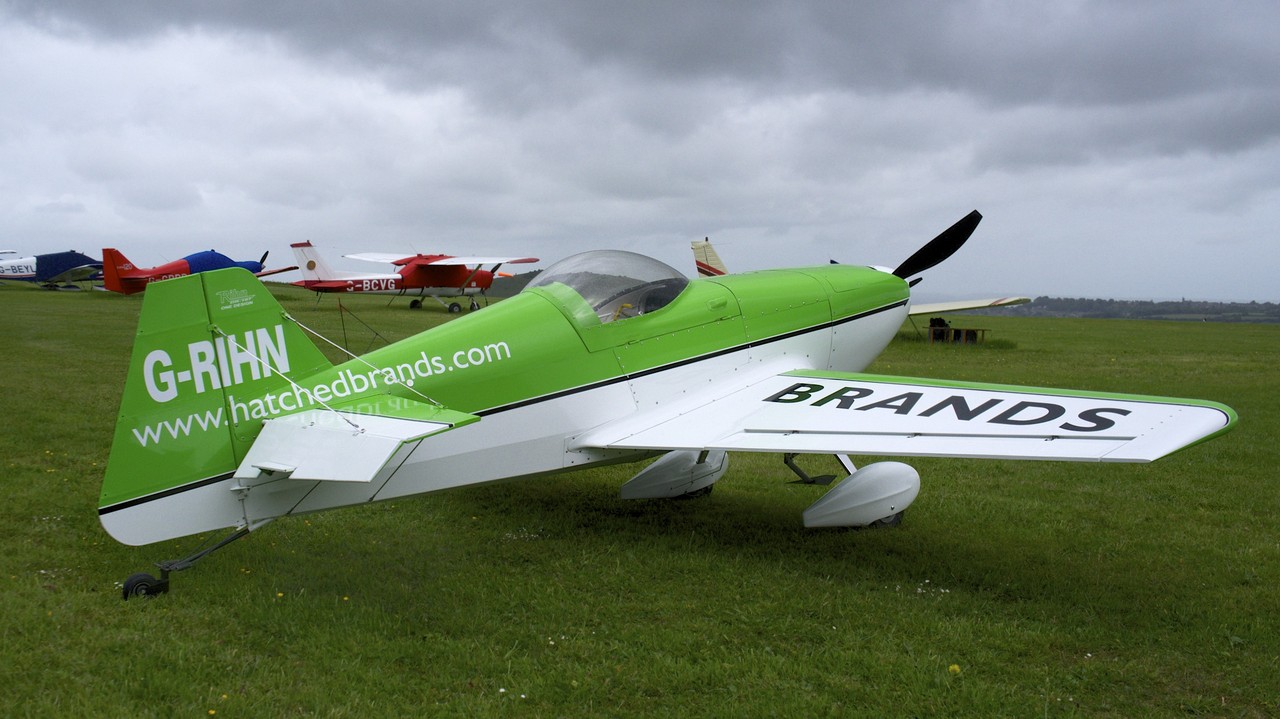
The DR-107's competition credentials were definitively established when Phil Burgess piloted G-RIHN to the National Championship title in 2010. This victory came after extensive modifications and upgrades that demonstrated the design's potential for top-level competition. The aircraft's fast roll rate, high G-load capability, and responsive handling characteristics have made it competitive in advanced aerobatic competitions across multiple countries.
While the original concept of creating a one-design class within the International Aerobatic Club did not progress significantly, the DR-107 found success competing against diverse aircraft types in existing categories. Its ability to hold its own against factory-built competitors validated Rihn's design philosophy.
Global Impact and Continuing Legacy
More than three decades after its first flight, the DR-107 remains an active design with new aircraft still being completed by homebuilders worldwide. Recent examples include ZK-XSG in New Zealand, which received its first flight in May 2014, and ZK-EZG2, registered in 2018. In the United Kingdom, multiple examples including G-RIHN and G-CVII continue active competition careers.
The construction timeline typically spans several years, with some builders taking over three years to complete their aircraft before receiving airworthiness certificates. This extended build time reflects both the aircraft's complexity and the meticulous attention to detail required for aerobatic certification standards.
Technical Innovation Impact
The DR-107's influence extends beyond its direct operators to the broader homebuilt aerobatic community. Rihn's demonstration that high-performance competition aerobatic aircraft could be built affordably by amateur constructors challenged industry assumptions about the accessibility of advanced aerobatic flying. The design's success encouraged other designers to consider similar approaches, contributing to a renaissance in homebuilt aerobatic aircraft development.
The aircraft's compact 17-foot length and 75.5 square feet of wing area exemplify efficient design, maximizing performance while minimizing material requirements and construction complexity. This efficiency translated directly into lower costs and reduced construction time compared to larger aerobatic designs.
Current Status
Today, the DR-107 represents a mature design with a proven track record spanning multiple decades and continents. Its combination of performance, affordability, and buildability continues to attract new constructors, ensuring the design's relevance in contemporary aerobatic aviation. The aircraft serves both as recreational aerobatic mount and serious competition machine, fulfilling Rihn's original vision of bringing high-performance aerobatic flying within reach of dedicated amateur aviators.