
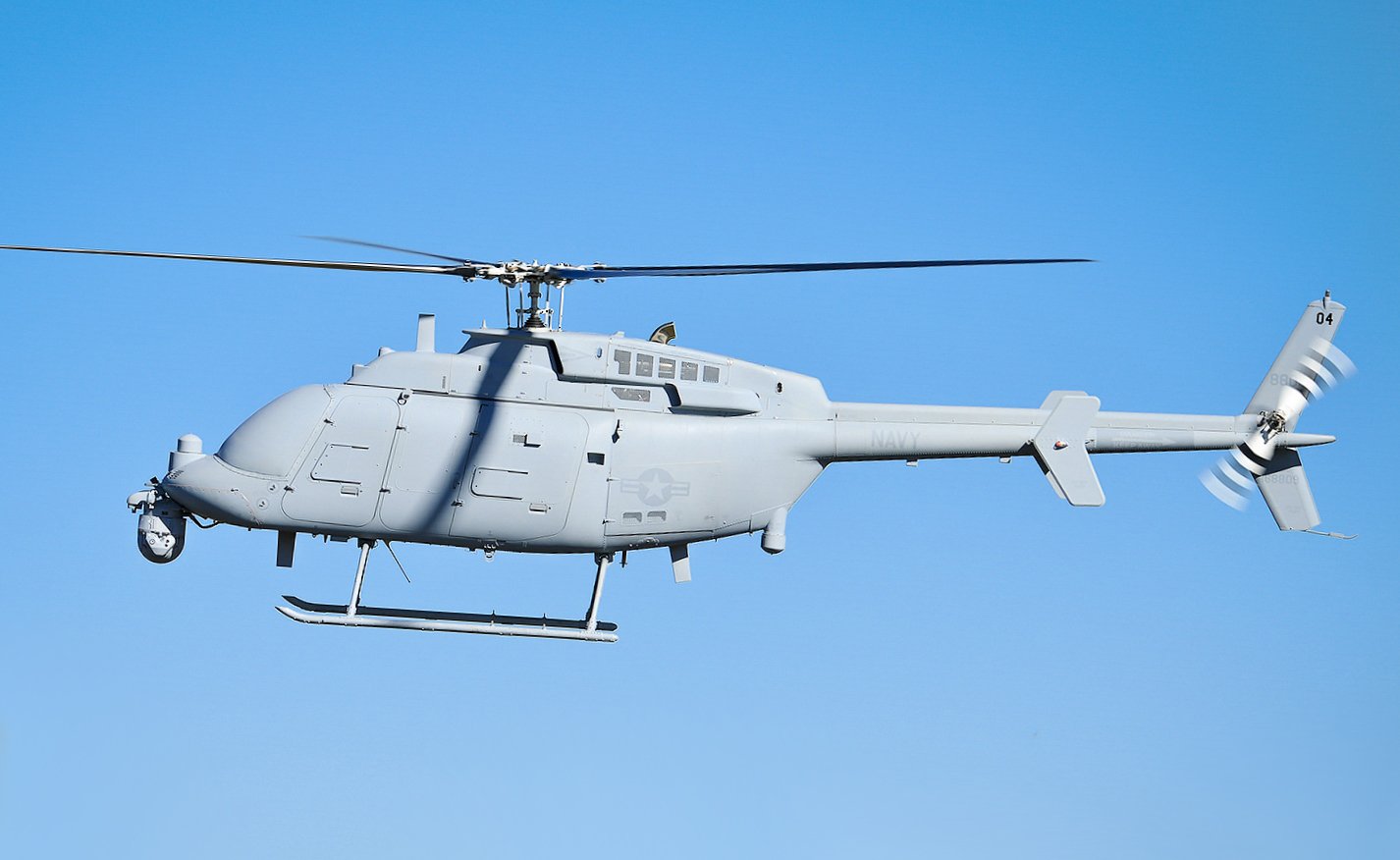
Development Origins
The MQ-8C Fire Scout emerged from a two-decade development program that began in 1999 as the Vertical Takeoff Autonomous Unmanned Vehicle (VTAUV). Northrop Grumman's approach centered on adapting the commercially successful Bell 407 helicopter, which had accumulated over 4.4 million flight hours across more than 1,600 airframes worldwide. This foundation provided proven aerodynamics and reliability while incorporating advanced autonomous flight control systems.
The prototype "Fire-X" aircraft conducted its maiden flight on December 10, 2010, at Arizona's Yuma Proving Ground. Following extensive testing, the operational MQ-8C variant achieved its first flight milestone on October 31, 2013, at Naval Base Ventura County, Point Mugu, California. The aircraft completed two successful flights that day - the first lasting seven minutes beginning at 12:05 p.m. to validate autonomous control systems, followed by a nine-minute flight at 2:39 p.m. reaching 500 feet altitude.
Operational Capabilities
The MQ-8C represents a substantial advancement over earlier MQ-8A and MQ-8B variants, delivering 15-hour endurance compared to their more limited flight duration. By August 2015, test aircraft achieved an 11-hour endurance flight with over an hour of fuel remaining, setting new records for the Fire Scout series. Production aircraft were projected to achieve 12 hours of total endurance under standard atmospheric conditions.
The platform's 2,600-pound payload capacity enables it to carry sophisticated sensor packages, communications equipment, and precision targeting systems. Operating at altitudes up to 20,000 feet with a 150-nautical-mile range, the MQ-8C provides over-the-horizon surveillance and targeting capabilities previously unavailable to naval forces. Its autonomous flight systems eliminate the need for onboard crew while maintaining precise control from shipboard or shore-based stations.
Manufacturing and Production
Northrop Grumman established a distributed manufacturing system for MQ-8C production. Bell Helicopter's Ozark, Alabama facility performs airframe modifications on the basic Bell 407 structure, while final assembly occurs at Northrop Grumman's Unmanned Systems Center in Moss Point, Mississippi. Summit Aviation in Somerset, Kentucky manufactures specialized Faraday cages that are integrated during final assembly to protect electronic systems from electromagnetic interference.
Low-rate production commenced in 2012, with the first operational aircraft delivered to the U.S. Navy in December 2014. By March 2020, 32 of 38 ordered aircraft had been delivered, with total deliveries reaching 36 systems by 2022. This controlled production rate allowed for continuous refinement of manufacturing processes and incorporation of lessons learned from operational deployments.
Naval Service Record
The MQ-8C achieved Initial Operational Capability with the U.S. Navy in July 2019 after extensive testing and evaluation. Its first operational deployment occurred in December 2015 aboard the Arleigh Burke-class destroyer USS Jason Dunham (DDG-109), demonstrating the aircraft's ability to operate from the confined deck spaces of naval vessels.
By July 2019, the MQ-8C fleet had accumulated over 1,500 flight hours across more than 700 sorties, proving its reliability in operational conditions. The aircraft's extended endurance provides what Northrop Grumman describes as "tremendous operational advantage" by dramatically increasing time-on-station while reducing the frequency of launch and recovery cycles that interrupt surveillance missions.
Mission Versatility
Operational requirements for the MQ-8C were largely driven by U.S. Special Operations Command's need for persistent surveillance and precision targeting support. The aircraft excels in intelligence-gathering, reconnaissance, and real-time targeting for ground, air, and sea forces. Its ability to operate autonomously for extended periods makes it particularly valuable for monitoring hostile coastlines, tracking vessel movements, and providing communications relay services.
The MQ-8C also supports combat logistics operations, using its substantial payload capacity to transport critical supplies to forward-deployed forces. This dual-role capability maximizes the aircraft's utility during extended naval operations where every square foot of deck space represents premium real estate.
Program Resilience
The broader MQ-8 program demonstrated remarkable resilience through multiple funding challenges and programmatic restarts. After the Navy initially cut production funding in December 2001, the U.S. Army's 2003 contract award for seven improved evaluation machines revived development momentum. The program survived three complete restarts over its 20-year development cycle, with Northrop Grumman consistently delivering functional products within five years of each contract renewal.
This persistence paid dividends when the MQ-8C finally achieved operational status, providing the Navy with a mature, reliable platform that had been thoroughly tested and refined through years of development challenges. The aircraft's proven Bell 407 foundation combined with Northrop Grumman's autonomous systems expertise created a low-risk solution to complex naval surveillance requirements.