
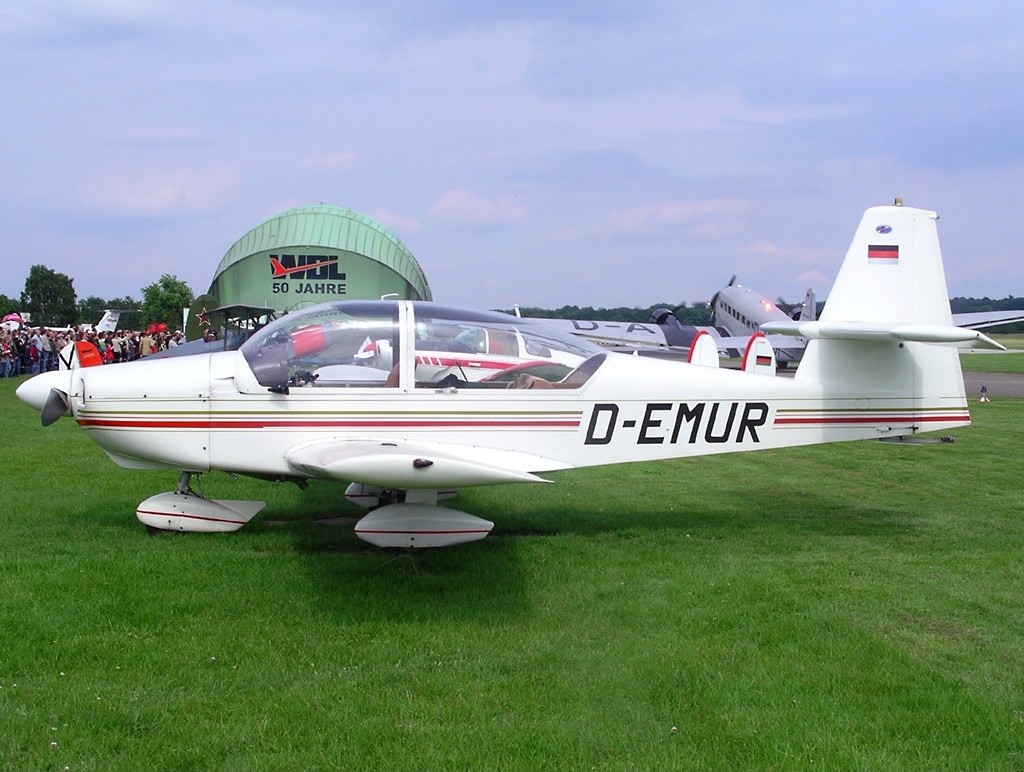
Design Origins and Development
The RS-180 Sportsman emerged from the prolific mind of René Fournier, the French aircraft designer renowned for his innovative approach to light aircraft engineering. Building upon his successful RF-6 series, Fournier conceived the RS-180 as part of his broader vision to create affordable, reliable aircraft with exceptional flying characteristics and low operating costs. The design process proved challenging, requiring a complete redesign between the first prototype's maiden flight in March 1973 and the second prototype's debut three years later in April 1976.
This extended development period reflected Fournier's commitment to perfecting the aircraft's handling characteristics and structural integrity. The RS-180 incorporated aerobatic capabilities despite its touring aircraft designation, maintaining the performance standards that had made Fournier's earlier designs popular among both training institutions and private pilots.
Manufacturing Partnership
Production responsibility fell to Sportavia-Pützer GmbH, established by Alfons Putzer in Dahlem, West Germany. This partnership represented a strategic alliance between French design expertise and German manufacturing precision. Sportavia had secured licensing rights to produce Fournier designs, positioning the company within the broader VFW-Fokker Group consortium that dominated European aerospace manufacturing during the 1970s.
Sportavia-Pützer's total output across all aircraft models reached approximately 312 units, making it a significant player in the European light aircraft market. The company's location in West Germany provided access to the growing general aviation market in Central Europe, where demand for four-seat touring aircraft was expanding rapidly during the post-war economic boom.
Production History and Variants
The RS-180 entered production during the late 1970s, though exact production figures remain unclear in available records. The final aircraft of this type, registered as D-EFBN and bearing construction number 6020, marked the end of the production run. This relatively low construction number suggests limited production compared to other contemporary light aircraft, reflecting either market constraints or the specialized nature of the design.
The aircraft served primarily in the civilian market as a touring and training platform. Its side-by-side seating configuration and aerobatic capabilities made it suitable for flight instruction, while the four-seat capacity provided practical utility for private owners seeking cross-country capability.
Technical Configuration
The RS-180 featured conventional low-wing design principles that had proven successful in Fournier's earlier aircraft. The single-engine configuration provided simplicity and economy of operation, crucial factors for the private aircraft market of the 1970s. The aircraft's structural design incorporated the aerobatic strength requirements that characterized Fournier's approach to aircraft engineering, even in designs intended primarily for touring use.
This robust construction philosophy reflected lessons learned from earlier Fournier designs, which had gained reputations for longevity and reliability in service. The RS-180's airframe design emphasized ease of maintenance and inspection, critical factors for aircraft operating from smaller airfields with limited maintenance facilities.
Operational Legacy
The RS-180 Sportsman remained relatively obscure compared to other Fournier designs that achieved greater commercial success. However, its influence extended beyond its limited production numbers through design elements that appeared in subsequent aircraft developments. The Slingsby T-67M Firefly, developed as a composite variant of the RF-6B series, incorporated lessons learned from the RS-180 program and eventually served as a basic trainer for multiple air forces, including the United States Air Force.
This connection to later military training aircraft demonstrated the soundness of Fournier's original design concepts, even though the RS-180 itself never achieved widespread adoption. The aircraft's engineering principles contributed to a lineage of designs that proved their worth in demanding military training environments.
Current Status
Today, the RS-180 Sportsman represents a minor footnote in aviation history, overshadowed by more successful contemporary designs and even other aircraft from Fournier's own portfolio. The small production numbers and specialized nature of the aircraft mean that few examples remain in active service. Those that do continue flying serve primarily as testament to the quality of 1970s German manufacturing and French design innovation.
The aircraft's legacy lies not in revolutionary technological advancement but in its representation of the collaborative European aerospace industry that emerged during the post-war reconstruction period. The partnership between Fournier's design expertise and Sportavia-Pützer's manufacturing capabilities exemplified the international cooperation that would later characterize major European aerospace projects.