
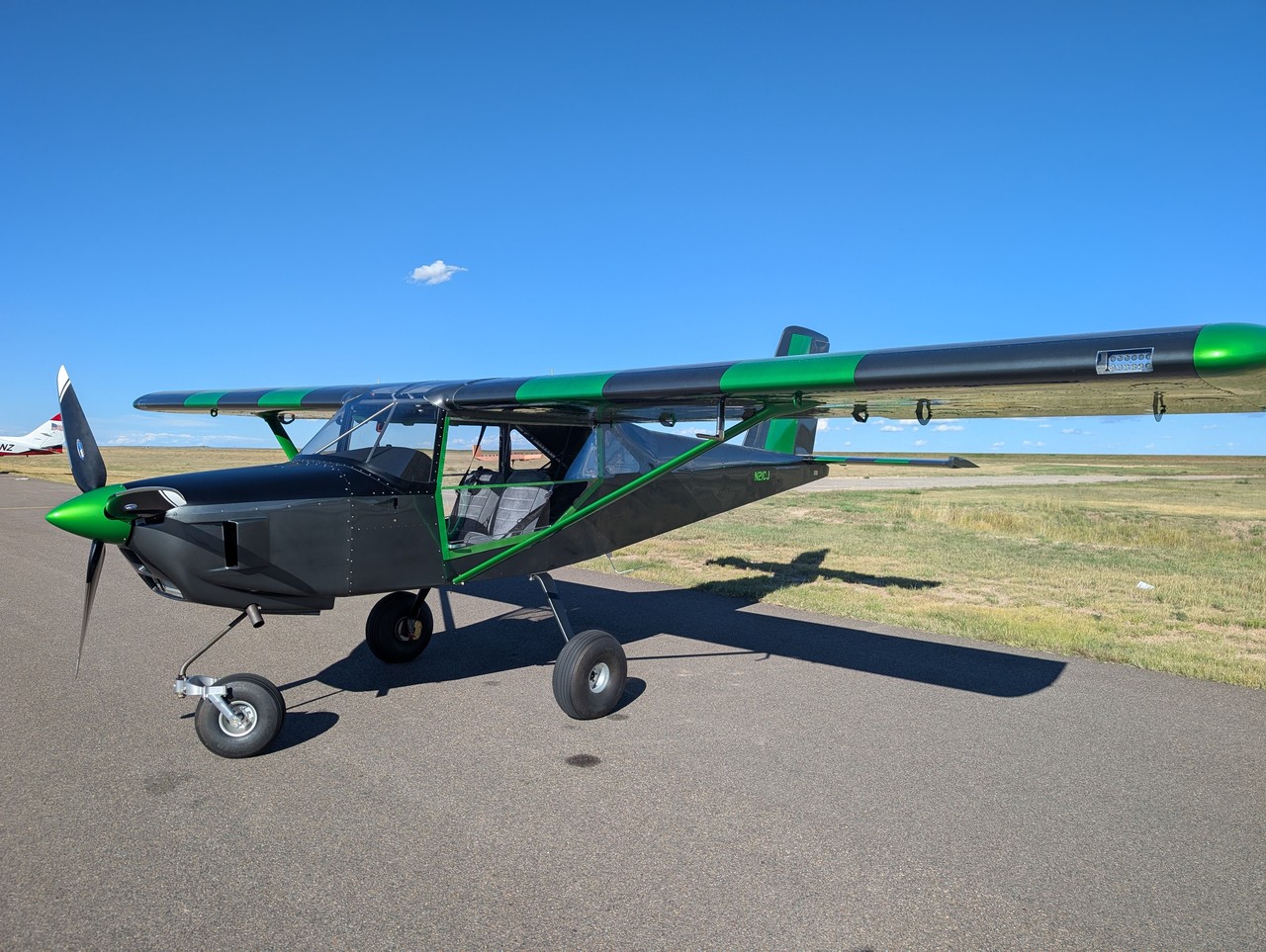
Development and Design Philosophy
Designer Randy Schlitter conceived the S-21 Outbound as an evolution of RANS Aircraft's successful S-20 Raven, addressing the growing demand for faster-building homebuilt aircraft without compromising performance. Introduced at EAA AirVenture Oshkosh in 2016, the design represented a fundamental shift from traditional fabric-covered aircraft to all-metal construction. Schlitter's primary objective centered on halving the typical 1,000-1,200 hour build time associated with comparable STOL aircraft while enhancing performance and utility.
The prototype, registered as N215RD, achieved first flight on December 17, 2017, validating Schlitter's innovative approach to homebuilt design. The aircraft incorporates several groundbreaking features, including extruded aluminum leading and trailing edge wing spars that eliminate the need for traditional ribs and complex skin attachment methods. This design allows the entire wing structure to be completed in approximately 50 hours, a remarkable achievement demonstrated by RANS technicians.
Construction Innovation
The S-21's construction methodology represents a significant advancement in amateur aircraft building. Match-hole drilling technology ensures precise component alignment, while pull rivets replace traditional solid rivets throughout most of the airframe. The fuselage features a chromoly steel cockpit cage for enhanced safety, surrounded by aluminum sheet construction. The wing design utilizes extruded aluminum spars with a simple skin attachment system, dramatically simplifying what has traditionally been the most complex aspect of aircraft construction.
This manufacturing approach positions the S-21 between traditional scratch-built aircraft and factory-completed examples. Builders receive precision-manufactured components that fit together with minimal adjustment, yet retain the satisfaction and cost savings associated with homebuilt construction. The kit includes pre-formed aluminum sheets, machined parts, and detailed instructions that guide builders through the 500-700 hour construction process.
Engine Options and Performance
The S-21 accommodates multiple engine configurations, with the Continental Titan X-340 serving as the flagship powerplant. This 180-horsepower, four-cylinder engine delivers exceptional performance, generating 1,500 feet per minute climb rates and 135-knot cruise speeds at 75 percent power. The Titan installation supports gross weights up to 1,800 pounds, enabling significant payload capacity for backcountry operations.
Alternative engine options include the Rotax 912 ULS and 912 iS, both producing 100 horsepower at 5,800 rpm. While the Rotax engines limit gross weight to 1,320 pounds, they provide economical operation with 104-knot cruise speeds and 850 feet per minute climb performance. The Lycoming YO-233 represents another approved option, though it sees limited installation.
With the Titan X-340, the S-21 demonstrates impressive short-field capabilities, requiring only 380 feet for takeoff and 375 feet for landing. The aircraft maintains controllable flight down to 38 miles per hour, with a never-exceed speed of 215 miles per hour. Service ceiling reaches 14,500 feet, while maximum range extends to 527 miles with 3.9 hours endurance.
The Manufacturer Legacy
RANS Aircraft, founded by Randy and Michele Schlitter around 1974-1975, has evolved into one of the most respected names in homebuilt aviation. Operating from their Hays, Kansas facility, the company has maintained family ownership for five decades, celebrating their 50th anniversary in 2024. The company's focus on STOL aircraft began with designs like the S-6 Coyote, gradually evolving toward more sophisticated all-metal construction.
The Schlitters built their reputation on practical, flyable designs that prioritize utility over complexity. Their organized factory operation includes extensive in-house fabrication capabilities, ensuring quality control throughout the manufacturing process. This approach has enabled RANS to maintain consistent delivery schedules while supporting builders worldwide with technical assistance and spare parts availability.
Operational Characteristics
Pilots appreciate the S-21's predictable handling characteristics and robust construction. The high-wing configuration provides excellent visibility for backcountry operations, while the side-by-side seating arrangement facilitates instruction and passenger comfort. Large tundra tires up to 26 inches in diameter enable operations from unprepared surfaces, expanding the aircraft's utility for remote area access.
The aircraft is available in both tricycle and conventional gear configurations, with taildragger variants particularly popular among backcountry enthusiasts. Flap deployment enhances short-field performance, while the 11.1:1 glide ratio provides reasonable engine-out characteristics. Structural limits of +6/-4 G accommodate moderate aerobatic maneuvers, though the aircraft is primarily designed for utility operations.
Current Status and Legacy
Production continues through 2024, with active registrations including examples like N34RB (serial 02210166) maintaining currency through 2029. Recent completions demonstrate the design's ongoing popularity, with builders in Ohio, Wisconsin, and internationally completing projects. The S-21 competes directly with established designs like the CubCrafters Carbon Cub EX and American Legend Super Legend HP, often providing superior performance per dollar invested.
The aircraft's significance extends beyond its individual capabilities, representing the evolution of homebuilt aviation toward more sophisticated manufacturing techniques. By proving that complex aircraft can be built quickly without sacrificing quality, the S-21 has influenced industry-wide approaches to kit design and manufacturing.