
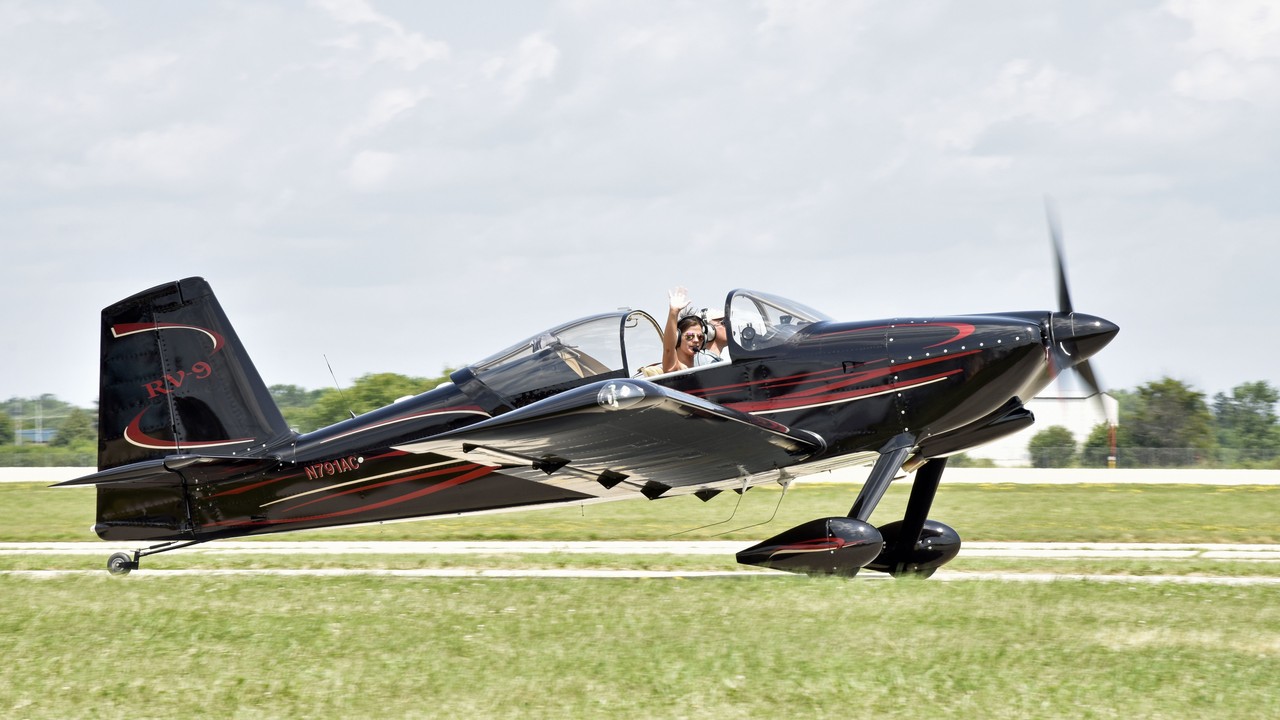
Design Philosophy Revolution
Richard VanGrunsven's RV-9 represented a fundamental shift in Van's Aircraft philosophy when development began in the mid-1990s. Unlike the company's previous models that emphasized aerobatic capability and razor-sharp handling, VanGrunsven deliberately designed the RV-9 as a docile touring aircraft prioritizing stability and fuel economy. This strategic pivot targeted pilots seeking cross-country capability rather than aerobatic thrills, expanding Van's market beyond the traditional sport aviation community.
The aircraft incorporated a newly designed high-aspect-ratio wing featuring a Roncz airfoil, delivering a stall speed comparable to the Cessna 150 while maintaining respectable cruise performance. This wing design, with increased span compared to the similar RV-7, provided the gentle handling characteristics that made the RV-9 suitable for low-time pilots while achieving impressive fuel efficiency.
Development and Production Milestones
The RV-9's development history proved unusual within Van's Aircraft timeline. The original prototype N96VA first flew in 1997 but was lost in an accident on April 2, 2000. Remarkably, the tricycle-gear RV-9A variant flew first, with the second prototype N129RV taking to the air on June 15, 2000, three years before the conventional-gear RV-9 made its maiden flight on March 4, 2002.
Van's began supplying kits to dealers in 2000, introducing a manufacturing revolution with the RV-9A. This variant became the first Van's aircraft to feature "matched-hole" components, where airframe parts arrived pre-formed to precise contours with rivet holes accurately located. This innovation eliminated assembly jigs and dramatically reduced construction time, later influencing subsequent models including the RV-7 and RV-10.
Van's Aircraft Legacy
Richard VanGrunsven founded Van's Aircraft after building his first RV-1 in 1965 as a modified Stits SA-3 Playboy. The 1972 RV-3 established the foundation for all subsequent models, launching a dynasty that would produce 14 different variants over nearly five decades. By the time the RV-9 entered production, Van's had already established itself as the most successful kit aircraft manufacturer, with over 10,500 RV aircraft completed across all models.
The Aurora, Oregon company's success stemmed from VanGrunsven's engineering philosophy combining high performance with buildable designs. Each RV model addressed specific market segments while maintaining the family's reputation for excellent flying qualities and reasonable construction complexity.
Technical Excellence and Engine Options
The RV-9 accommodates engines ranging from 118 to 160 horsepower, with the Lycoming O-235-L2C serving as the minimum powerplant and the O-320 providing maximum performance. VanGrunsven's prototype testing with the 118-horsepower O-235 proved that modest power could deliver impressive results when paired with efficient aerodynamics. The standard 160-horsepower Lycoming O-320 installation achieves 167 mph cruise speed while burning approximately 8 gallons per hour.
The aircraft's aluminum monocoque construction employs flush riveting throughout, contributing to both structural integrity and aerodynamic cleanliness. With an empty weight of 1,028 pounds and maximum gross weight of 1,750 pounds, the RV-9 carries 36 gallons of fuel while maintaining excellent useful load for two occupants and baggage.
Builder Community and Global Reach
The RV-9 attracted builders worldwide, with completed aircraft appearing in Australia beginning in 2004 and examples registered across multiple continents. Recent completions include a 2024 RV-9A that required 16 years of construction by a Boeing engineer, demonstrating the aircraft's appeal to professional aerospace workers seeking personal aviation projects.
Construction time varies significantly among builders, but the matched-hole technology typically reduces assembly duration compared to earlier RV models requiring extensive drilling and fitting. The side-by-side seating configuration appeals to builders seeking to share flying experiences with passengers, contrasting with tandem-seat variants better suited to aerobatic training.
Operational Impact and Current Status
By November 2022, builders had completed 1,173 RV-9 and RV-9A aircraft, establishing a substantial active fleet supporting the experimental aircraft community. This production figure represents significant success within the homebuilt market, where completion rates often disappoint compared to kit sales.
The RV-9's legacy extends beyond pure numbers, proving that high-performance touring aircraft could achieve excellent results with moderate horsepower while maintaining handling suitable for inexperienced pilots. This design philosophy influenced subsequent Van's models and demonstrated the viability of efficiency-focused homebuilts in an era often dominated by speed-oriented designs.
Today's RV-9 fleet continues growing as builders complete long-term projects, with the aircraft serving recreational pilots seeking reliable cross-country transportation combined with the satisfaction of flying aircraft they constructed personally. The model's docile characteristics ensure continued popularity among builders transitioning from training aircraft to high-performance homebuilts.