
Service History
The S-1 Cadet carved out a specialized niche in the aviation market as a trainer aircraft that emphasized durability over economy. While the competing Piper J-3 Cub cost roughly one-third as much, the Interstate design offered superior speed, strength, and rough-field capabilities that attracted military attention. The U.S. Army adopted the type for liaison and observation duties, procuring 250 aircraft as the L-6 Grasshopper and eight S-1As as L-8A Cadets for the Bolivian Air Force through Lend-Lease agreements.
Wartime Operations
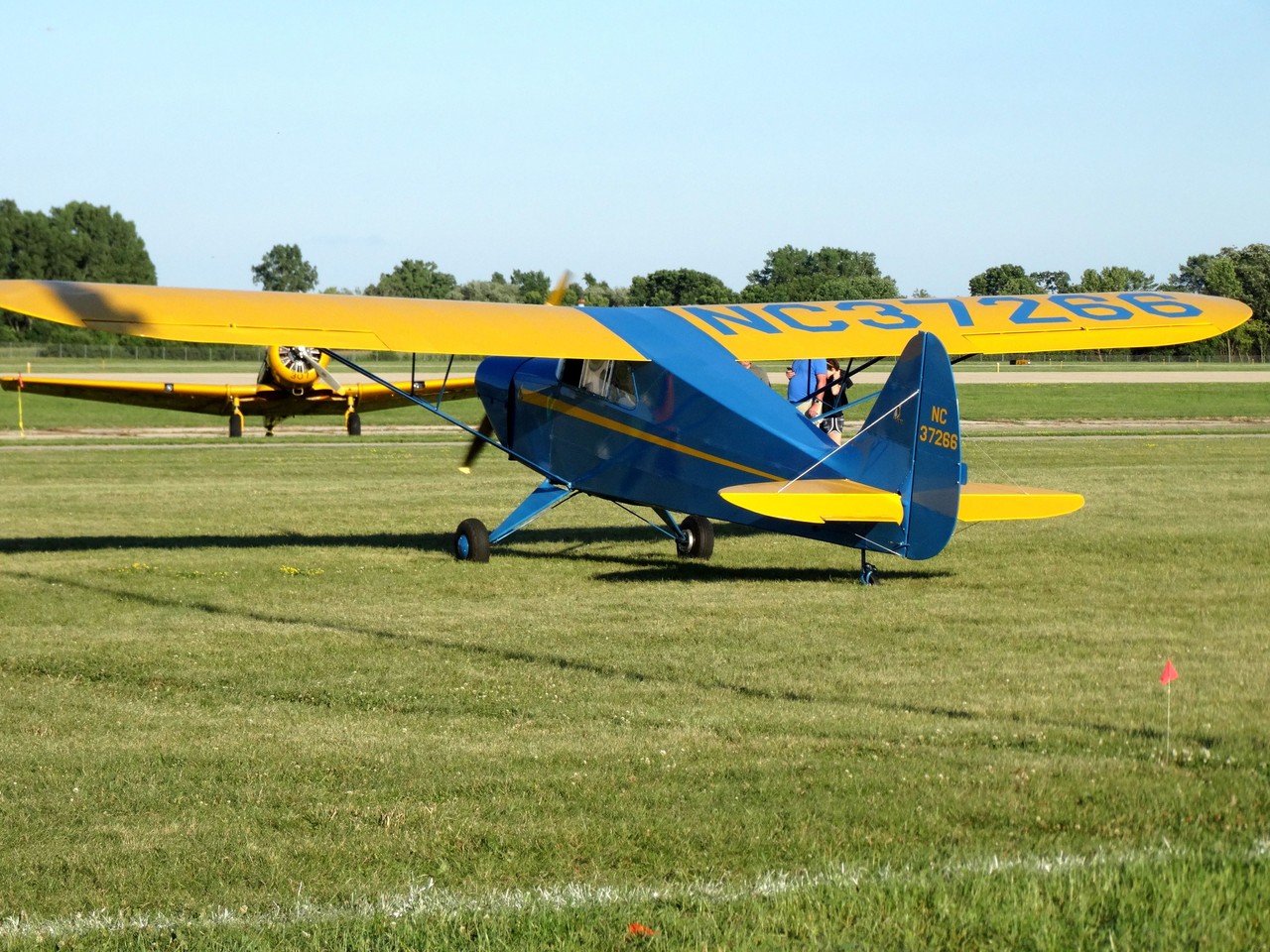
The Cadet gained historical significance on December 7, 1941, when civilian instructor Cornelia Fort and her student were flying S-1A NC37266 "The Pearl" near Pearl Harbor during the Japanese attack. Their aircraft became one of the first American planes targeted by enemy fire, surviving strafing that destroyed Robert Tyce's nearby aircraft. This incident marked the Cadet's entry into World War II history, later depicted in the film Tora! Tora! Tora!
Colonel Einar Axel Malmstrom flew an L-6 variant during the war, conducting reconnaissance missions over occupied France until being shot down on April 24, 1944. After surviving as a prisoner of war, Malmstrom continued his military career until his death in a T-33 crash on August 21, 1954. Malmstrom Air Force Base in Montana bears his name, connecting the Cadet to Cold War aviation history.
The Manufacturer
Interstate Aircraft and Engineering Corporation established itself as the first lightplane manufacturer on the West Coast, responding to President Franklin Roosevelt's 1938 challenge to "darken the skies with airplanes." The company began production at their El Segundo facility in December 1940, reaching 20 aircraft by early 1941. However, the company's ambitious plans were curtailed by wartime material restrictions and competition from established manufacturers.
In 1945, Interstate sold the rights to Harlow Aircraft Company, which quickly transferred the tooling and parts to Call Aircraft Company in Afton, Wyoming. Call Aircraft rebuilt numerous S-1, S-1A, and L-6 models in 1946 for $5,000 each (equivalent to $81,000 in 2024 dollars), including two CallAir S-1A-90C variants in 1952. Arctic Aircraft Company acquired the type certificates in the late 1960s, certifying an upgraded S-1B2 variant called the Arctic Tern in 1975.
Engine and Technical Innovation
The Cadet's engine options evolved throughout production to meet varying performance requirements. Initial S-1 models used the 50-horsepower Continental A50, while the production S-1A received the 65-horsepower Continental A65-8 or Franklin 4AC-176-B2. Higher-performance variants included the S-1A-85F with an 85-horsepower Franklin 4AC-199-D2 and the S-1A-90F equipped with a 90-horsepower Franklin 4AC-199-E2.
The aircraft's construction combined traditional and innovative elements for its era. Interstate engineers used a welded steel tube fuselage with spruce wood wings featuring metal ribs, all covered in fabric. The landing gear incorporated an oleo strut and compression spring suspension system that provided exceptional rough-field capability, distinguishing it from competitors designed primarily for improved airports.
Design Performance
The S-1B2 Arctic Tern variant demonstrated the design's evolution, with an empty weight of 1,103 pounds and maximum takeoff weight of 1,650 pounds. The upgraded model featured a 160-horsepower Lycoming O-320 engine, representing a significant power increase over original variants. This power-to-weight ratio enhancement reflected the aircraft's adaptation from basic trainer to bush flying operations.
Production Legacy
Despite producing only 320 aircraft compared to thousands of Piper Cubs, the Cadet achieved lasting recognition through its robust construction and historical associations. The type's limited production reflected its higher manufacturing costs and specialized market position rather than design deficiencies. Post-war rebuilds and modifications extended the operational life of many examples, with some remaining airworthy into the 21st century.
"The Pearl" survives as a museum aircraft at the Heritage Flight Museum in Burlington, Washington, restored between 2013 and 2015 to commemorate its role in the Pearl Harbor attack. The aircraft's association with Cornelia Fort, a pioneering female aviator who later died while ferrying aircraft for the Women's Auxiliary Ferrying Squadron on March 21, 1943, adds to its historical significance. These connections ensure the Interstate S-1 Cadet's place in aviation history extends far beyond its modest production numbers.