
Service History
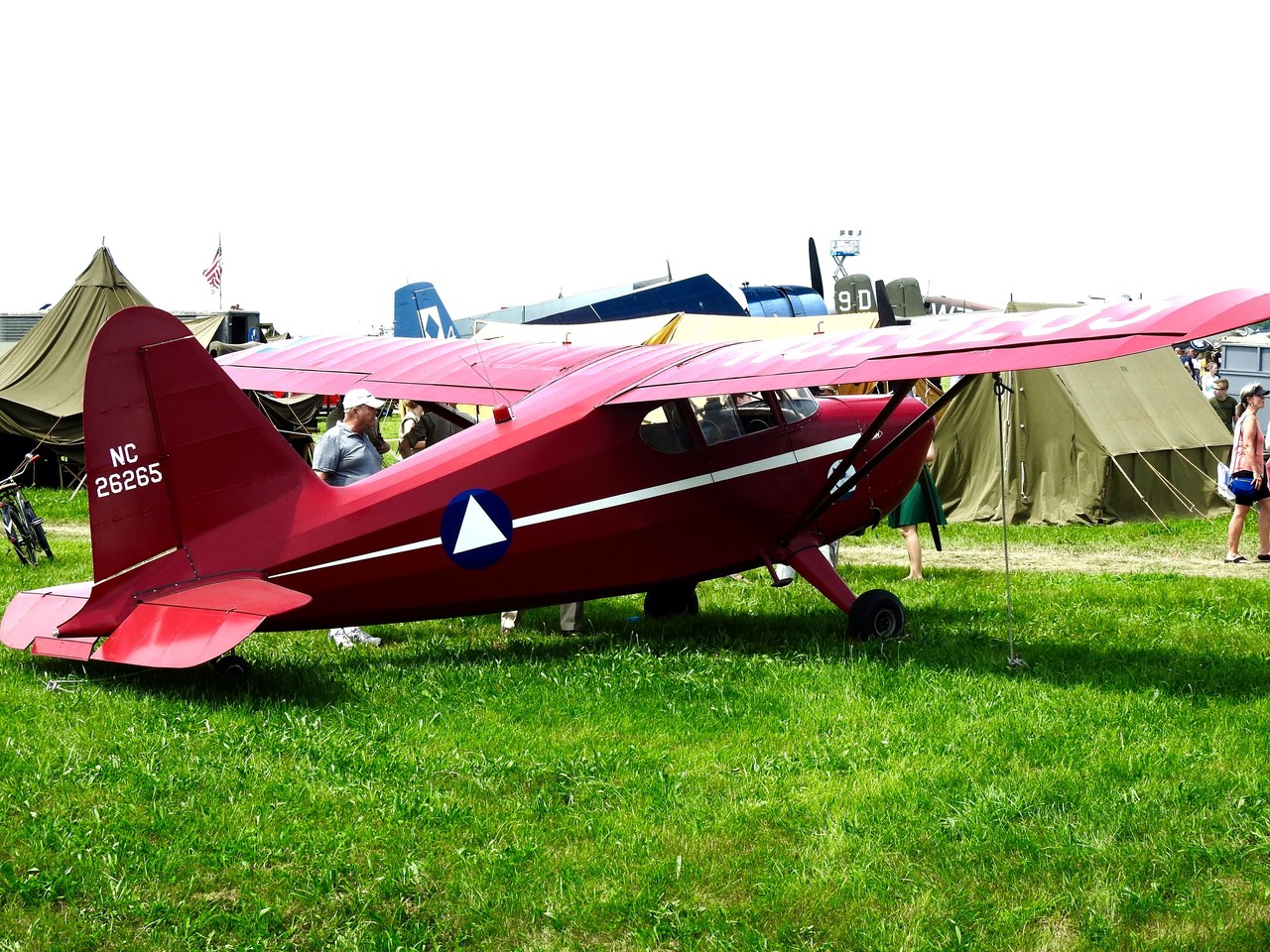
The Stinson 10 Voyager found its primary role in civilian private aviation, where it bridged the gap between expensive pre-war aircraft and the more accessible post-war designs. Unlike major airliners of the era, the Voyager served individual owners and small operators who needed reliable three-seat transportation. During World War II, the Civil Air Patrol adopted the type for coastal defense missions, flying 86,865 sorties totaling 244,600 hours hunting German U-boats along the Gulf of Mexico from 1942 to 1945.
Wartime Operations
The United States Army Air Forces evaluated six Model 10s as YO-54 aircraft for artillery observation roles between September 1940 and January 1941, but rejected them as unsuitable for military requirements. Despite this setback, the Army ordered eight new Model 10A variants as L-9A courier aircraft (serials 42-88666 through 42-88673) in 1942, while impressing twelve civilian examples into service as L-9B transports. The most notable wartime service came through Civil Air Patrol operations, where Model 10A aircraft carried single 100-pound bombs released via improvised baling wire mechanisms, though no confirmed submarine kills were recorded.
The Manufacturer
Stinson Aircraft Corporation, founded by aviation pioneer Eddie Stinson in 1920, had established itself as a successful manufacturer of light aircraft through models like the Detroiter and Reliant during the 1930s. The company operated from facilities in Wayne, Michigan, where it developed the Voyager series as an evolution of the earlier HW-75 design. In 1940, Vultee Aircraft acquired Stinson, and the company subsequently merged into Consolidated Vultee (Convair) in 1943. The Stinson name disappeared from aviation after the war, though its lineage continued through General Dynamics and eventually Lockheed Martin.
Engine Variations and Technical Innovation
The Voyager family employed multiple powerplant options across its production run. The original HW-75/Model 105 used either the 75-horsepower Continental A-75 or 80-horsepower Continental A-80-6 inline engines. The 1940 Model 10 standardized on the 80-horsepower Continental A-80, while the 1941 Model 10A adopted the 90-horsepower Franklin 4AC-199 four-cylinder engine. The Model 10B variant featured the 75-horsepower Lycoming GO-145 engine, and some later Model 10A aircraft received 140-horsepower Lycoming O-290-D2 engines through supplemental type certificates.
Stinson engineers incorporated several innovative features to distinguish the Voyager from competitors. Ball-bearing control hinges provided exceptionally light control forces, while three-notch Johnson bar flaps enhanced short-field performance. The aircraft featured a fabric-covered steel tube fuselage with spruce spars and aluminum ribs, combining traditional and modern construction techniques. Standard fuel capacity was 20 gallons, though operators could upgrade to 40-gallon systems for extended range.
Design Evolution
The Voyager evolved from the Stinson HW-75, which was marketed as the Model 105 in 1939. Engineering teams focused on creating affordable private transportation with improved cabin comfort compared to earlier Stinson designs like the Reliant. The Model 10, introduced in 1940, featured wider seats and better interior appointments. The subsequent Model 10A and 10B variants of 1941 incorporated a slightly widened cabin for enhanced passenger comfort. An experimental Model 75C with 125-horsepower Franklin engine was built but rejected as underpowered for its intended role.
Production and Legacy
Stinson built 1,053 Voyager-series aircraft across all variants: 277 HW-75/Model 105 examples, 260 Model 10s, 515 Model 10A and 10B aircraft (construction numbers 7761 through 8275), and one experimental Model 75B/75C. Production ceased in 1941 as World War II shifted manufacturing priorities toward military aircraft like the L-5 Sentinel observation plane. France had ordered approximately 600 Voyagers before its 1940 defeat, but these aircraft were never delivered.
Today, approximately 24 Voyager variants remain airworthy from the original production run. Notable surviving examples include a 1941 Model 10A that burned in 1973 but was meticulously rebuilt over 12 years by Hans Steiner and his family, earning the Bronze Lindy award at EAA AirVenture Oshkosh in 2014. The Champaign Aviation Museum in Ohio and Wings of History Air Museum maintain displayed examples, preserving the type's role in both civilian aviation and wartime home defense operations.