
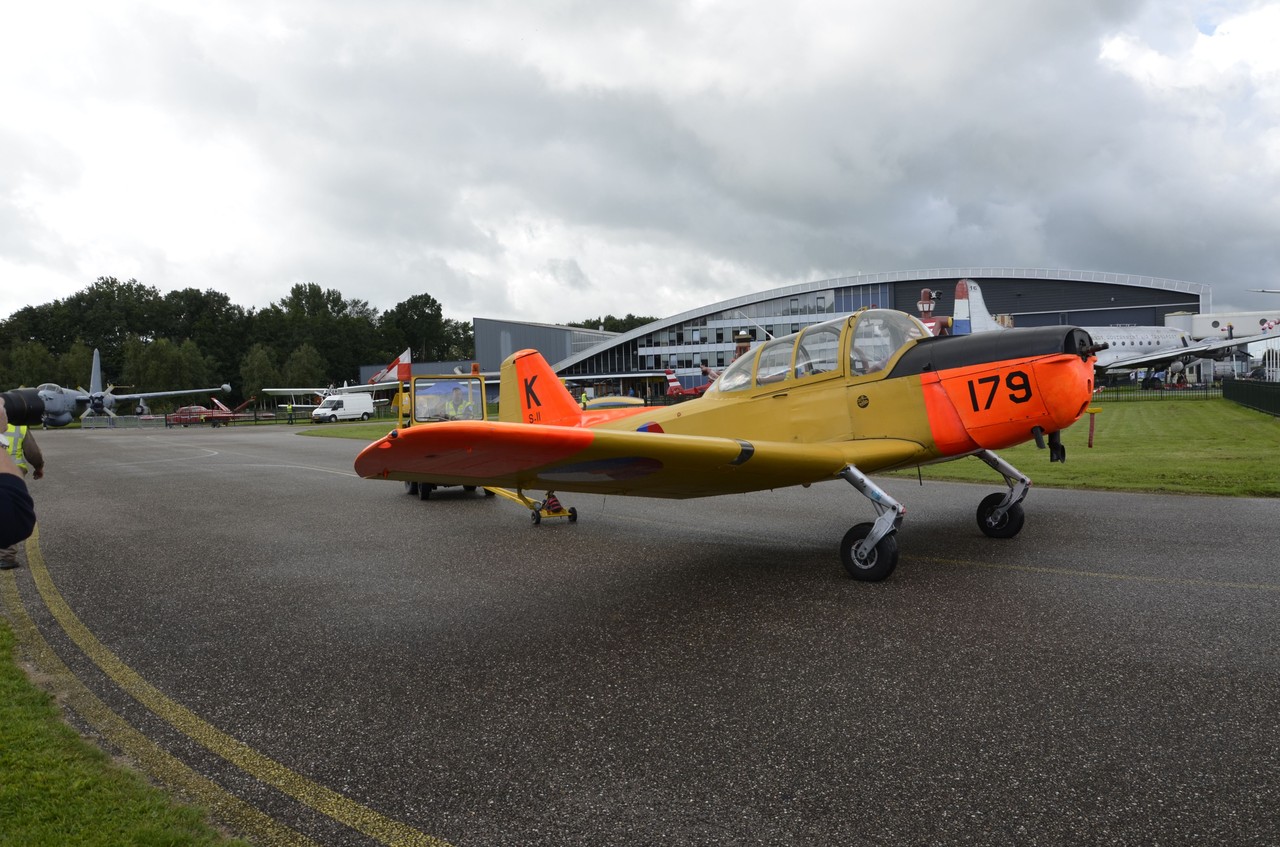
Service History
The S-11 Instructor carved out a specialized niche as a primary trainer for multiple air forces during the early Cold War period. The Dutch Air Force (Luchtstrijdkrachten) became the launch customer, taking delivery of 39 aircraft between 1949 and 1952 for elementary pilot training at Gilze-Rijen Air Base starting in 1950. The type's side-by-side seating configuration revolutionized flight training by allowing instructors to better observe and communicate with students, departing from the traditional tandem arrangement used in aircraft like the de Havilland Tiger Moth.
International Military Adoption
Israel became a significant operator, acquiring 41 S-11s beginning in 1951 after evaluating the type against the Boeing Stearman in 1949. However, the Israeli Air Force withdrew the aircraft from primary flight training by the end of 1953 due to performance issues in hot climates, where the Lycoming engine proved underpowered and the landing gear demonstrated fragility. The surviving aircraft were relegated to night flying and equipment training before final retirement, with ten examples sold to civilian flying clubs in 1957.
Brazilian, Bolivian, Paraguayan, and Italian air forces also operated the S-11 for primary training duties. The Italian Air Force used the Macchi-built M.416 variant until withdrawing the type between 1960 and 1965, while Brazil operated locally-produced T-21 and T-22 variants well into the training role.
The Manufacturer
Verenigde Nederlandsche Luchtenfabrieken Fokker emerged from post-war reconstruction on February 1, 1947, initially sustaining itself through glider production, military aircraft conversions, and bus manufacturing for Dutch Railway. The company's first original post-war design, the F-25 Promotor, achieved maiden flight in October 1946 but fell victim to surplus military aircraft competition after only 20 examples were built.
The S-11 marked Fokker's return to international prominence and enabled the company to establish licensing agreements that extended Dutch aviation influence globally. On May 11, 1953, Fokker established Fokker Industria Aeronautica SA in Rio de Janeiro to fulfill Brazilian government contracts for 100 S-11 equivalents and 50 S-12 variants. The original Fokker company eventually faced bankruptcy in 1996, with its assets acquired by various entities including GKN Aerospace.
Engine and Technical Innovation
The Lycoming O-435-A six-cylinder air-cooled engine provided 190 horsepower for the S-11's operations, though this powerplant proved marginal in demanding conditions. Fokker's design team, working under project designation 223 with involvement from Frits Diepen, created a mixed-construction aircraft combining a steel-tube fuselage with plywood and linen covering and all-metal wings and stabilizers.
The revolutionary side-by-side seating arrangement distinguished the S-11 from contemporary trainers and influenced future training aircraft design. This configuration, combined with the low-wing layout, provided modern handling characteristics while maintaining post-war economic viability through proven construction techniques.
Development and Testing
The prototype PH-NBE (construction number 6187) first flew on December 18, 1947, followed by the second prototype PH-NBF (c/n 6188) on March 12, 1948. Early 1948 modifications improved the aircraft's handling characteristics based on initial flight testing. The development program suffered a setback when PH-NBF crashed in Sweden on June 16, 1949, while PH-NBE was scrapped on May 10, 1950, following completion of the certification process.
Production and Variants
Fokker's Amsterdam North facility manufactured all 101 Dutch-built S-11s between 1948 and 1953, with completed aircraft transported by deck barge to Schiphol-East for final preparation and delivery. Licensed production significantly expanded the type's reach, with Macchi in Italy producing the M.416 variant using eleven component sets supplied by Fokker, including ten complete aircraft and one fuselage shipped by rail.
The Brazilian T-22 variant introduced tricycle landing gear for enhanced ground handling, while maintaining the basic S-11 configuration. A single S-12 variant (c/n 6287, registered PH-NDC on November 15, 1948) provided training flexibility with both tailwheel and nosewheel configurations.
Legacy and Preservation
The S-11 Instructor's influence extended beyond its production numbers through its pioneering seating arrangement and successful technology transfer to emerging aviation industries. At least one aircraft remains airworthy today in the Israeli Air Force Museum collection, while several Italian M.416 variants are preserved in aviation museums across Europe.
The type's greatest achievement lay in demonstrating that post-war European aviation could develop competitive training aircraft and establish successful international partnerships, paving the way for the Netherlands' continued presence in global aerospace manufacturing through subsequent Fokker designs.