
Design Origins and Development
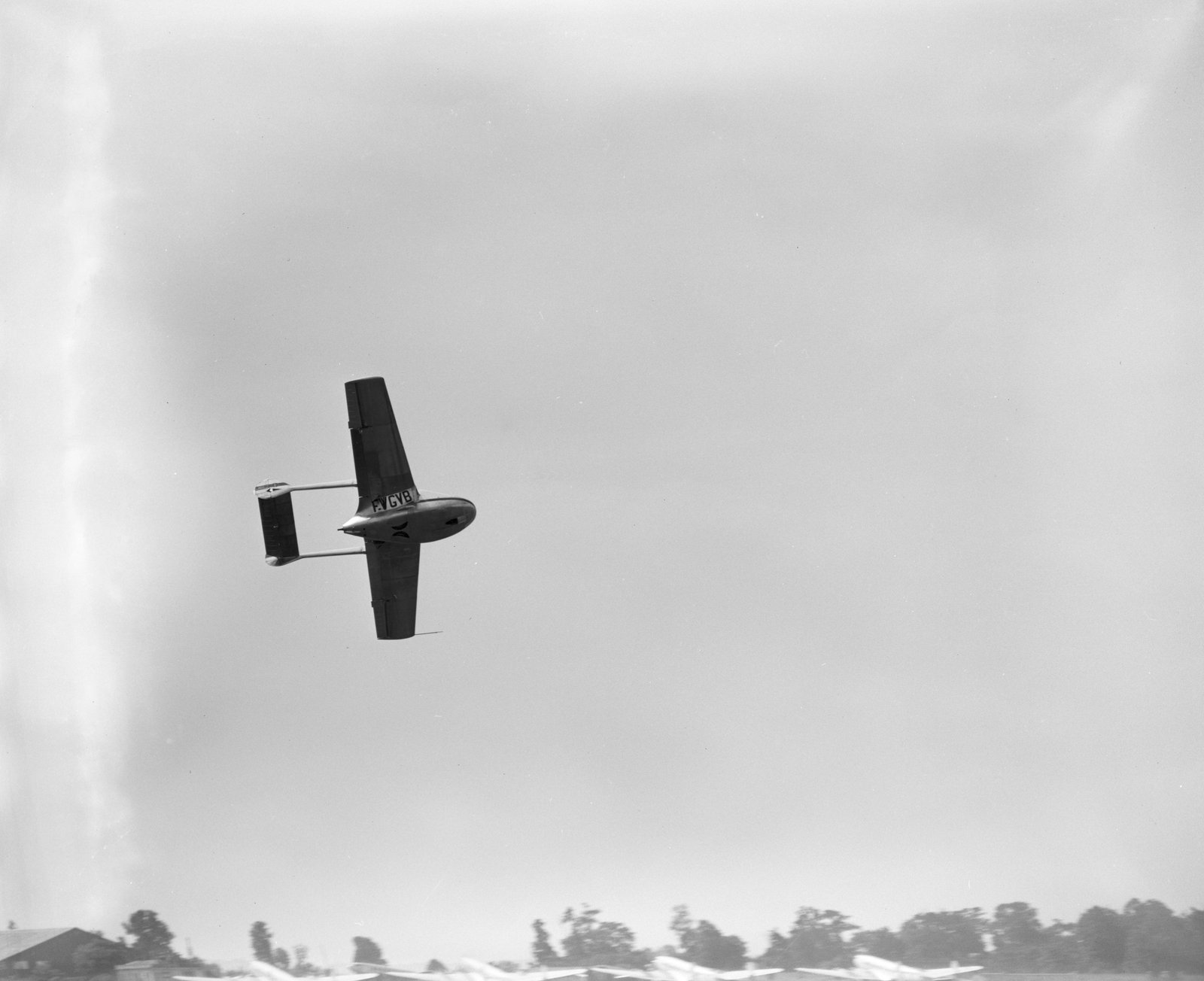
The S-200 Minijet emerged from a French government initiative to reorganize general aviation following World War II. The Service d'Aviation Légère Simplifiée (SALS) issued a request for proposals seeking a versatile aircraft capable of liaison, training, and aerobatic roles. Designer Yves Gardan responded with an innovative twin-boom configuration featuring a short, tubby nacelle housing both the engine and cockpit.
Gardan's design represented a bold leap into the jet age for civilian aviation. The aircraft's most revolutionary feature was its powerplant: the Turbomeca Palas turbojet, which held the distinction of being the world's first practical small turbojet engine. This 350-pound-thrust engine enabled the S-200 to claim the title of first civilian turbojet aircraft, establishing the very light jet category decades before it would become commercially viable.
The Manufacturer
SIPA (Société Industrielle pour l'Aéronautique) undertook the S-200's development and construction during the early 1950s. The French company was part of the post-war aviation industry's efforts to establish new roles and markets following the conflict's end. SIPA also developed related designs, including the S-300 tandem trainer, which first flew on September 4, 1954, building upon lessons learned from the S-200 program.
Flight Testing and Performance Shortfalls
The S-200's maiden flight on January 14, 1952, marked a historic moment in aviation as the first civilian jet took to the skies. However, early flight testing quickly revealed significant performance limitations that would doom the program. The aircraft suffered from an inadequate thrust-to-weight ratio, with its maximum takeoff weight of 1,850 pounds severely taxing the modest output of the Palas engine.
The Turbomeca powerplant, while groundbreaking in its compact size, proved fuel-thirsty with high consumption rates that severely limited the aircraft's range to just 350-435 miles. Pilots found the S-200's takeoff performance particularly disappointing, as the aircraft struggled to achieve adequate climb rates with its 894 feet-per-minute capability falling short of expectations.
Comparative evaluations against competing designs from Morane and Fouga demonstrated the S-200's fundamental performance deficiencies. The aircraft's maximum speed of 193-250 mph and service ceiling of 16,500 feet, while respectable for the era, could not compensate for its poor fuel economy and limited payload capacity.
Production History
SIPA's ambitious plans for the S-200 never materialized beyond the prototype stage. Exactly seven prototypes were constructed during the early 1950s before the program was terminated due to the aircraft's underwhelming performance characteristics. No full-scale production was ever undertaken, making the S-200 one of aviation's most significant might-have-beens.
The limited production run reflected the harsh realities of early jet aviation. While the concept of a small civilian jet was sound, the available technology of the early 1950s simply could not deliver the performance required for commercial success. The Palas engine, despite its pioneering status, lacked the thrust and efficiency needed to make the S-200 a viable aircraft.
Technical Innovation
Despite its commercial failure, the S-200 introduced several notable design features. The twin-boom configuration provided structural efficiency while allowing for a compact central nacelle. The tandem seating arrangement maximized the use of available space while maintaining the aircraft's streamlined profile. These design elements would later influence subsequent light jet developments.
The integration of the world's first practical small turbojet represented a significant technological achievement. Turbomeca's Palas engine, though underpowered for the S-200's needs, established the foundation for future small jet engine development and demonstrated the feasibility of miniaturized turbine technology.
Legacy and Survivors
The S-200's historical significance far exceeds its limited production numbers. As the first civilian turbojet and original VLJ, it established a category that would eventually include successful designs like the Eclipse 500 and Cessna Citation Mustang. The aircraft's influence extended to subsequent minijet projects, including the improved S-300, the American Dale Weejet, and the Bede BD-5J.
Remarkably, two S-200 Minijets remain airworthy today, with one example preserved in the United States and another in France. The French survivor is maintained by enthusiasts who operate the website minijet.org, dedicated to preserving the aircraft's history and technical documentation.
Yves Gardan continued his distinguished career in light aircraft design following the S-200 program, contributing to numerous successful designs until his death in 2009. His pioneering work on the Minijet, though commercially unsuccessful, demonstrated the vision and technical courage that would eventually make very light jets a reality in the 21st century.