
Development and Design
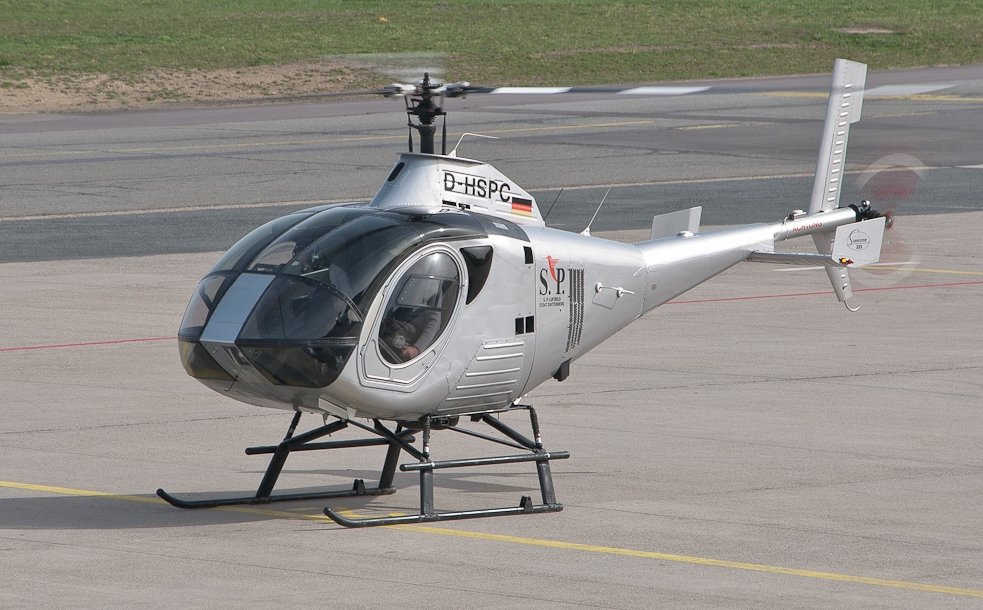
The S-333 emerged from Schweizer Aircraft's ambitious plan to create an affordable turbine helicopter using proven components from their successful Model 300C. Led by Schweizer's internal engineering team, the design retained the dynamic components, rotors, and control systems of the piston-powered 300C while introducing a completely new four-seat fuselage. The prototype, converted from an existing 300C, achieved first flight on June 14, 1988, at Schweizer's facilities in Elmira, New York.
The aircraft represented a significant technological leap forward with its new-technology rotor blades featuring a cambered NACA 0015 modified airfoil. The enlarged rotor system, with its 27.5-foot diameter creating 594.2 square feet of disc area, delivered nearly 30 percent better performance than its predecessor. The fuselage grew substantially, widening 17 inches and lengthening 24 inches compared to the original Model 330 design.
Production History
FAA certification came in September 1992, with initial deliveries of the S-330 beginning in early 1993. The aircraft used a Rolls-Royce 250-C10A turboshaft engine, providing the reliability and performance characteristics that flight schools demanded for turbine transition training. An improved variant, the 330SP, entered service in spring 1997, followed by the definitive S-333 model in September 2000.
The S-333 featured the more powerful and fuel-efficient Rolls-Royce 250-C20W turboshaft, producing approximately 420 shaft horsepower. This engine, part of the venerable M250 family that has seen more than 32,000 units produced since the 1960s, enabled the helicopter to achieve a maximum speed of 121 mph and operational range of 367 miles.
Production numbers remained modest but steady throughout the aircraft's manufacturing life. Schweizer built approximately 32 Model 330s before focusing on the improved variants. The S-333 proved more popular, with 67 units completed, along with 10 examples of the related five-seat S-434 variant. By 2007, only the S-333 remained in active production.
Corporate Changes and Manufacturing
Schweizer Aircraft Corporation, founded in 1939 and initially known for glider production, had entered the helicopter business through a 1983 licensing agreement with Hughes Aircraft to manufacture the Model 300C. The company purchased the program outright in 1986, providing the foundation for their turbine helicopter ambitions.
Sikorsky Aircraft acquired Schweizer on August 26, 2004, integrating the S-333 line into their light helicopter portfolio. Sikorsky, then a United Technologies subsidiary, officially rebranded the aircraft as the Sikorsky S-333 in February 2009. Manufacturing initially continued at the original Elmira facilities, though Sikorsky later moved final assembly operations to their own facilities while outsourcing some components, including 11 cockpit assemblies subcontracted in 2014.
Lockheed Martin's $9 billion acquisition of Sikorsky in November 2015 brought another ownership change, but by then the S-333's production days were numbered. Sikorsky ceased taking orders for the S-333 by the end of 2014, concluding more than two decades of production.
Military and Civil Operations
While designed primarily for the civilian market, the S-333 found important niches in military training applications. The Dominican Air Force and Royal Saudi Land Forces operated the type, valuing its ability to provide initial turbine helicopter experience at costs approaching those of piston-powered aircraft. Saudi Arabia's Interior Ministry ordered nine examples of the larger S-434 variant in November 2007, with deliveries beginning in 2009, though several were later returned due to premature component wear issues.
In civilian service, the S-333 served flight schools, private operators, and light utility companies. Its four-seat configuration made it suitable for training missions while providing enough capacity for small passenger operations or light cargo work. Companies like Soloflex Inc. operated upgraded versions, with aircraft such as N61456 delivered in 1997.
Technical Innovation and Legacy
The S-333's development contributed technologies that extended far beyond the aircraft itself. Sikorsky utilized rapid prototyping techniques pioneered during the S-333 program in the development of their X-2 technology demonstrator, which later influenced advanced rotorcraft programs. The helicopter's advanced rotor system and modern turboshaft powerplant provided a testbed for technologies that would appear in larger Sikorsky products.
The aircraft filled a crucial gap in Sikorsky's product line after 2004, providing an entry-level turbine helicopter that complemented their larger commercial and military offerings. International marketing efforts included partnerships such as a late 1988 assembly and marketing agreement with Jordan for Middle Eastern operations.
Current Status
In 2018, Schweizer R.S.G. reacquired the production rights from Sikorsky, reverting to the original Schweizer S333 designation. The company continues operations today, maintaining the light helicopter tradition established nearly eight decades ago. While exact numbers of airworthy aircraft remain unclear, the S-333's relatively recent production run suggests many examples remain in active service, continuing to provide cost-effective turbine helicopter operations worldwide.