
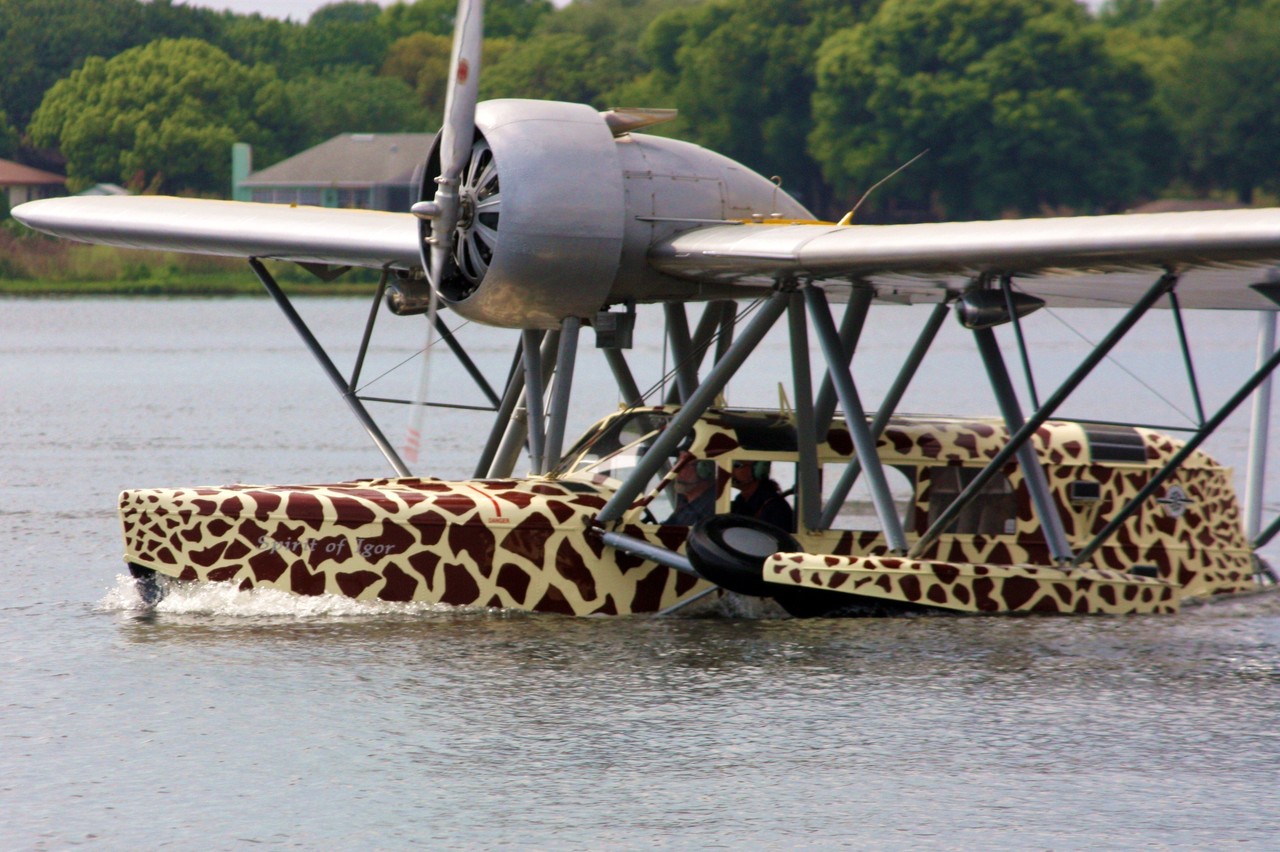
The Personal Amphibian Revolution
The S-39 emerged as Igor Sikorsky's response to demands from wealthy sportsmen and executives who wanted their own flying boats after witnessing the success of his larger S-38. Unlike its twin-engine predecessor designed for commercial service, the S-39 scaled down the amphibian concept for individual ownership, despite the onset of the Great Depression. At $20,000 fully equipped, it commanded a premium price equivalent to dozens of automobiles.
Design and Development
Igor Sikorsky personally led the S-39's design as a smaller, more affordable version of his S-38. The original prototype featured twin British Cirrus Hermes engines producing just 100-115 horsepower each, but this configuration proved underpowered and crashed on December 30, 1929, six days after its maiden flight on December 24. Sikorsky quickly redesigned the aircraft around a single, more powerful engine.
The production S-39 became the first aircraft to utilize Pratt & Whitney's new R-985 Wasp Junior, a nine-cylinder radial engine delivering 300 horsepower. Test pilot Boris Sergievsky demonstrated the aircraft's aerobatic capabilities by performing a loop on its first flight in early February 1930, proving the structural integrity of Sikorsky's design. The aircraft featured a high-wing configuration with a simplified hull design and single tail fin, incorporating full aerodynamic cleanup compared to earlier amphibians.
Manufacturing and Production
Sikorsky Aircraft Corporation produced the S-39 at its new facility in Stratford, Connecticut, marking the first aircraft designed and manufactured there after the company's relocation from Long Island. Between 1930 and 1931, the company built between 21 and 23 examples, with sources varying on the exact total. This limited production reflected both the specialized nature of the aircraft and the economic constraints of the Depression era.
Operational Excellence
The S-39 quickly established itself as a capable performer, setting two to three world records for aircraft in its class. Most famously, explorers Martin and Osa Johnson operated their S-39 "Spirit of Africa" across more than 60,000 miles of African terrain, documenting wildlife and remote regions. This extensive operational history demonstrated the aircraft's reliability and range capabilities far from maintenance facilities.
Shell Eastern Petroleum Corporation acquired the final production S-39-C (construction number 920), reflecting the aircraft's appeal to corporate operators seeking access to remote locations. The aircraft's 375-mile range and 115-mile-per-hour maximum speed provided practical performance for business and exploration missions.
Limited Military Service
While designed as a civilian aircraft, the S-39 saw brief government service. The U.S. Coast Guard borrowed one example in September 1930 for aerial patrol duties during the International Yacht Race off Newport, Rhode Island. In 1934, the Coast Guard acquired a second S-39 from U.S. Customs after it was confiscated from smugglers, adding it to their fleet of 15 miscellaneous aircraft types used for maritime patrol.
Technical Specifications
The S-39 measured 31 feet 11 inches in length with a 52-foot wingspan, utilizing between 320 and 350 square feet of wing area depending on the specific variant. Empty weight reached 2,678 pounds, while maximum gross weight was rated at 4,000 pounds, providing a useful load of 1,322 pounds for fuel, passengers, and baggage. The aircraft typically accommodated one or two crew members plus four to five passengers.
Performance included a cruising speed of 97-100 miles per hour, with a stalling speed of just 54 miles per hour that enhanced safety during water operations. The Sikorsky GS-1 airfoil contributed to the aircraft's stable flight characteristics and forgiving handling qualities that made it suitable for owner-pilots.
Sikorsky Aircraft Corporation
Founded by Russian immigrant Igor Sikorsky in 1923, Sikorsky Aircraft Corporation had already established itself as a leader in multi-engine flying boats before creating the S-39. The company was acquired by United Aircraft and Transport Corporation in 1929, later becoming part of United Technologies Corporation in 1975. Lockheed Martin acquired Sikorsky in 2015, and the company continues operations today as Sikorsky, a Lockheed Martin company, though focused primarily on helicopter manufacturing.
Survival and Legacy
Today, only one airworthy S-39 remains in existence. The composite S-39-C registered NC-50V (construction number 912) underwent a remarkable 40-year, 40,000-hour restoration by Dick Jackson in Rochester, New Hampshire. Jackson discovered the aircraft's hull in Alaska during the 1960s and meticulously returned it to flight status, achieving airworthiness in 2003. This example, now housed at Fantasy of Flight in Polk City, Florida, holds the distinction of being the oldest flying Sikorsky aircraft.
Two additional examples survive in museums: S-39-B construction number 904 is displayed at the New England Air Museum in Windsor Locks, Connecticut, while S-39-C construction number 920 undergoes restoration by Frederick W. Patterson III in American Canyon, California. A fourth example remains as a wreck in Two Lakes, Alaska.
The S-39's significance extends beyond its limited production numbers. It proved that single-engine amphibians could provide reliable service for private operators, establishing design principles that influenced subsequent flying boat development. The aircraft bridged the gap between Sikorsky's early experimental flying boats and later production amphibians, demonstrating that the personal flying boat market could sustain a viable, if specialized, product line during America's economic difficulties.