
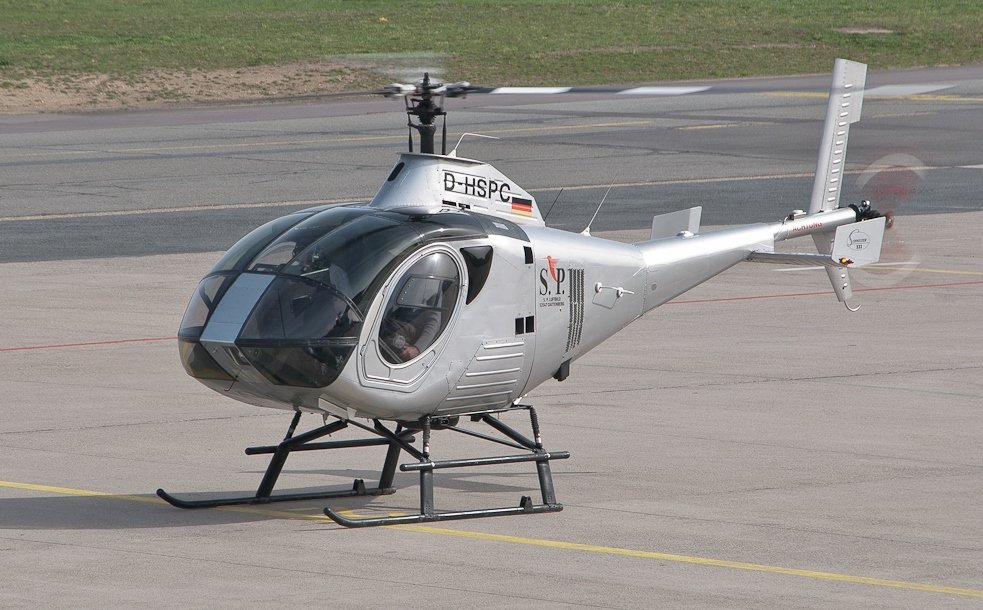
Development and Corporate Origins
The S-434 emerged from Sikorsky's 2004 acquisition of Schweizer Aircraft Corporation, bringing the Connecticut-based helicopter giant into the light helicopter market for the first time. Schweizer had developed the foundation S-333 design, but Sikorsky engineers substantially redesigned the aircraft, incorporating advanced technology from their MQ-8B Fire Scout unmanned helicopter program. The development team integrated a new four-blade rotor system, redesigned tail-rotor blades, and an improved Kaflex driveshaft, transforming the basic S-333 into a more sophisticated machine.
Manufacturing took place at Sikorsky Global Helicopters' Light Helicopter Division facility in Horseheads, New York, rather than at the company's traditional Stratford, Connecticut headquarters. The first prototype completed its maiden flight on December 18, 2008, marking the beginning of what would become one of the most limited helicopter production programs in modern aviation history.
Technical Specifications and Performance
Powered by a single Rolls-Royce 250-C20W turboshaft engine generating 320 shaft horsepower for takeoff, the S-434 offered substantially more power than typical light helicopters in its class. The aircraft's empty weight of 1,345 pounds allowed for a gross weight of 2,900 pounds, with maximum takeoff weight reaching 3,200 pounds when carrying external loads. Its 84-gallon fuel capacity provided extended operational range for utility missions.
The helicopter's spacious cabin design measured 67.6 inches wide and 53.3 inches high, providing excellent visibility and comfort for occupants. The four-blade main rotor spanning 27 feet 6 inches delivered smooth operation and reduced vibration compared to traditional two-blade systems. At 11 feet in height, the S-434 maintained a compact profile suitable for diverse operational environments.
Limited Commercial Success
Despite its advanced design and capable performance, the S-434 attracted minimal commercial interest during its production years from 2008 to 2015. Saudi Arabia's Ministry of the Interior became the helicopter's primary and essentially sole customer, ordering nine aircraft for government operations. On June 15, 2009, Sikorsky announced delivery of the first two S-434s to Saudi Arabia, representing a rare bright spot in the program's commercial history.
The helicopter never achieved meaningful penetration in civilian markets, with one industry analysis noting that the S-434 "was never delivered to a commercial customer." This lack of commercial acceptance proved fatal to the program's long-term viability, as Sikorsky had invested heavily in modernizing the design without securing adequate market demand.
Manufacturing Legacy and Corporate Changes
Sikorsky Aircraft's venture into light helicopters represented a strategic diversification effort by parent company United Technologies Corporation, which had acquired Schweizer specifically to complement Sikorsky's focus on medium and heavy helicopters. However, the S-434's commercial failure contributed to broader questions about the viability of Sikorsky's light helicopter operations.
By March 2015, Sikorsky management announced they were no longer accepting orders for the S-434 and were actively considering selling or shuttering their entire single-engine helicopter production lines. This decision effectively ended the S-434 program after producing just 10 aircraft over seven years, making it one of the least successful helicopter programs in Sikorsky's nearly century-long history.
Corporate Transformation and Current Status
The S-434's production end coincided with major corporate changes at Sikorsky. In November 2015, Lockheed Martin acquired Sikorsky Aircraft from United Technologies Corporation in a $9.0 billion transaction, fundamentally reshaping the helicopter manufacturer's strategic direction. Under Lockheed Martin ownership, Sikorsky refocused on its core strengths in military and heavy commercial helicopters, definitively ending the light helicopter experiment.
Today, Sikorsky Aircraft continues operating as a Lockheed Martin subsidiary, celebrating its 100-year anniversary in 2023. The company has returned to its traditional emphasis on advanced military rotorcraft and large civilian helicopters, leaving the light helicopter market to specialized manufacturers. The few S-434s delivered to Saudi Arabia remain in service with that nation's Ministry of the Interior, representing the entire operational fleet of this rare helicopter type.
Historical Assessment
The S-434 program demonstrates the challenges facing established manufacturers attempting to enter new market segments. Despite Sikorsky's reputation for engineering excellence and the helicopter's technically advanced design incorporating unmanned aircraft technology, market acceptance proved elusive. The program's failure highlighted the difficulty of competing in the light helicopter market against established players like Robinson and Bell, who had developed dedicated dealer networks and proven track records in civilian operations.
With only 10 aircraft produced, the S-434 stands as a cautionary tale about the importance of market research and customer demand in aircraft development, regardless of technical merit or corporate resources.