
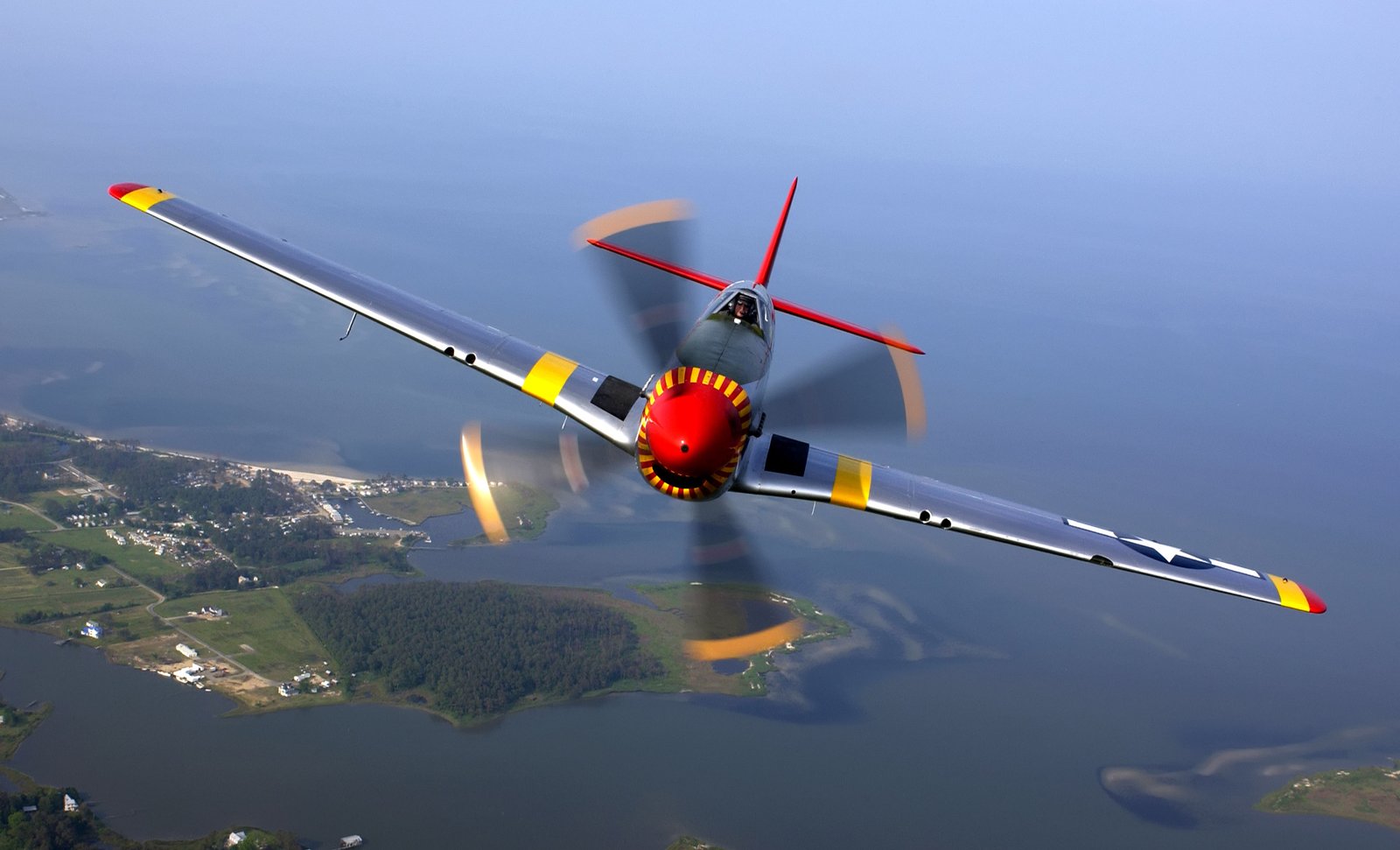
Development and Design Philosophy
Jim Stewart began developing the S-51D in 1968, dedicating over 25 years to creating what would become the most dimensionally accurate P-51D replica available to homebuilders. Stewart, an engineer at Pratt & Whitney, took a leave of absence in 1989 to focus exclusively on perfecting the aircraft's tooling and design. His obsession with accuracy extended to every detail, from the cockpit dimensions to the external contours that faithfully reproduced the legendary Mustang's lines at 70% scale.
The prototype completed its maiden flight on March 30, 1994, after two decades of meticulous development. By late June 1994, the aircraft had accumulated 40 hours of test flying, validating Stewart's design approach that prioritized both visual authenticity and aerobatic performance capabilities.
Manufacturing and Market Reception
Stewart 51, based in Vero Beach, Florida, brought the S-51D to market in 1994 as a comprehensive kit designed to meet FAA's 51% rule for amateur-built aircraft. The company completed all welding, metal forming, and in-jig assembly work, delivering airframe assemblies rather than individual components to builders. Each kit contained over 3,400 parts requiring more than 30,000 rivets, with an estimated construction time of 2,000 hours for the standard kit.
The S-51D became a regular attraction at the Oshkosh airshow throughout the 1990s, where pilot Elliot Cross demonstrated its impressive aerobatic capabilities. By 1998, Stewart 51 had sold 72 kits with two aircraft completed and flying. However, the company faced significant financial challenges when initial pricing proved far below actual production costs, creating reliability issues in fulfilling customer orders.
Corporate Changes and Continued Development
In the early 2000s, Precision Aero Engineering (PAE) of Camarillo, California acquired Stewart 51, taking over the design rights, parts inventory, and the original prototype. PAE was developing a specialized V-8 powerplant for the S-51 at the time of acquisition. Subsequently, a group of builders obtained design rights in 2007, followed by Hudgens in 2010, who focused primarily on manufacturing parts for existing aircraft. Stewart 51 Partner, LLC currently holds the production and marketing rights, though new kit availability remains limited.
Powerplant and Performance
The S-51D's distinctive characteristic was its adaptation of automotive Chevrolet V-8 engines for aircraft use, accepting powerplants ranging from 300 to 600 horsepower. The prototype utilized a Chevrolet 454 cubic inch, high-output V-8 producing 400 horsepower at 4,700 rpm and weighing 740 pounds. Extensive modifications included gear-driven timing to reverse crankshaft rotation, dual-plug aluminum heads, electronic ignition systems, dry sump oil pumps, and Airflow Performance mechanical fuel injection.
Stewart's earlier development work in 1970 involved testing a 200-plus horsepower small-block V-8 with an HY-VO chain gearbox in two plans-built aircraft before scaling up to the big-block engines for kit production. The specified propeller system featured a 91-inch diameter, constant-speed, four-bladed Hartzell unit driven through a spur gear reduction of 2.13:1.
Construction and Specifications
Built entirely from sheet aluminum using conventional construction techniques, the S-51D measured 26 feet in wingspan with 123 square feet of wing area. The cockpit width of 21 inches provided adequate space for tandem seating under the characteristic bubble canopy. With a 400-horsepower engine, the aircraft required a takeoff roll of 1,080 feet and a landing roll of 1,800 feet under standard conditions.
Production Numbers and Current Status
Production figures varied throughout the program's history. By late 2012, 14 examples were known to be completed with 30 more under construction. March 2014 records showed 12 aircraft registered with the Federal Aviation Administration, though 19 had been registered at one time. The relatively modest production numbers reflected both the specialized nature of the market and the financial challenges faced by successive manufacturers.
International Presence and Notable Examples
The S-51D attracted international attention, with James Wickham importing an incomplete project to Victoria, Australia in late 2008. Registered as VH-JWK with serial number 158, this aircraft completed its first flight at Tyabb, Victoria on December 31, 2011, demonstrating the global appeal of Stewart's design.
Legacy in Homebuilt Aviation
Despite being surpassed in pure performance by later carbon fiber designs like the Thunder Mustang in the late 1990s, the S-51D maintained its reputation as the most accurate scaled P-51D replica available. The aircraft proved that homebuilt designs could achieve both dimensional accuracy and aerobatic performance, contributing significantly to the evolution of warbird replica aircraft and establishing benchmarks that influenced subsequent designs in this specialized segment of general aviation.