
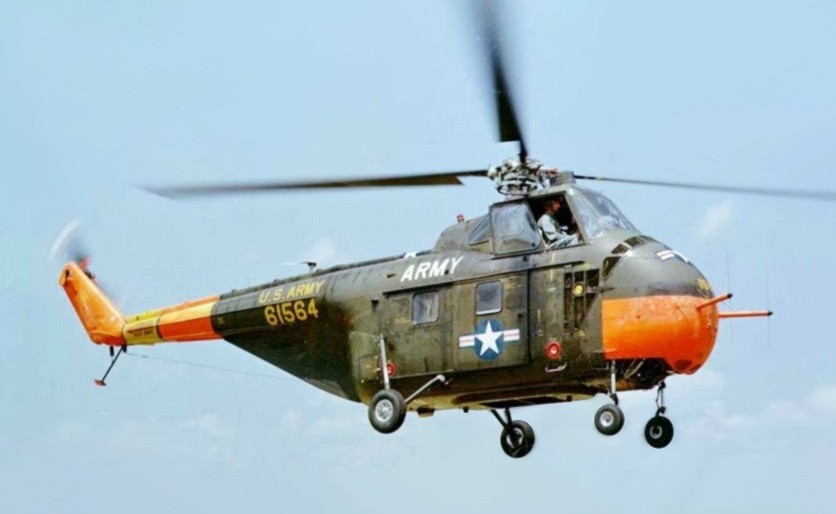
Revolutionary Transport Design
The S-55 emerged from Igor Sikorsky's vision to create a true utility helicopter capable of meaningful transport missions. Under Sikorsky's leadership at Sikorsky Aircraft Corporation, the design team developed an innovative pod-and-boom configuration that separated the passenger compartment from the engine and transmission systems. Chief test pilot Dimitry D. "Jimmy" Viner lifted the prototype (designated YH-19 with serial 49-2012) into the air from Bloomfield, Connecticut, marking a watershed moment in rotorcraft development.
Korean War Pioneer
The S-55 proved its worth immediately during the Korean War from 1950 to 1953, serving as the conflict's primary transport helicopter. The U.S. Air Force operated 55 H-19A Chickasaw variants primarily for search and rescue and medical evacuation missions. The U.S. Navy acquired 118 HO4S-1 and HO4S-3 helicopters, while the Marines fielded 244 HRS-1, HRS-2, and HRS-3 variants. The Army eventually operated 410 H-19C and H-19D helicopters, with a major order for 338 H-19D aircraft placed in 1952.
The helicopter's military capabilities extended beyond basic transport. Anti-submarine warfare variants carried sonar equipment and torpedoes, making the S-55 the first helicopter equipped for ASW missions. In July 1952, two USAF H-19A helicopters achieved the first transatlantic helicopter crossing, demonstrating the type's reliability and range capabilities.
Commercial Aviation Breakthrough
Los Angeles Airways received the first commercial S-55 in March 1952, launching scheduled helicopter passenger service in California. Sikorsky built 216 commercial variants designated S-55C and S-55D, priced at approximately $137,500 in 1953. These aircraft pioneered helicopter airline operations, cargo transport, and offshore oil platform support missions that would become standard applications for commercial helicopters.
Manufacturing Excellence
Sikorsky Aircraft Corporation, founded by Igor Sikorsky in 1923 and acquired by United Aircraft Corporation in 1929, manufactured exactly 1,281 S-55 series helicopters at facilities in Bridgeport and Stratford, Connecticut. Production ran from 1949 to 1962, with a brief suspension before building three final units for the Chilean Air Force. The company had established itself as the helicopter industry leader following the success of the VS-300 in 1940, the first practical helicopter.
Licensing agreements expanded global production significantly. Westland Aircraft Ltd. in the United Kingdom began licensed production in 1950, building their Whirlwind variant. SNCASE in France started production in 1952, followed by Mitsubishi Heavy Industries in Japan beginning in 1958. These international manufacturers produced an additional 477 aircraft, bringing total S-55 production to approximately 1,758 helicopters.
Powerplant and Performance
The Wright R-1820-95 Cyclone seven-cylinder radial piston engine provided 950 shaft horsepower to drive the S-55's four-blade main rotor system. Wright Aeronautical, later Curtiss-Wright, had developed the R-1820 series in the 1930s, with thousands produced for aircraft including the Boeing B-17 Flying Fortress. The engine's proven reliability made it ideal for helicopter operations in harsh conditions.
With this powerplant, the S-55 achieved a maximum speed of 112 miles per hour, a service ceiling of 10,600 feet, and a range of 354 miles. The helicopter could lift a maximum takeoff weight of 7,540 pounds, typically operating with a crew of two or three and up to 12 passengers in high-density seating configurations.
Global Service Record
More than 30 nations operated S-55 helicopters in military and civilian roles. The Israeli Air Force employed the type for tactical transport and search and rescue missions. Other significant operators included Portugal, Greece, South Africa, Denmark, and Turkey. By 1962, the global S-55 fleet had accumulated 1,475,000 flight hours, demonstrating the design's durability and operational utility.
Enduring Legacy
Many S-55 helicopters received turboshaft engine conversions, designated S-55T, replacing the original radial engine with an AlliedSignal LTS101-650 turboshaft producing 650 shaft horsepower while reducing weight by 900 pounds. These modernized aircraft extended the type's service life well beyond the piston-engine era.
The Smithsonian National Air and Space Museum preserves the original prototype (serial 49-2012) as recognition of the S-55's historical significance. Additional examples survive in museums across the United Kingdom and Norway, while some converted aircraft remain airworthy today. The S-55 established helicopter transportation as a practical reality and influenced air mobility doctrine that continues to shape modern military and civilian helicopter operations.