
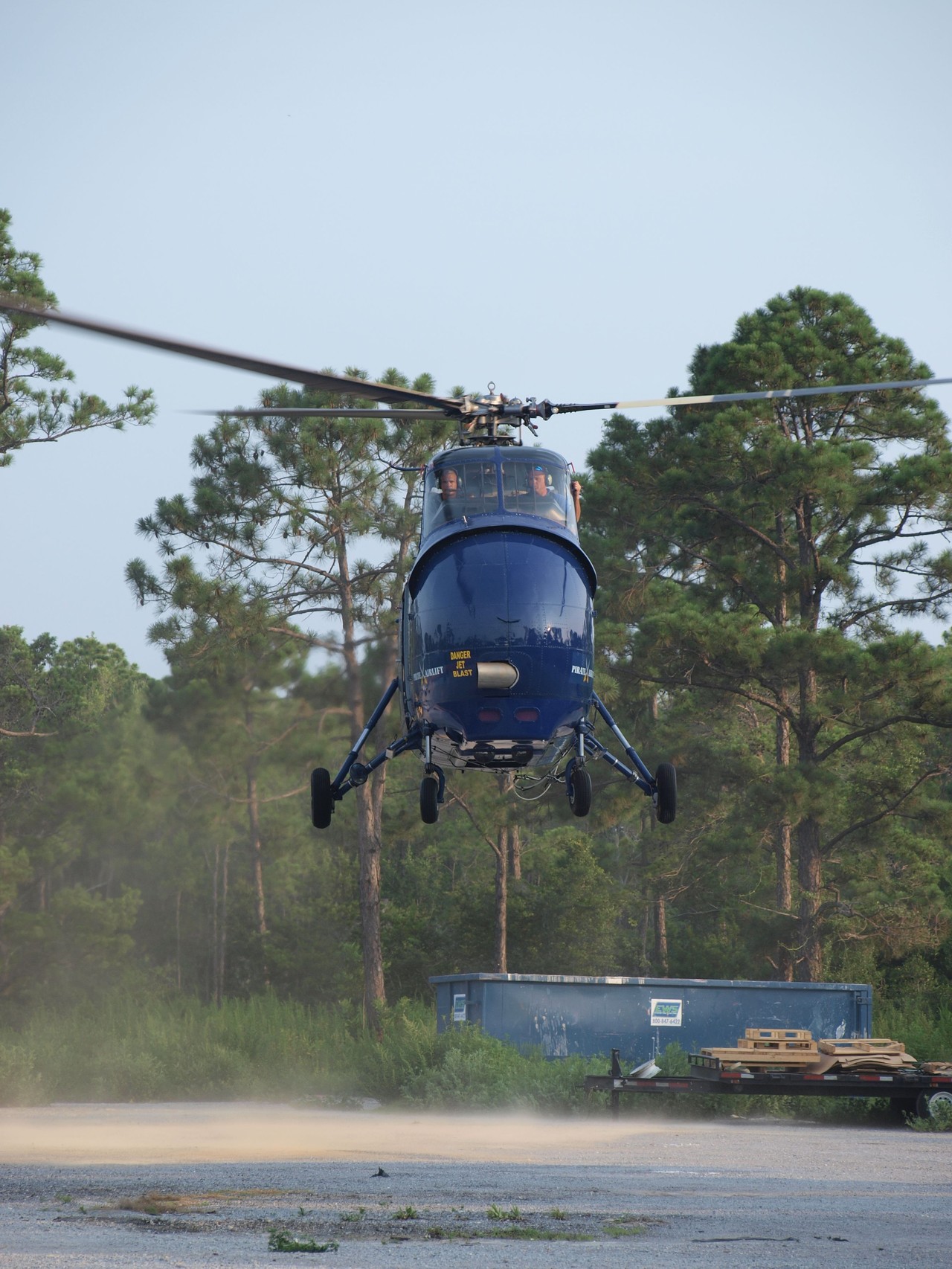
Conversion Genesis
By the late 1960s, hundreds of Sikorsky S-55 helicopters faced obsolescence as their original Pratt & Whitney R-1340 and Wright R-1820 radial piston engines reached the end of their economical service lives. Aviation Specialties Inc. recognized an opportunity to modernize these robust airframes through turbine conversion, beginning development of the S-55T prototype in 1969. The first converted aircraft, registered N1255T, received Federal Aviation Administration certification on January 19, 1971, marking the beginning of a specialized conversion program that would extend the operational lives of approximately 50 S-55 helicopters.
Technical Transformation
The S-55T conversion centered on replacing the original 600-horsepower Pratt & Whitney R-1340 Wasp or 700-horsepower Wright R-1820 Cyclone radial engines with the Garrett TPE331 turboshaft engine producing 840 shaft horsepower. This powerplant upgrade provided a significant improvement in power-to-weight ratio while eliminating the maintenance-intensive requirements of the complex radial piston engines that had powered the original design since 1949. The turbine engine offered enhanced reliability, reduced vibration, and simplified pre-flight procedures compared to the multi-cylinder radial configurations.
The conversion retained the S-55's proven three-blade main rotor system and two-blade anti-torque tail rotor, preserving the flight characteristics that had made the original design successful in both military and civilian operations. The aircraft maintained its capacity for two crew members and up to twelve passengers, or equivalent cargo loads, while delivering improved performance through the enhanced power output.
Global Operations
S-55T conversions found markets worldwide, with operators recognizing the value of combining proven airframe design with modern turbine reliability. Seven converted aircraft were delivered to the Fuerza Aerea de Chile, demonstrating the type's appeal to military operators seeking cost-effective utility helicopter capabilities. European operators included Swiss and Swedish companies, with aircraft HB-XDS delivered to Switzerland on May 7, 1972, and SE-HGZ entering Swedish service on March 15, 1975.
Canadian and Alaskan operators proved particularly receptive to the S-55T conversion, where the type's robust construction and improved cold-weather starting capabilities of the turbine engine provided operational advantages in harsh northern climates. The enhanced power output proved valuable for high-altitude and hot-weather operations where piston engines suffered significant performance degradation.
Manufacturing Heritage
Sikorsky Aircraft Corporation had established the S-55 as a cornerstone utility helicopter design, with 1,281 aircraft produced at the company's Bloomfield, Connecticut facility between 1949 and 1958. The original design emerged from Igor Sikorsky's development team in the late 1940s, with the prototype YH-19 (serial number 49-2012) completing its first flight on November 10, 1949, piloted by Dimitry D. Viner.
License production by international manufacturers had added 477 additional aircraft to the S-55 family total, with Westland Aircraft Ltd. in the United Kingdom, Société Nationale des Constructions Aéronautiques du Sud-Est in France, and Mitsubishi Heavy Industries in Japan contributing to global production numbers. This extensive manufacturing base provided a substantial pool of potential conversion candidates for the S-55T program.
Operational Legacy
The S-55T conversion program represented one of the early successful turbine retrofit initiatives in helicopter aviation, predating similar programs for other classic designs. By 1975, approximately 50 conversions had been completed, with aircraft serving in utility roles including cargo transport, passenger service, and specialized missions requiring the S-55's proven lifting capabilities enhanced by turbine power.
Most S-55T aircraft have since been retired from active service, with Swedish operator SE-HGZ completing its final operations in June 2004 after nearly three decades of service. The conversion program demonstrated the viability of extending airframe service lives through powerplant modernization, a concept that would later be applied to numerous other helicopter types.
Technical Specifications
The S-55T maintained the dimensional characteristics of the original S-55 design while achieving enhanced performance through the 840-shaft-horsepower Garrett TPE331 turboshaft engine. Maximum gross weight reached 7,700 pounds in some configurations, with the turbine powerplant providing superior performance margins compared to the original piston engines. The conversion preserved the S-55's reputation for reliability while delivering the operational advantages of turbine power, including reduced maintenance requirements and improved high-altitude performance capability.