
Service History
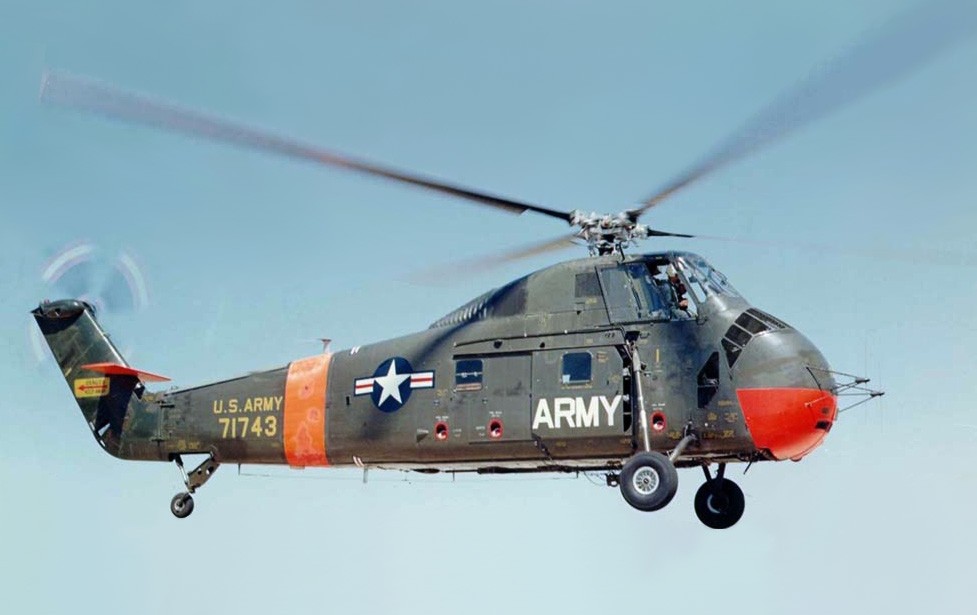
The S-58 dominated anti-submarine warfare operations for the U.S. Navy throughout the late 1950s and 1960s, with the HSS-1 Seabat variant entering service in August 1955. By April 1963, the fleet of 1,614 S-58s had accumulated 1,684,695 flight hours, demonstrating remarkable operational reliability. The helicopter's versatility extended beyond naval operations - Marine Corps CH-34C variants transported troops while Army H-34 Choctaws served in utility roles. At peak production in 1958, Sikorsky's workforce of 10,653 employees delivered approximately one helicopter per day from their assembly lines.
Wartime Operations
The S-58 saw extensive combat service during the Vietnam War in the 1960s, where its robust construction and powerful engine proved invaluable for troop transport and utility missions. British Westland Wessex variants, powered by twin Napier Gazelle turboshaft engines instead of the American radial, served with distinction during the 1982 Falklands War. In one notable engagement, a Royal Navy Wessex disabled the Argentine submarine Santa Fe using depth charges and machine gun fire. The helicopter also participated in the Malayan Emergency in the early 1960s, where its ability to operate from small clearings proved crucial for counterinsurgency operations.
The Manufacturer
Sikorsky Aircraft Corporation, founded by aviation pioneer Igor Sikorsky in 1923, had established itself as America's leading helicopter manufacturer by the 1950s. Based in Bridgeport, Connecticut, the company had previously developed the groundbreaking VS-300 in 1939 and the successful S-55 in 1947. United Aircraft Corporation acquired Sikorsky in 1929, transforming it into the Sikorsky Aircraft Division by the 1950s. Following United Technologies' merger with Lockheed Martin in 2015, the company continues operations today as Lockheed Martin Sikorsky, maintaining its position as a premier rotorcraft manufacturer.
Engine & Technical Innovation
The S-58's heart was the Wright R-1820 Cyclone, a nine-cylinder radial engine producing 1,525 horsepower. This air-cooled powerplant, manufactured by Curtiss-Wright, had proven its reliability in World War II aircraft including the Douglas DC-3. The engine's nose-mounted configuration was revolutionary for helicopters, providing better weight distribution than previous designs. Igor Sikorsky's engineering team incorporated several innovations including four-blade main and tail rotors, a downward-sloping foldable tail for carrier operations, and tricycle landing gear for improved ground stability. The design met the Navy's demanding 1952 requirement for twice the power of the preceding S-55.
Performance Characteristics
Pilots appreciated the S-58's stability and lifting capability, though the radial engine's heat output required careful management, particularly on offshore oil platform operations. The helicopter achieved a maximum speed of 120 knots and could transport 16 fully equipped troops or 12 civilian passengers. In medical evacuation configuration, it accommodated six stretchers plus an attendant. The aircraft's folding rotor and tail section enabled efficient shipboard storage, while its tricycle gear provided safer deck operations compared to conventional skid-equipped helicopters.
Production & International Variants
Sikorsky manufactured 1,821 S-58s between 1954 and January 1969, initially at Bridgeport before shifting production to a new Stratford, Connecticut facility. The 1,000th aircraft rolled off the assembly line on November 20, 1958, followed by the 1,500th in June 1962. International production significantly expanded the type's global presence: Sud-Aviation in France built approximately 166 units, while Westland constructed 356 Wessex variants in the United Kingdom. Licensed variants incorporated different powerplants - Sud-Aviation used twin Turboméca Bastan IV turboshaft engines, while Westland's Wessex featured the twin Napier Gazelle turboshaft configuration.
Legacy and Survivors
Production ceased as the more advanced SH-3 Sea King entered service in 1962, offering superior performance and all-weather capability. Many surplus military S-58s found civilian careers through conversion programs like the S-58T, which California Helicopter International developed using Pratt & Whitney Canada PT6A Twin Pac turboshaft engines. By 1981, 146 S-58T conversion kits had been delivered for offshore oil and utility operations. Today, few original S-58s remain airworthy, with notable survivor D-HAUG operated by Meravo-Luftreederei GmbH in Germany for airshows and film work. The helicopter's influence extended far beyond its production numbers, establishing design principles and operational procedures that influenced subsequent rotorcraft development for decades.