
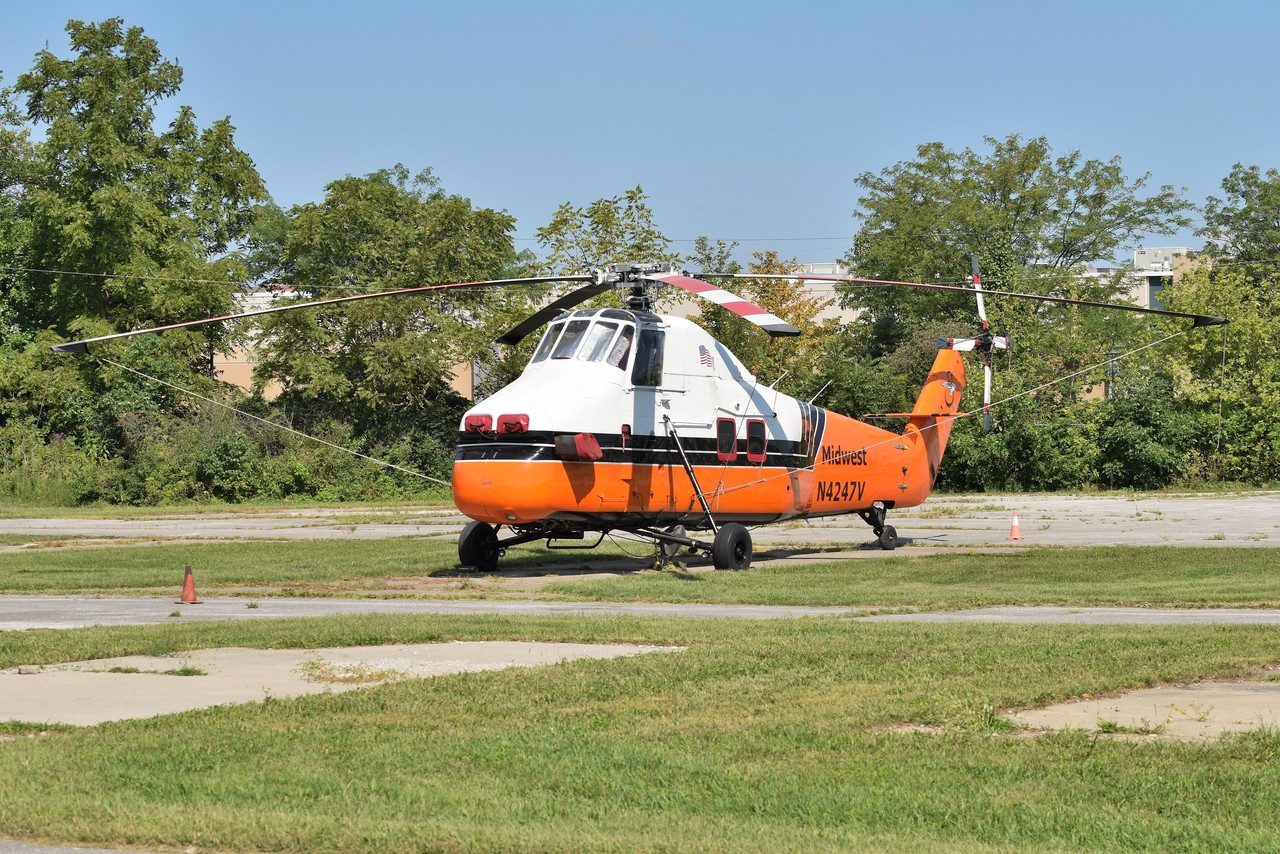
A Second Life Through Innovation
When Sikorsky Aircraft Corporation closed its S-58 production line in January 1970 after manufacturing approximately 1,800 helicopters at Stratford, Connecticut, hundreds of military surplus H-34 Choctaws sat idle worldwide. Rather than allowing these proven airframes to languish, Sikorsky's engineering team conceived an ambitious conversion program that would breathe new life into the aging fleet through modern turbine technology.
The prototype S-58T, registered N8478, lifted off on August 26, 1970, marking the beginning of a transformation that would extend the operational life of Igor Sikorsky's 1950s design well into the modern era. After rigorous testing that consumed a $4 million investment, the Federal Aviation Administration granted supplemental type certificate SH71EA on April 15, 1971.
Engineering Excellence in Conversion
The heart of the S-58T conversion lay in replacing the original Wright R-1820 Cyclone radial engine with the sophisticated Pratt & Whitney Canada PT6T-3 Twin-Pac turboshaft system. This powerplant coupled two PT6 turbine engines through a combining gearbox, delivering 1,343 kilowatts (1,800 shaft horsepower) to a single output shaft. The Twin-Pac, developed between 1959 and 1964, had accumulated 3.4 million operating hours across 3,411 units by January 1970, establishing a reputation for reliability that proved crucial for civilian operators.
Each conversion demanded approximately 2,000 hours of specialized labor, while building a complete S-58T from an existing airframe required 4,750 hours. Sikorsky's dedicated workforce of 70 technicians achieved a production rate of two conversions monthly, with the operation reaching full stride by June 1971 when eight helicopters had been completed, sixteen awaited conversion, and sixteen conversion kits stood ready for delivery.
Commercial Success and Global Reach
Air America received the first production conversion kit in April 1971 at Udorn, Thailand, launching the S-58T's operational career in the demanding conditions of Southeast Asia. The Royal Thai Air Force became a significant military operator, acquiring twelve aircraft based at Lop Buri, while the Indonesian Air Force incorporated twelve S-58Ts into its Logistics Command structure.
Civilian operators embraced the S-58T's enhanced capabilities for heavy-lift operations, utility transport, and VIP configurations. Companies including Airfast Services, Crescent Airways, and McMahon Helicopter Service deployed the type across diverse missions, from construction support to passenger transport. The turbine powerplant's superior hot-and-high performance characteristics proved particularly valuable in challenging operating environments where piston-powered helicopters struggled.
Manufacturing Legacy and Corporate Evolution
Sikorsky Aircraft Corporation, founded by aviation pioneer Igor Sikorsky in 1923, had established itself as America's premier helicopter manufacturer through innovations spanning from the 1920s multi-engine aircraft to revolutionary rotorcraft designs. The company's acquisition by United Aircraft Corporation in 1929 provided the financial foundation for decades of technological advancement, with Sikorsky personally leading design efforts until his retirement in 1957.
By 1981, Sikorsky had completed nearly 150 S-58T conversions before selling program rights to California Helicopters International. This transfer marked the end of Sikorsky's direct involvement in the conversion program, though the company continued developing new helicopter designs. Today, operating as Lockheed Martin Sikorsky following the 2015 acquisition, the manufacturer remains active in military and civilian rotorcraft production.
Operational Performance and Pilot Experience
The S-58T retained the basic dimensions of its piston-powered predecessor while delivering significantly enhanced performance through turbine power. Pilots appreciated the Twin-Pac's smooth operation and instant throttle response compared to the radial engine's lengthy warm-up requirements and vibration characteristics. The turboshaft system's 435 liters per hour fuel consumption at maximum continuous power provided predictable operating costs for commercial operators.
With accommodation for two to three crew members and up to twelve passengers or equivalent cargo capacity, the S-58T filled a crucial niche in the medium-lift helicopter market. Its service ceiling exceeding 12,000 feet and range approaching 300 nautical miles made it suitable for missions requiring both payload capacity and operational flexibility.
Enduring Service and Modern Operations
As of January 1991, approximately 80 S-58T helicopters remained in active service worldwide, testament to both the original airframe's durability and the conversion program's success. Despite occasional accidents, including incidents involving N1168U as recently as September 2019, many S-58Ts continue operating in utility roles decades after their conversion.
The S-58T program ultimately produced approximately 160 aircraft, with 120 serving civilian operators and 40 in military service. While lacking the cultural prominence of the original H-34 Choctaw's military legacy, the S-58T demonstrated the viability of cost-effective turbine conversions, providing a model for extending airframe service life that influenced subsequent retrofit programs across the aviation industry.