
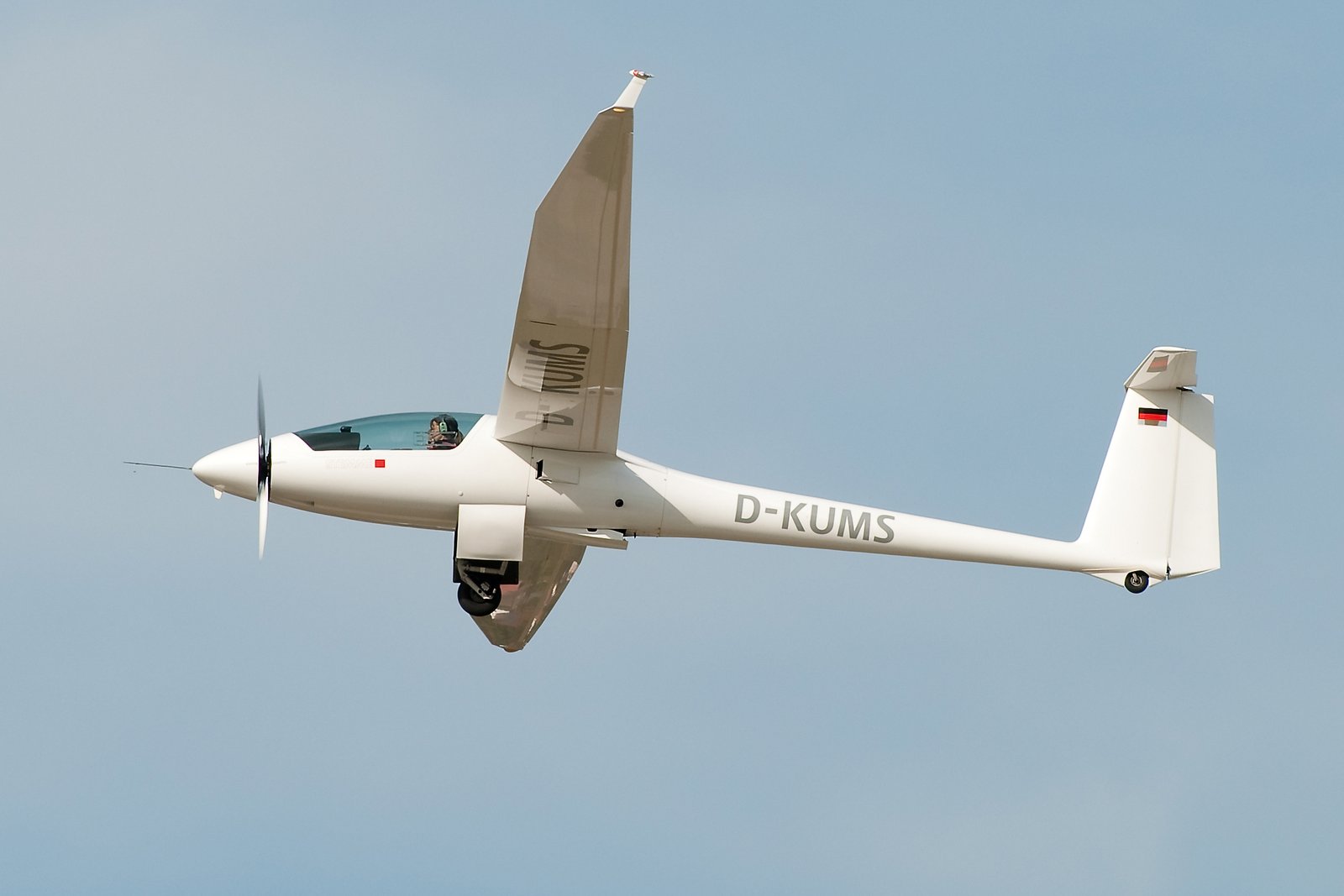
Development and Design
The STEMME S-6 emerged from STEMME AG's ambition to create a modular touring aircraft family that would redefine the motorglider market. Announced at the AERO trade show in Friedrichshafen in April 2001, the aircraft represented a significant evolution from the company's earlier S10 series. The design team at STEMME AG focused on addressing key limitations of existing motorgliders: excessive noise and vibration, cramped cockpits, and limited touring capability.
Test pilot Lothar Dalldorff lifted the prototype off the runway at Strausberg Airport on November 29, 2006, marking the beginning of a comprehensive flight test program. The aircraft incorporated several groundbreaking features, including a carbon fiber reinforced polymer (CFRP) construction with detachable three-section wings plus winglets, and a steel framework designed specifically for engine and landing gear integration. The wider fuselage addressed comfort concerns that had plagued earlier motorgliders, while the non-retractable three-bladed feathering propeller system promised reduced complexity and maintenance requirements.
Technical Innovation
The S-6's technical specifications reflect its advanced design philosophy. With a 20-meter wingspan and wing area of 17.37 square meters, the aircraft achieves an impressive aspect ratio of 18.6, contributing to its exceptional 38:1 glide ratio. The maximum takeoff weight of 850 kilograms allows for substantial fuel capacity, with a long-range fuel option of 130 liters enabling extended cross-country flights.
Powering the S-6 is the Rotax 914 F2, a flat-four turbocharged engine producing 84.5 kW (113.3 horsepower) through a geared drive system. This engine, manufactured by BRP-Rotax GmbH & Co KG, drives an MTV-7-A/170-51 three-bladed constant-speed propeller with a 1.70-meter diameter. The turbocharged variants, designated S6-T and S6-RT, utilize the 115-horsepower version of the Rotax 914, providing enhanced high-altitude performance crucial for efficient cross-country soaring.
Performance and Capabilities
The S-6's performance envelope demonstrates the successful integration of efficient power and exceptional soaring capability. At Flight Level 100, the aircraft cruises at 256 kilometers per hour (159 mph), while maintaining a fuel consumption rate of just 15 liters per hour at 55 percent power. The never-exceed speed of 268 kilometers per hour (167 mph) provides adequate margin for maneuvering in thermals and along ridges.
With its maximum range of 1,398 kilometers (869 miles), the S-6 enables true cross-country touring that was previously impractical for motorgliders. The aircraft's noise signature of 60 decibels represents a significant achievement in reducing the acoustic footprint that had made earlier motorgliders unwelcome at many airports. Additionally, the S-6 can serve as a glider tug, certificated to tow gliders up to 750 kilograms maximum takeoff weight.
Manufacturing and Production
STEMME AG achieved European Aviation Safety Agency type certification for the S-6 on October 22, 2008, following an extensive certification program. Manufacturing commenced at the company's Strausberg facility, with deliveries beginning in the second quarter of 2009, significantly later than the originally anticipated 2003 timeline announced at the aircraft's debut.
Production remained limited throughout the aircraft's manufacturing run, with exactly 18 airframes completed by 2011. This modest production reflected both the specialized nature of the high-performance motorglider market and the substantial investment required for the aircraft's advanced composite construction. Manufacturing continued beyond 2011, with examples such as a 2013 S6-RT (registration N566P) indicating ongoing, albeit limited, production activity.
The Manufacturer
STEMME AG traces its heritage to the 1980s motorglider revolution in Germany. The company evolved from STEMME GmbH, which achieved its first major success with the S10 prototype's maiden flight in 1986 and subsequent public debut at the AERO Friedrichshafen show in 1987. The transition to joint-stock company status occurred in 1990, coinciding with S10 series production and type certification.
In 2014, STEMME strategically outsourced many glider structural components to Remos AG, allowing the company to focus on final assembly and systems integration. Today operating as STEMME GmbH, the company continues motorglider production with the S12 family, which was unveiled at AERO Friedrichshafen in April 2015 and received EASA certification in March 2016.
Legacy and Current Status
Despite limited production numbers, the S-6 established new benchmarks for motorglider performance and refinement. Several aircraft remain airworthy as of 2026, including well-maintained examples with low flight hours. The aircraft found its primary market among private owners and soaring clubs, distributed in the United States through dealers such as Bell Aviation in Columbia, South Carolina.
The S-6's significance extends beyond its modest production numbers, representing a successful integration of advanced composite construction, efficient turbocharged propulsion, and refined aerodynamics that influenced subsequent motorglider development. While never achieving the commercial success that STEMME originally envisioned, the S-6 demonstrated that the touring motorglider concept could deliver airline-like cross-country capability combined with the pure soaring performance that defines the sport of gliding.