
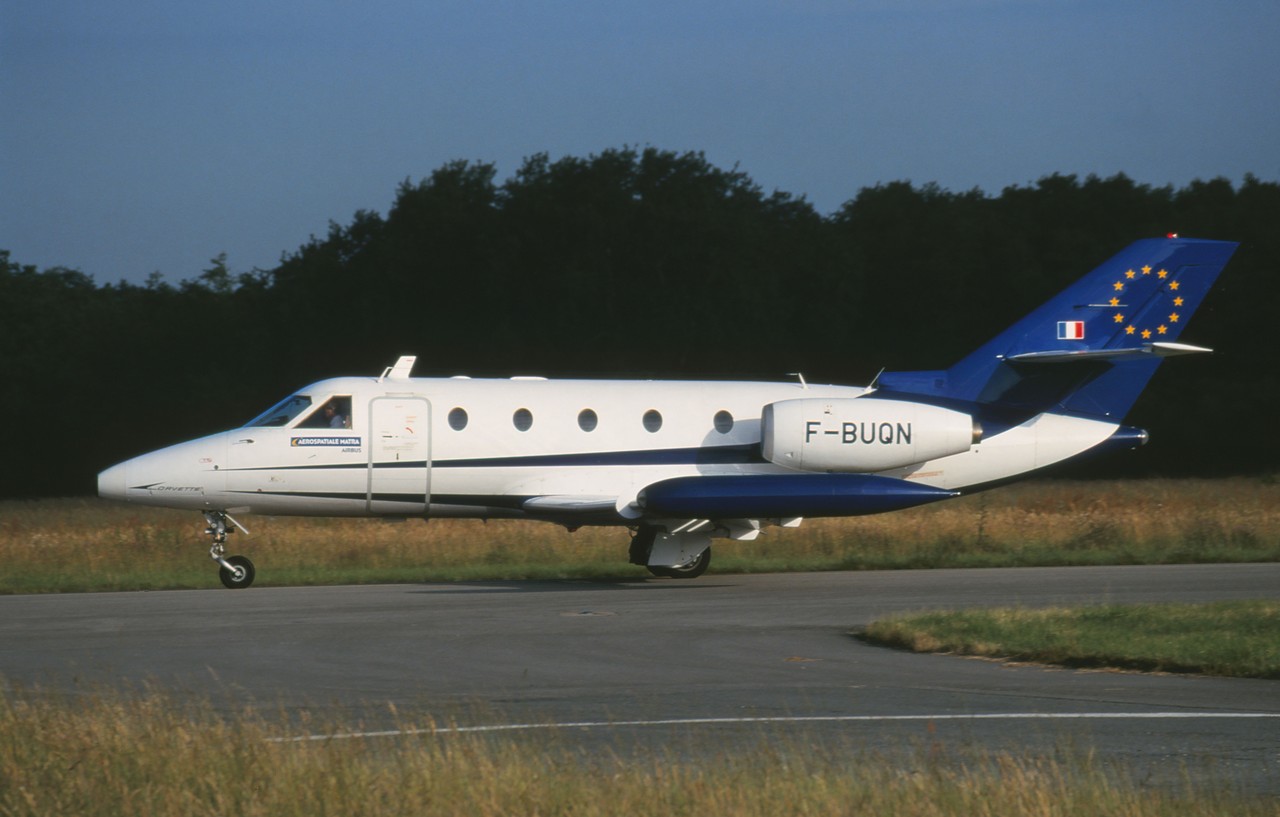
Development and Design
The SN-601 Corvette originated from a January 1968 French government requirement for a compact twin-turbofan liaison and trainer aircraft. The project began as a joint effort between Sud-Aviation and Nord-Aviation, initially designated the SN.600 Diplomate. The design team envisioned a versatile platform that could serve both executive transport and regional airline roles, featuring a narrow fuselage, swept surfaces, and aft-mounted engines similar to the emerging Cessna Citation concept.
The first prototype took to the skies on July 16, 1970, powered by interim Pratt & Whitney Canada JT15D-1 engines producing 2,200 pounds of thrust each. The planned SNECMA M49 Larzac engines faced development delays, forcing the switch to the proven Canadian powerplants. Tragedy struck on March 22, 1971, when the prototype crashed during stall testing near Istres, killing all three crew members aboard.
The Manufacturer
Aérospatiale emerged in 1970 from the merger of Sud-Aviation and Nord-Aviation, representing France's consolidated effort to compete in the global aerospace market. These companies themselves had grown from France's post-World War II aviation industry nationalization, which had produced ambitious projects like the Breguet Deux-Ponts and Sud-Est Armagnac airliners. Aérospatiale would operate independently until 1990, when its aircraft division merged with Deutsche Aerospace to form the European Aeronautic Defence and Space Company, later becoming today's Airbus SE.
Redesign and Production
The crash investigation led to significant design changes for the second prototype. Engineers extended the fuselage by 5.5 feet to its final length of 45.4 feet, installed a taller vertical stabilizer, and added distinctive wingtip fuel tanks to improve range performance. The upgraded JT15D-4 engines provided 2,300-2,500 pounds of thrust each, delivering substantially better performance than the original powerplants.
The redesigned aircraft first flew on December 20, 1972, followed by a third prototype on March 7, 1973. Production began at the Saint-Nazaire facility later that year, with the first production example flying on November 9, 1973. The manufacturing run proved brief, lasting only until 1977 with just 40 aircraft completed.
Performance and Capabilities
The production Corvette demonstrated impressive performance for its era, achieving maximum speeds of 410 knots at altitude and cruise speeds of 306-310 knots. The aircraft could climb at 1,000 feet per minute to its service ceiling above 41,000 feet, while carrying passengers up to 1,400 nautical miles with standard fuel loads. With a maximum gross weight of 14,550 pounds and empty weight of 7,738 pounds, the Corvette offered substantial payload capacity in its class.
The cockpit accommodated two pilots, while the cabin could be configured for 6-14 passengers depending on the interior layout and mission requirements. This flexibility made it suitable for both corporate executive transport and short-haul regional airline service.
Commercial Service
Despite its technical merits, the Corvette struggled in the marketplace against established competitors like the Dassault Falcon 20, Cessna Citation, and Learjet 24. High acquisition and operating costs limited appeal to corporate customers, while airlines found better economics in other aircraft types. Nevertheless, several French carriers including Air Alsace, Air Alpes, and Air Inter operated small numbers of Corvettes on regional routes.
Jetstar Holland BV became one of the more notable operators, acquiring two Corvettes in 1977 including PH-JSB (serial number 26) and PH-JSC. The Amsterdam-based company represented the type of European corporate operators that formed the Corvette's primary customer base.
Aérospatiale attempted to expand into the crucial American market through various distribution agreements with companies including LTV, Piper, and Corvette Inc., but these efforts failed to generate significant sales. The lack of U.S. market penetration severely limited the program's commercial viability.
Legacy and Current Status
The Corvette program is often cited as one of France's least successful commercial aircraft ventures, ranking alongside the Dassault-Breguet Mercure in terms of market failure. The France's Court of Audit later criticized the project for crashes, delays, cost overruns, and poor sales performance that never justified the development investment.
However, the Corvette deserves recognition as a pioneer of the regional jet concept. Its multi-role design philosophy predated the successful Canadair Regional Jet, Embraer ERJ family, and Dornier 328Jet by nearly two decades. The aircraft demonstrated that properly designed small jets could serve both executive and airline markets effectively.
Approximately 33 Corvettes remain active today, primarily with European corporate operators who value the type's performance and passenger comfort. While never achieving commercial success, the SN-601 Corvette represents an important chapter in the evolution of business aviation and early regional jet development.