
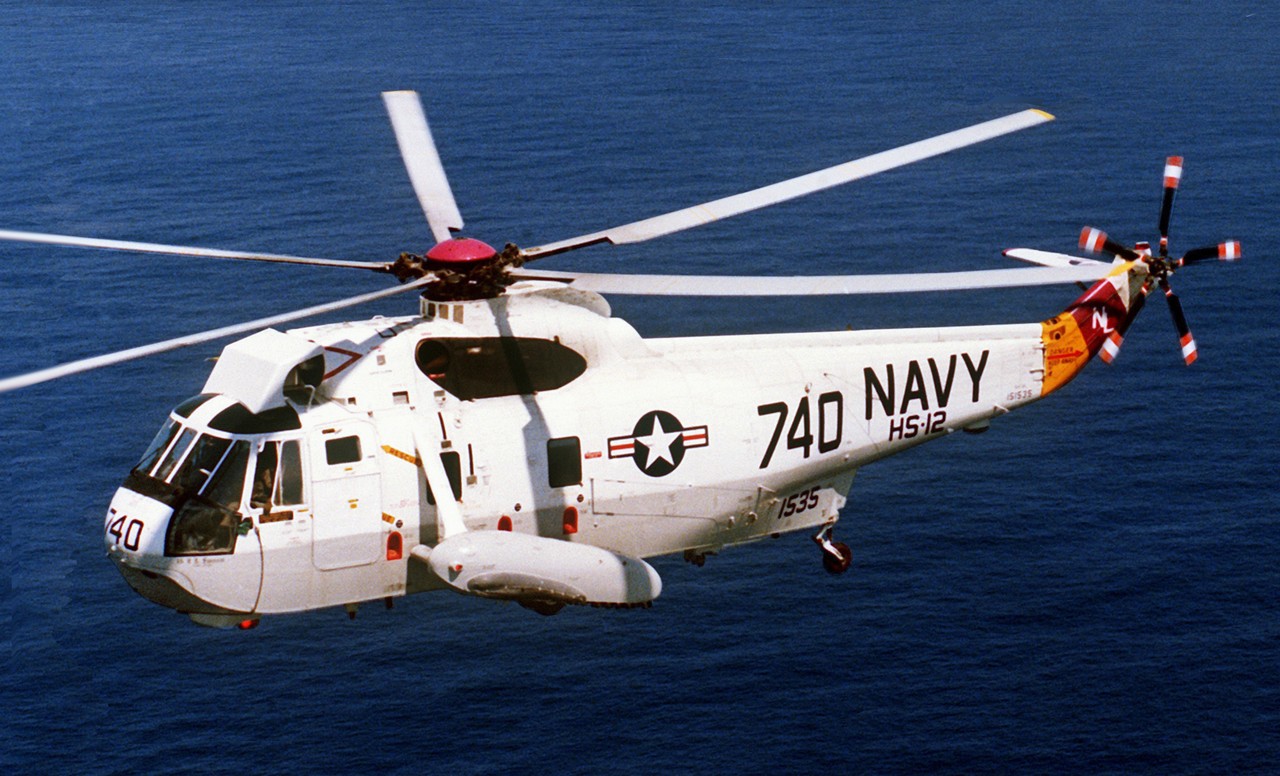
Military Origins and Development
The S-61's development began in September 1957 when Sikorsky received a United States Navy contract for an advanced amphibious anti-submarine warfare helicopter. The prototype XHSS-2 Sea King completed its maiden flight on March 11, 1959, establishing the foundation for what would become one of aviation's most successful helicopter families. Production deliveries of the military HSS-2, later redesignated SH-3A Sea King, commenced in September 1961, marking the beginning of extensive naval service.
Commercial Aviation Pioneer
Recognizing the civilian potential of their military design, Sikorsky rapidly developed commercial variants. The land-based S-61L first flew on November 2, 1961, featuring a fuselage 4 feet 3 inches longer than the military version to accommodate substantial passenger and cargo loads. The amphibious S-61N followed on August 7, 1962, specifically optimized for overwater operations and offshore oil rig support missions that would define much of the type's commercial success.
New York Airways operated the most ambitious S-61 passenger service, ordering ten aircraft for urban helicopter routes. The airline initially planned up to 360 daily flights from a heliport atop the 59-story Pan Am Building in Manhattan. However, the operation proved economically unsustainable, averaging only eight passengers per flight, leading to the heliport's closure in 1968.
International Operations
Pakistan International Airlines demonstrated the S-61's versatility in challenging conditions, operating four helicopters throughout East Pakistan from 1962 to 1966. The service connected 20 towns and cities including Bogra, Chittagong, Barisal, and Kushtia, reducing the 21-hour overland journey to Khulna to just 37 minutes by air. This operation showcased the helicopter's ability to provide reliable transportation in regions with limited ground infrastructure.
The Manufacturer's Legacy
Sikorsky Aircraft Corporation, founded by aviation pioneer Igor Sikorsky, established itself as America's premier helicopter manufacturer through designs like the S-61. The company pioneered numerous rotorcraft innovations and continues operations today as part of Lockheed Martin's aerospace division. Beyond the S-61, Sikorsky produced iconic helicopters including the UH-60 Black Hawk and presidential transport aircraft.
Technical Excellence
The S-61A was powered by two General Electric CT58-140 turboshaft engines, each producing 1,500 shaft horsepower. Early production aircraft utilized T58-GE-8B engines rated at 1,250 shaft horsepower each. The helicopter's 62-foot main rotor provided a disc area of 3,019 square feet, enabling it to lift a maximum takeoff weight of 19,000 pounds. Passenger capacity ranged from 7 to 28 depending on configuration and mission requirements.
During the 2000s, Sikorsky introduced the S-61T modernization program, incorporating composite main rotor blades, modular wiring systems, and optional glass cockpit displays. These upgrades reportedly increased lift capability and cruise speed while reducing maintenance requirements for operators maintaining aging fleets.
Safety Challenges
Despite its operational success, the S-61 experienced notable accidents during its early service years. Los Angeles Airways suffered two fatal crashes within three months in 1968, including Flight 841 near Paramount, California, killing 23 people, and Flight 417 in Compton, California, resulting in 21 fatalities. The second accident involved the prototype S-61L, highlighting the risks of early commercial helicopter operations.
Production and Global Reach
Sikorsky manufactured 794 S-61 helicopters between 1961 and 1980, with licensed production extending to manufacturers in England, Italy, Canada, and Japan. This international manufacturing network expanded the type's global presence and provided local support for operators worldwide. The extended production run demonstrated sustained demand for the helicopter's unique amphibious capabilities.
Enduring Service
The United States Department of State signed a contract in June 2010 for 110 modernized S-61T helicopters, supporting diplomatic operations globally. This order, decades after original production ended, testified to the design's continued relevance for specialized transport missions. Examples remain operational worldwide, particularly in offshore oil support roles where the S-61's amphibious capabilities and payload capacity provide unmatched utility.
The S-61A's legacy extends beyond its production numbers, having fundamentally changed maritime operations economics and demonstrated the viability of large commercial helicopters. Its transition from military anti-submarine platform to versatile commercial transport established templates for helicopter development that influence modern rotorcraft design.