
Service History
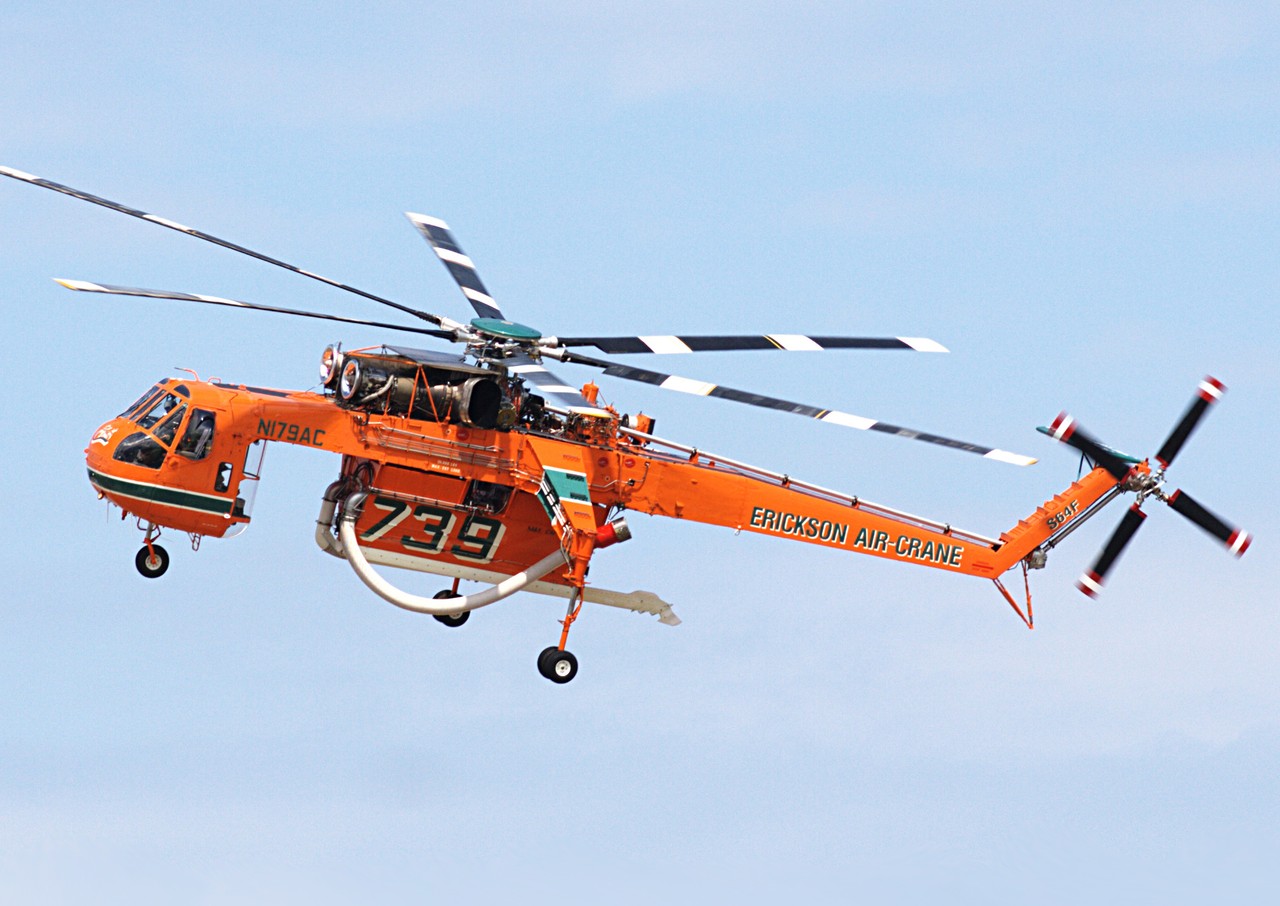
The S-64 Skycrane dominated the specialized heavy-lift market from its introduction, with total production reaching 215-250 aircraft across all variants by the early 1970s. As of 2000, Erickson Air-Crane operated 18 S-64 variants and had established the type as the industry standard for precision heavy lifting, firefighting, and construction support. The aircraft's ability to transport loads impossible for any other rotorcraft—including entire prefabricated buildings, logging equipment, and military artillery—created entirely new markets for helicopter operations.
Military Service
The U.S. Army adopted the design as the CH-54 Tarhe, ordering six YCH-54A evaluation models in June 1963 followed by 54 CH-54A production aircraft and 29-37 CH-54B variants. During the Vietnam War, the 478th Aviation Company supporting the 1st Cavalry Division and the 291st Aviation Company employed CH-54s for artillery positioning, supply delivery, and recovery of downed aircraft. The Tarhe's 10-ton external lift capability proved invaluable for transporting howitzers to fire bases inaccessible to ground vehicles and recovering valuable equipment from hostile territory. German forces evaluated two S-64A prototypes sent to Weser Flugzeugbau, but no European production orders materialized.
The Manufacturer
Sikorsky Aircraft Corporation developed the S-64 as an evolution of their unsuccessful S-60 prototype, which crashed on April 3, 1961, after limited testing beginning March 25, 1959. Founded by aviation pioneer Igor Sikorsky in 1923, the company had established helicopter leadership with the VS-300 in 1939 and mass production during World War II. Operating as a division of United Aircraft Corporation (later United Technologies), Sikorsky completed the S-64 development in just 13 months from April 1961 approval to first flight. On February 1, 1992, Sikorsky sold the complete S-64 type certificate, manufacturing rights, and worldwide support to Erickson Air-Crane, which continues production from Central Point, Oregon.
Engine & Technical Innovation
The S-64's twin Pratt & Whitney T73 turboshaft engines marked a crucial advancement over piston powerplants, delivering 4,500 shaft horsepower each in the initial T73-P-1 configuration and 4,800 horsepower in the later T73-P-700 variant used on CH-54B and S-64F models. Derived from the JT12 turbojet, these engines provided the power-to-weight ratio essential for heavy external loads while maintaining single-engine safety margins. The minimalist fuselage design concentrated on the six-bladed main rotor system and external cargo hook, with the tandem cockpit providing both pilots clear sightlines for precision load placement. Twin-wheeled landing gear on later variants improved ground stability during loading operations.
Performance Characteristics
Pilots praised the S-64's precise control authority during external load operations, though early testing revealed low-speed control sensitivity inherited from the S-60 prototype experience. The aircraft achieved a maximum speed of 150 miles per hour and cruised at 113 miles per hour, optimized for accuracy rather than speed. The tandem seating arrangement placed both pilots in ideal positions for load monitoring, with the rear pilot typically handling external cargo operations while the forward pilot managed flight controls. This configuration became standard for subsequent heavy-lift helicopter designs worldwide.
Production & Legacy
Sikorsky's Stratford facility produced 87 S-64 variants between 1962 and 1970, with peak production of 30 aircraft in 1968. The U.S. Army procured 89-97 CH-54 variants depending on source counts, while civilian operators purchased seven S-64E aircraft following FAA certification on August 21, 1969. Rowan Drilling Company became the first commercial operator, acquiring two S-64E helicopters on April 18, 1969, for Alaska oil rig support. Jack Erickson entered the market in 1971, eventually building the business that acquired the entire program in 1992. Today, Erickson's upgraded S-64E and S-64F models continue the lineage with modern avionics and enhanced performance, maintaining the S-64's position as the world's premier flying crane helicopter. Examples operate globally in firefighting, construction, and specialized transport roles, with the distinctive open-frame design remaining instantly recognizable nearly six decades after first flight.