
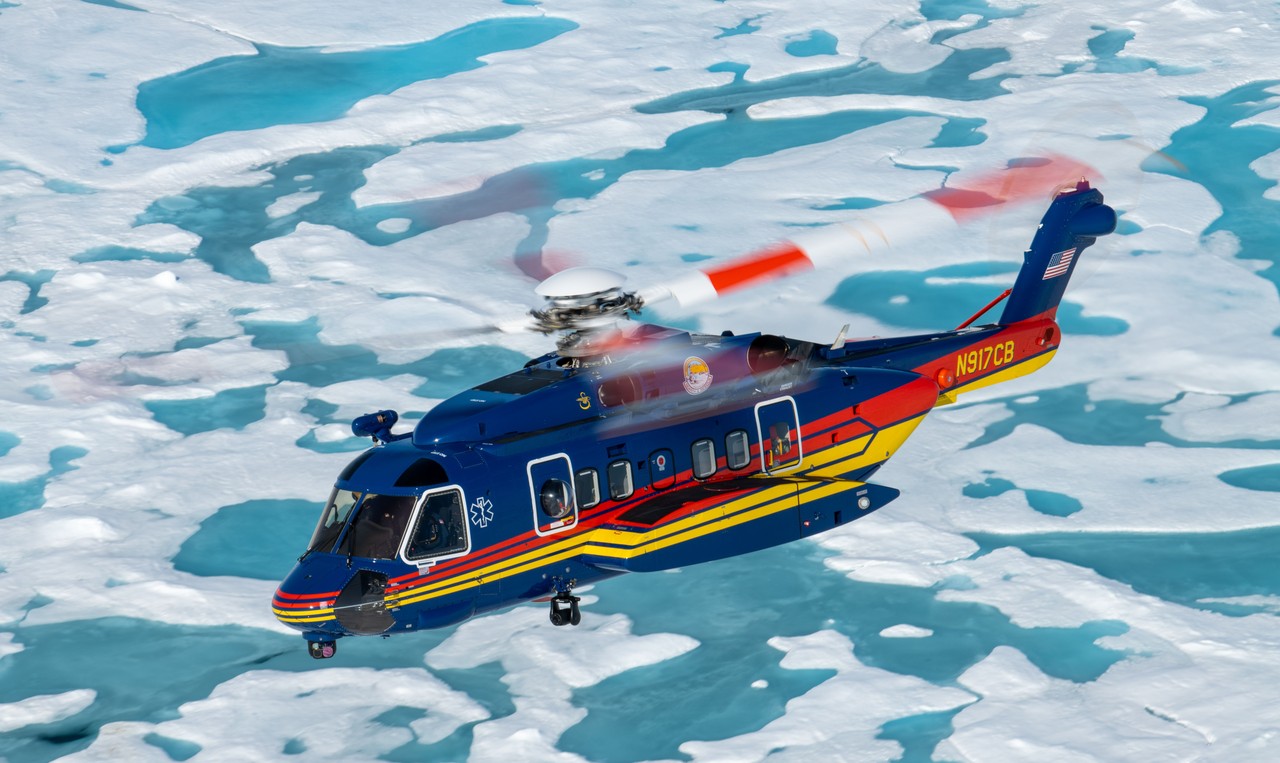
Development Origins
The S-92 emerged from Sikorsky's ambitious 1992 vision to create a "Growth Hawk" that would scale up their successful S-70 Black Hawk helicopter for commercial markets. By 1995, Sikorsky had assembled Team S-92, an international consortium including Mitsubishi Heavy Industries from Japan, Jingdezhen Helicopter Group from China, Gamesa from Spain, AIDC from Taiwan, and Embraer from Brazil. The program officially launched at the Paris Airshow that year, targeting markets dominated by the Aerospatiale Super Puma.
Five prototypes supported the development program, beginning with a ground-test article followed by four flying machines. The maiden flight occurred on December 23, 1998, at Sikorsky's Development Flight Center in West Palm Beach, Florida. During testing, engineers discovered significant improvements were needed - the third prototype incorporated a redesigned tail rotor configuration and a 16-inch nose extension to resolve flight trim issues.
Certification and Production
After a comprehensive 1,570-hour flight test program, the S-92 achieved FAA Part 29 type certification on December 19, 2002. European EASA certification followed on June 8, 2004. Launch customer PHI, Inc. received the first production S-92 in late 2004, marking the beginning of regular deliveries.
Sikorsky established final assembly operations at their Coatesville, Pennsylvania facility, but created an innovative international manufacturing network. The most significant partnership emerged in India, where Tata-Sikorsky Aerospace Limited began cabin production near Hyderabad in 2010. By October 2013, this facility had delivered 50 complete cabins and achieved production capacity of four cabins monthly, plus manufacturing 5,000 different components at a secondary facility. The 200th S-92 rolled off the production line in 2013.
Technical Innovation
Powering the S-92 are twin General Electric CT7 turboshaft engines, with early prototypes using 1,305-kilowatt CT7-6D engines before transitioning to production-standard CT7-8 powerplants. The helicopter retained proven dynamic components from the S-70 family while incorporating a completely new airframe designed for passenger comfort and operational efficiency.
The standard S-92A accommodates two pilots and up to 19 passengers in airline-style seating, though configurations vary based on mission requirements. In 2015, Sikorsky introduced the S-92 GWE (Gross Weight Expansion) variant, adding 1,200 pounds of additional payload capacity to meet growing operational demands.
Military Applications
The S-92's most prestigious military application became the VH-92A variant for U.S. presidential transport duties. Lockheed Martin partnered with Sikorsky on this specialized version, with Lockheed Martin handling mission systems integration while Sikorsky provided the base aircraft. The first test machine flew in 2017, followed by low-rate production authorization in 2021. Initial deliveries began in 2022, with the VH-92A achieving full operational service in 2024 as the new presidential helicopter.
Commercial Operations
Commercial S-92 operations span three primary markets: offshore oil and gas support, search-and-rescue missions, and executive transport. The helicopter's airline-style cabin and twin-engine reliability made it particularly attractive for offshore operators serving oil platforms in harsh environments like the North Sea and Gulf of Mexico.
Sikorsky developed a specialized S-92A VVIP variant for head-of-state transport, securing multiple international orders. Though this variant competed unsuccessfully in the U.S. VVX presidential helicopter competition against the EH-101, it found success with government customers seeking high-end executive transport capabilities.
The Manufacturer Legacy
Sikorsky Aircraft traces its origins to Igor Sikorsky, who built his first experimental helicopter in Russia in 1909 before immigrating to America and founding the company that would revolutionize rotorcraft design. Today, Sikorsky operates as part of Lockheed Martin's Rotary and Mission Systems division, continuing the innovation legacy established by its founder.
Current Status
Production continues at modest rates, with four aircraft delivered in 2022 and three in 2023, indicating sustained if limited market demand. The S-92 occupies a unique niche as one of the few helicopters designed specifically for airline-style passenger transport, competing in specialized markets where its combination of capacity, range, and twin-engine safety proves essential. While never achieving the mass-market success Sikorsky initially envisioned, the S-92 has established itself as the premium choice for operators requiring maximum passenger capacity and operational reliability in demanding environments.