
Development and Design Innovation
The S-97 Raider emerged from Sikorsky's ambitious 20-year development of X2 Technology, beginning with the original X2 Technology Demonstrator that flew from 2008 to 2011. Program launch occurred in October 2010, with construction of two initial prototypes beginning in late 2012. Aurora Flight Sciences delivered composite fuselages to Sikorsky in September 2013, leading to the first prototype rollout ceremony in October 2014.
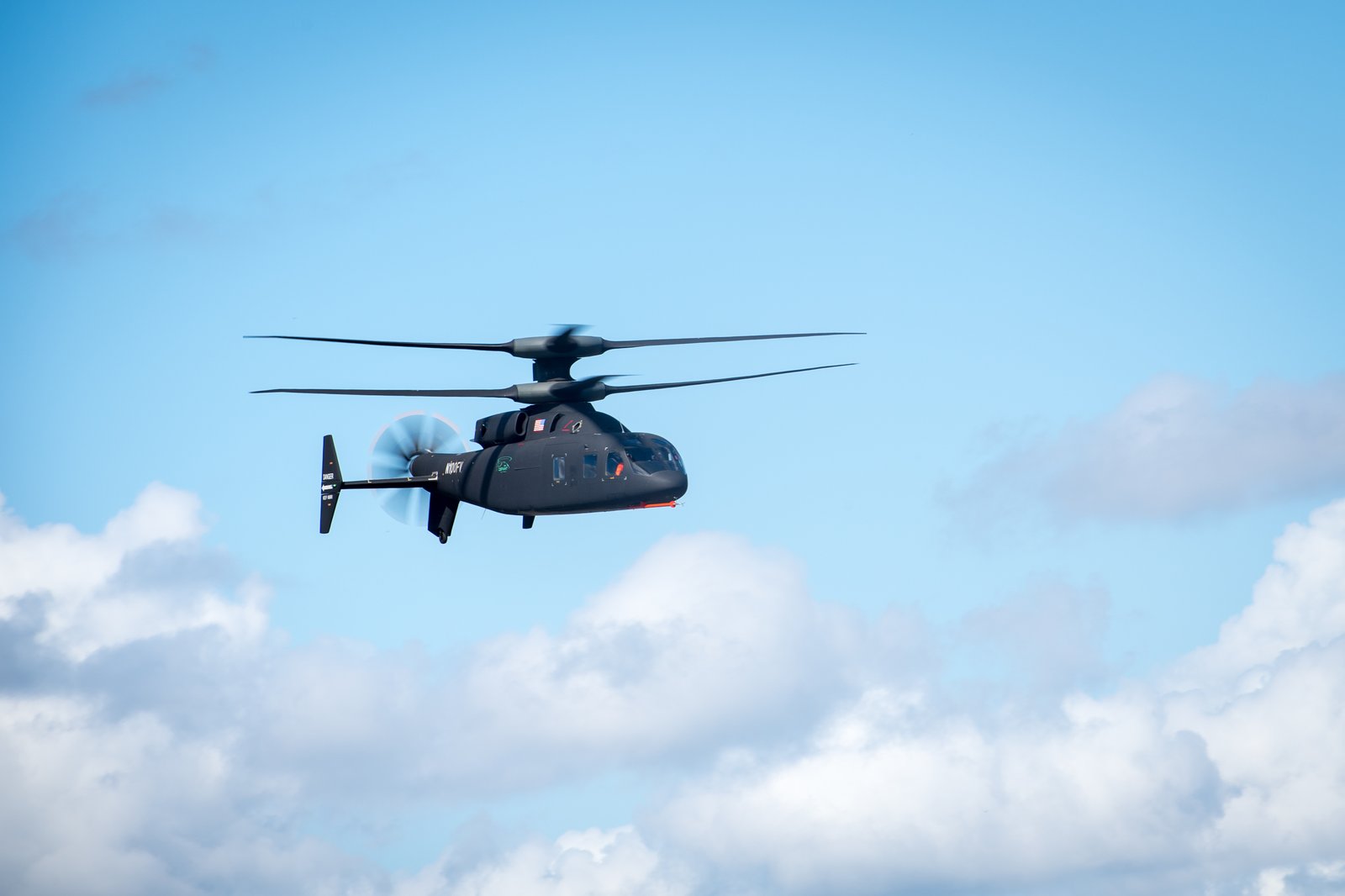
The revolutionary design combined twin coaxial main rotors—each equipped with four composite blades—connected to a split-torque transmission system and augmented by a six-bladed pusher tail rotor. This configuration enabled the aircraft to achieve helicopter-like hover capability while reaching fixed-wing aircraft speeds, addressing fundamental limitations that had constrained rotorcraft performance for decades.
Testing and Technical Validation
The maiden flight on May 22, 2015, marked the beginning of an intensive test program that would validate the X2 Technology concept. The first prototype successfully reached 150 knots during initial testing phases, demonstrating the viability of high-speed coaxial rotor flight. However, the program faced a significant setback in August 2017 when the first prototype suffered damage during a hard landing incident.
Recovery came in June 2018 when the second prototype returned to flight operations, continuing the validation mission. By January 2019, Sikorsky had confirmed construction of three test airframes total. A notable milestone occurred in July 2020 when the S-97 flew in formation with the SB-1 Defiant—Sikorsky's larger Future Vertical Lift demonstrator—at the company's West Palm Beach facility for Army evaluation.
Performance Capabilities
The S-97 Raider achieved impressive performance specifications that far exceeded conventional helicopter capabilities. With a maximum cruise speed of 253 mph (220 knots), the aircraft nearly doubled the speed of traditional rotorcraft while maintaining full hover capability. Service ceiling reached approximately 10,000 feet, with an operational range of 354 miles on internal fuel and mission endurance of 2 hours 40 minutes.
The troop transport configuration accommodated six fully equipped soldiers, making it suitable for light tactical missions requiring rapid insertion and extraction. The twin coaxial rotor system, with its reduced acoustic signature and improved turning radius compared to conventional helicopters, offered significant tactical advantages for military operations.
Engine and Technical Specifications
The original S-97 prototypes utilized General Electric T700 turboshaft engines, proven powerplants with extensive military service history. Plans called for upgrading to the more advanced General Electric T901 engine under the Army's Improved Turbine Engine Program (ITEP), which would have provided increased power output and improved fuel efficiency. The T901 upgrade became a mandatory requirement for the subsequent Future Attack Reconnaissance Aircraft competition.
Military Program Evolution
Rather than pursuing direct production, the S-97 served exclusively as a technology demonstrator within the U.S. Army's Future Vertical Lift initiative. In June 2019, the program transitioned to support the Future Attack Reconnaissance Aircraft Competitive Prototype (FARA CP) development effort. The Army awarded design contracts to five manufacturers in April 2019 for FARA candidates, establishing a target fielding date of 2028.
Competing as the "Raider X" variant in the FARA competition, the S-97 technology ultimately was not selected for production. Despite this outcome, the program successfully validated critical technologies that continue influencing modern helicopter development programs across the industry.
Manufacturing Heritage
Sikorsky Aircraft Corporation, operating as a Lockheed Martin subsidiary since 2015, brought decades of rotorcraft expertise to the S-97 program. The company's heritage traces back to Igor Sikorsky's pioneering helicopter work in the 1940s, including development of the world's first practical helicopter, the VS-300. Aurora Flight Sciences contributed specialized composite manufacturing capabilities, delivering lightweight yet durable fuselage structures that enabled the aircraft's high-speed performance.
Current Status and Legacy
The S-97 Raider program concluded its active flight testing phase with the aircraft now serving as a static display at Sikorsky's Development Flight Center in West Palm Beach, Florida. The first prototype, which completed the historic maiden flight in May 2015, is used for educational demonstrations and engineering reference.
The program's most significant achievement was proving that coaxial rotor systems could exceed 250 knots while retaining helicopter hover capability—a breakthrough that influenced subsequent rotorcraft designs including the competing SB-1 Defiant. This technological validation represents a critical milestone in the U.S. Army's modernization of attack and reconnaissance helicopter capabilities.
Though the S-97 never achieved production status, its technology demonstrator role successfully advanced the state of rotorcraft engineering. The X2 Technology principles validated through this program continue shaping next-generation helicopter designs, ensuring the Raider's influence on military aviation extends far beyond its three prototype airframes.