
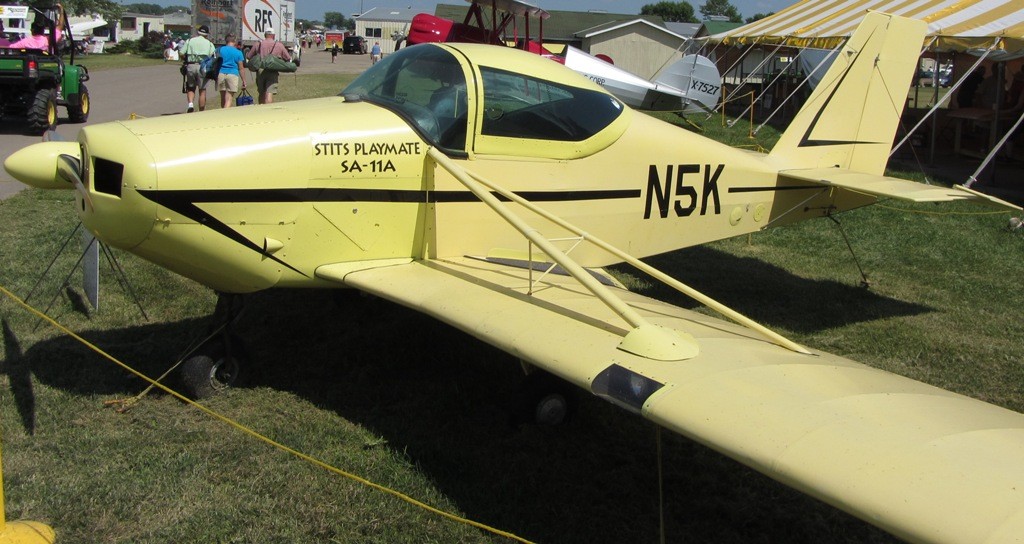
Revolutionary Design Innovation
The SA-11 Playmate's defining characteristic was its groundbreaking wing-folding system, which transformed how homebuilt aircraft could be stored and transported. Ray Stits engineered a mechanism that allowed pilots to fold and lock the wings in place within half a minute, complete with visual safety inspections to ensure proper locking. This innovation made the Playmate highly portable compared to conventional aircraft, enabling owners to trailer their planes home or store them in standard garages.
Ray Stits and the Homebuilt Movement
Ray Stits emerged as a pioneering figure in post-World War II homebuilt aviation, beginning his aircraft design career in 1948. By the time he developed the SA-11 in the early 1960s, Stits had established himself as an advocate for making aircraft design accessible to amateur builders. His philosophy centered on creating simple, inexpensive designs that ordinary aviation enthusiasts could construct in their workshops, democratizing an activity previously reserved for major manufacturers.
The SA-11 prototype made its maiden flight in 1963, representing Stits' vision of practical homebuilt aviation. Rather than pursuing complex high-performance designs, Stits focused on reliability, ease of construction, and innovative features that solved real-world problems for private aircraft owners.
Construction and Technical Specifications
The Playmate utilized a welded steel tubing fuselage covered with aircraft fabric, a construction method that balanced durability with buildability for amateur constructors. The low-wing configuration incorporated strut bracing and tricycle landing gear, providing stable ground handling characteristics important for recreational pilots. With an empty weight of 886 pounds and gross weight of 1,500 pounds, the aircraft offered a useful load of 614 pounds.
The Lycoming O-320 engine, producing 150 horsepower from its four air-cooled cylinders, became one of general aviation's most widely adopted powerplants. This engine choice reflected Stits' practical approach, selecting proven, readily available components rather than exotic alternatives. The aircraft's 24-gallon fuel capacity provided a range of 369 nautical miles at the cruise speed of 100 knots.
Performance Characteristics
Pilots found the SA-11 offered respectable performance for its category, with a maximum speed of 115 knots and an impressive rate of climb of 1,625 feet per minute. The service ceiling of 17,500 feet exceeded many comparable homebuilt designs, while the cruise speed of 100 knots provided efficient cross-country capability. These performance figures, combined with the folding wing convenience, made the Playmate attractive to recreational pilots seeking both capability and practicality.
Production and Distribution
Unlike traditional aircraft manufacturing, SA-11 Playmates were constructed by individual homebuilders using Stits plans rather than centralized factory production. This approach, typical of the homebuilt category, allowed builders to customize their aircraft while learning fundamental aviation construction techniques. Production records document SA-11A construction spanning from 1963 through 1995, with examples registered in 1970, 1971, 1975, 1976, 1980, and 1995.
Stits Aircraft produced plans and components for 374 aircraft across all company models, though the specific number of SA-11 Playmates remains undocumented in available records. The extended production period reflects the enduring appeal of the design among homebuilders.
Museum Preservation and Legacy
In 1969, Ray Stits donated the original SA-11 prototype to the EAA AirVenture Museum in Oshkosh, Wisconsin, where it remains preserved as an important example of 1960s homebuilt innovation. The prototype's Lycoming engine was subsequently transferred to power the Stits SA-9A "Skycoupe" prototype, demonstrating the practical, development-focused approach characteristic of homebuilt aviation.
The EAA AirVenture Museum houses one of the world's most comprehensive collections of homebuilt aircraft, and the SA-11's presence recognizes its significance in the movement's evolution. The aircraft represents a crucial period when designers like Stits were establishing the foundations of modern experimental aviation.
Contemporary Operations
Multiple SA-11A Playmates continue operating under private ownership throughout the United States and Canada. FAA registry records document numerous examples maintaining active or historical registrations, with at least one aircraft holding a valid airworthiness certificate extending through May 2027. These surviving aircraft testify to the soundness of Stits' design approach and the quality of construction achieved by homebuilders.
The SA-11 Playmate stands as a testament to the innovation possible within homebuilt aviation, proving that amateur designers could develop solutions to practical problems that even major manufacturers had not addressed. Its wing-folding mechanism influenced subsequent homebuilt designs and demonstrated how thoughtful engineering could expand aviation's accessibility to private owners facing storage and transportation challenges.