
Development and Design Philosophy
Ray Stits conceived the Flut-R-Bug series in 1955 as an evolution of his single-seat SA-5A design, developing the tandem two-seat SA-6 variant to meet growing demand for affordable homebuilt aircraft. The design philosophy centered on simplicity, transportability, and cost-effectiveness, with folding wings that allowed the aircraft to be towed behind an automobile for storage or transport to different airfields.
The SA-6's innovative pre-welded steel tube fuselage represented a significant advancement in kit aircraft construction, eliminating the need for amateur builders to perform complex welding operations. Stits Aircraft Company offered complete kits for $1,100 or plans alone for $35, making the design accessible to builders with varying budgets and skill levels.
Manufacturing and Production
Stits Aircraft Company operated from 1948 to 1965, with Ray Stits establishing himself as a pioneer in both aircraft design and fabric covering technology. His development of the Stits Process, later known as Polyfiber, revolutionized fabric aircraft covering and remains widely used today. The company sold plans for the SA-6 from August 1956 through April 1968, distributing 1,200 sets of plans worldwide alongside 27 complete kits.
Production reached international markets, with completed aircraft appearing across the United States, Europe, Australia, and New Zealand. The design's popularity stemmed from its combination of manageable construction requirements and practical features like the steerable nosewheel and full-span strip ailerons operated by external pushrods.
Technical Innovation
The SA-6 incorporated several design elements that would influence future homebuilt aircraft. The mid-wing configuration provided good ground clearance while maintaining stable flight characteristics, while the tricycle landing gear simplified ground handling compared to conventional tailwheel designs. Wings featured spruce spars with fabric covering, combining traditional construction methods with modern materials.
Engine installations typically used the Continental A65 producing 65 horsepower, though builders later experimented with Continental C-85-12F and Lycoming O-235 variants. Some ambitious constructors installed Porsche automotive conversions producing 95 horsepower, addressing the aircraft's modest performance with standard powerplants. A Sensenich two-bladed propeller measuring six feet in diameter provided efficient thrust conversion.
International Impact
The SA-6 achieved particular significance in Australia, where it earned recognition as the catalyst for the country's amateur-built aviation movement. VH-ULA, constructor number 122, received Australia's first post-war ultralight Certificate of Airworthiness in March 1958 after just 200 man-hours of assembly time. This aircraft later carried registration 19-7633 and remained active into the 2010s.
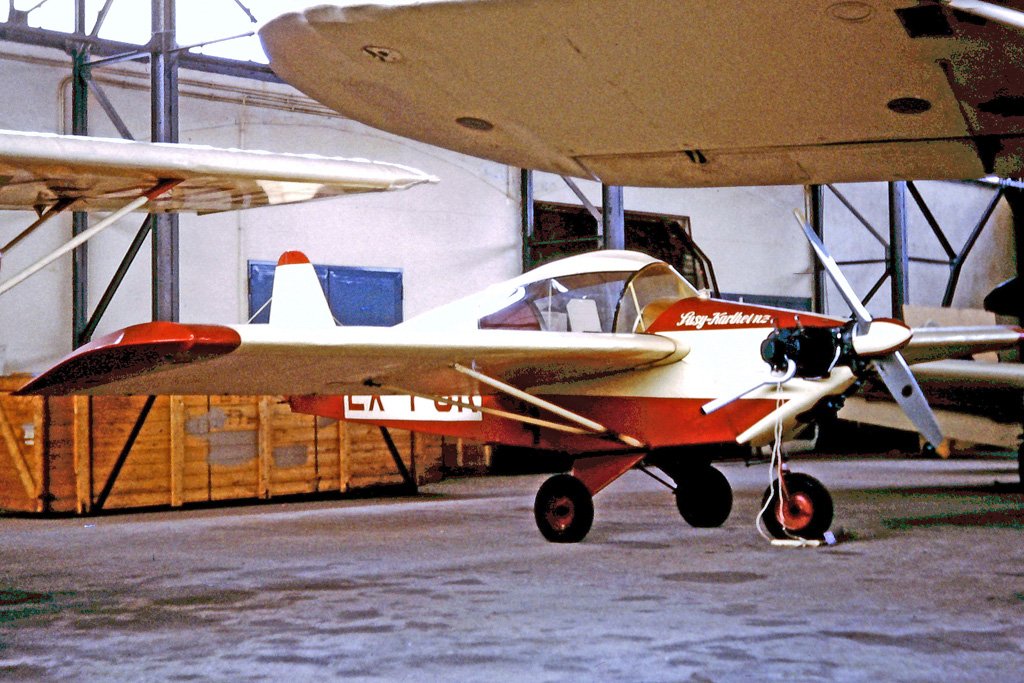
A second Australian example, VH-ULB, first flew in October 1959 and received registration on November 12 of that year. After sustaining damage at Aldinga on December 1, 1984, it was rebuilt and re-registered as 28-3193 in July 1999. European adoption included LX-PUR, photographed at Luxembourg Airport in 1965, demonstrating the design's international appeal.
Operational Characteristics
With an empty weight of 528 pounds and nine-gallon fuel capacity, the SA-6 offered economical operation suitable for recreational flying and basic training. The aircraft's towable design allowed owners without hangar access to store their aircraft at home and transport them to airports as needed. This feature proved particularly valuable in countries like Australia, where long distances between population centers made aircraft mobility important.
Pilots found the SA-6 forgiving to fly, though performance remained modest with the standard 65-horsepower installation. The tricycle gear configuration reduced ground handling challenges compared to tailwheel aircraft, making it suitable for pilots transitioning from training aircraft to homebuilt ownership.
Safety Record and Modifications
Between 1972 and 1994, aviation safety databases recorded nine incidents involving SA-6 aircraft, including two fatal accidents. N6733C crashed near Clear Lake, California on April 14, 1974, while N3HW was involved in a fatal accident at Big Creek, Idaho on July 20, 1986. These incidents reflected typical general aviation accident patterns rather than design-specific issues.
Later modifications addressed stability and performance concerns, with builders adding enclosed canopies, enlarged tail surfaces, and improved fairings. Engine upgrades became common as more powerful lightweight engines became available to homebuilders.
Legacy and Influence
The Flut-R-Bug series established important precedents for the homebuilt aircraft industry that emerged in subsequent decades. Its complete kit approach, pre-welded structures, and emphasis on transportability influenced later manufacturers including Van's Aircraft, whose RV series adopted similar construction philosophies. Ray Stits' innovations in both aircraft design and fabric covering technology left lasting impacts on amateur aviation that extended far beyond his company's 1965 closure.
Today, few SA-6 aircraft remain active, though examples continue flying in Australia and potentially other countries. The design's historical significance as a pioneer of accessible homebuilt aviation ensures its place in amateur aviation history, representing the transition from post-war surplus aircraft to purpose-built recreational designs.