
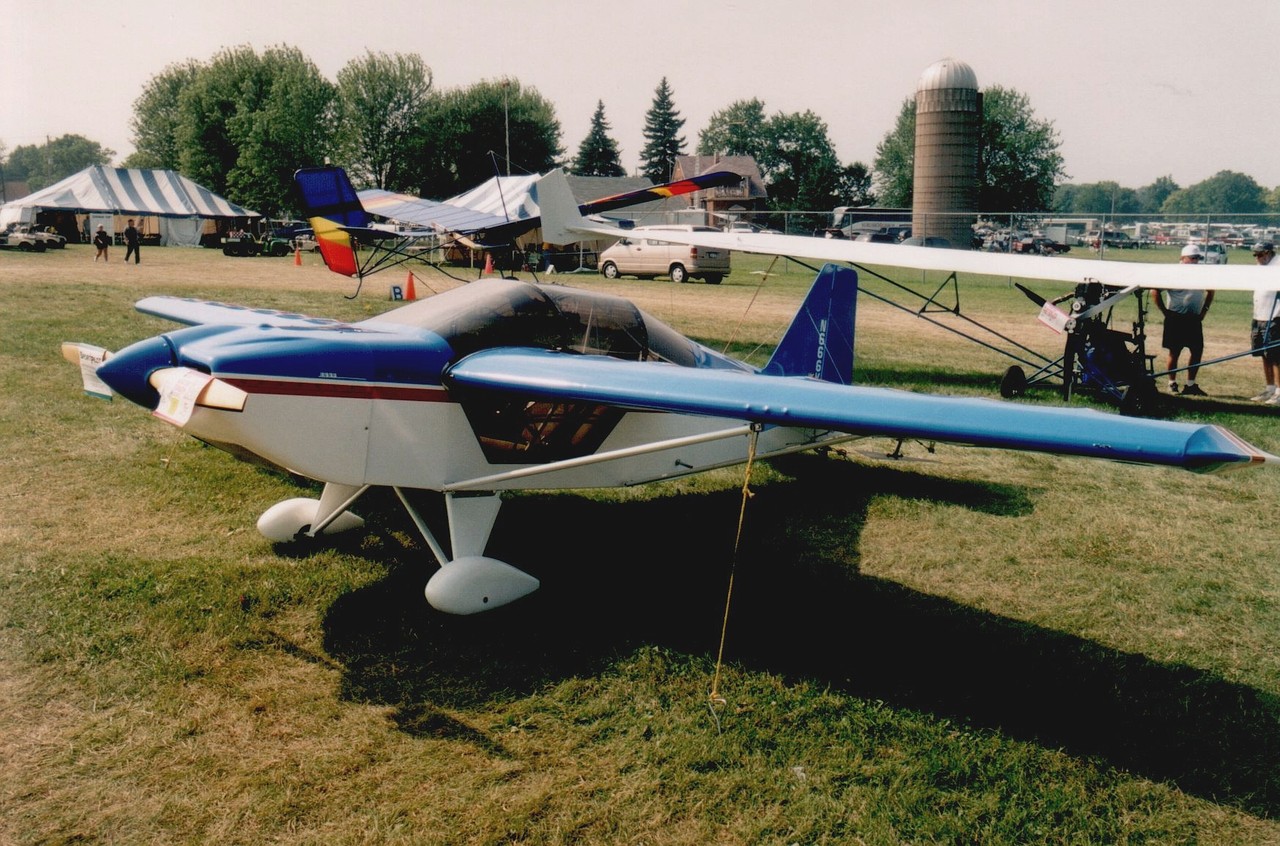
Design Philosophy and Development
Randy Schlitter conceived the S-10 Sakota in the late 1980s as an evolution of his single-seat RANS S-9 Chaos, which first appeared in 1986. Schlitter's design objectives centered on creating an affordable aerobatic aircraft that amateur builders could construct in their garages. The Sakota addressed a specific gap in the homebuilt market: most aerobatic aircraft required significant building experience and substantial financial investment, placing them beyond reach of typical sport pilots.
The aircraft employed a welded steel tube fuselage with fabric covering, a construction method that balanced structural integrity with buildability. Its mid-wing configuration provided excellent aerobatic characteristics while maintaining docile handling for cross-country flight. The compact design measured 21 feet 2 inches in length with a 24-foot wingspan, creating an 8.82 square meter wing area that generated a wing loading of 49 kilograms per square meter.
Production and Manufacturing
RANS Inc. launched S-10 production in 1988 from their facility in Hays, Kansas. The company focused exclusively on kit aircraft for the experimental and ultralight categories, targeting pilots who valued performance over certified aircraft restrictions. During its production run, which extended into the early 2000s, RANS delivered more than 250 kits worldwide, with some sources indicating 215 factory-built examples.
Individual builders continued completing their projects well beyond the initial production period, with documented first flights occurring as late as 2003. The extended completion timeline reflected the aircraft's appeal to weekend builders who constructed their Sakotas over periods spanning several years. Kit completions were registered through the 1990s across multiple countries, demonstrating the design's international appeal.
Powerplant Evolution
The S-10 Sakota initially employed the Rotax 582, a two-stroke engine producing between 48 and 65 horsepower. This powerplant, manufactured by BRP-Rotax GmbH in Austria, provided adequate performance for the aircraft's 460-510 pound empty weight while maintaining the simplicity valued by homebuilders. Early Sakota examples equipped with the 582 achieved cruise speeds of 93 mph and stall speeds as low as 44 mph.
As four-stroke technology advanced, many builders upgraded to the Rotax 912 series engines. The 912, 912A, 912S, and 912ULS variants offered 80 to 100 horsepower from their four-cylinder horizontally-opposed configuration. This powerplant transformation significantly enhanced the Sakota's capabilities, increasing cruise speed to 120 mph and extending range to 540 miles. The four-stroke engines also provided improved reliability and smoother operation, making the aircraft more suitable for extended cross-country flights.
Performance and Handling
The Sakota's aerobatic credentials distinguished it from typical homebuilt aircraft. Stressed for +6G and -4G loads during solo aerobatic flight, the aircraft could perform the full range of basic aerobatic maneuvers including loops, rolls, and inverted flight. Its 900 to 1,640 feet per minute climb rate provided adequate vertical performance for aerobatic sequences, while the 14,000-foot service ceiling offered sufficient altitude for extended routines.
Cross-country capability matched the aircraft's aerobatic performance. With fuel capacity ranging from 8 to 18 gallons depending on configuration, pilots could plan flights covering 124 to 540 miles. The taildragger landing gear configuration enabled operations from short grass strips, with takeoff and landing rolls between 200 and 400 feet. This short-field performance expanded operational flexibility beyond paved airport requirements.
International Distribution
The S-10 Sakota achieved global distribution despite its American origins. In Australia, the first example registered as VH-SUX with constructor number 1089063 in May 1997. New Zealand recorded four S-10 registrations, all remaining current as of 2014. British examples included G-BTWZ registered in 1998, G-BWIA, and G-BSWI registered in 1993, demonstrating sustained European interest throughout the 1990s.
This international presence reflected the aircraft's adaptability to different regulatory environments and flying conditions. The Sakota's classification as an experimental or ultralight aircraft in most jurisdictions simplified certification requirements, enabling builders to register their completed aircraft without extensive bureaucratic procedures.
Legacy and Current Status
RANS Inc. discontinued S-10 production by the early 2010s, with the company apparently ceasing operations or restructuring significantly. However, the Sakota's influence on homebuilt aviation extends beyond its production numbers. The design demonstrated that aerobatic capability could be packaged in an accessible, affordable kit aircraft, inspiring subsequent generations of similar designs.
Today, examples remain active across multiple continents. New Zealand maintains four airworthy S-10s as of 2014, while others continue flying in the United States, Australia, and Europe. The aircraft appears in aviation safety databases with recorded incidents including G-BSWI on October 26, 1993, and N104AH on October 15, 1994, typical of the operational history expected from an amateur-built aerobatic aircraft.
The Sakota's contribution to amateur aviation lies in its democratization of aerobatic flying. By providing +6G capability in a kit costing significantly less than certified aerobatic aircraft, the S-10 enabled sport pilots to experience inverted flight and aerobatic maneuvers previously reserved for those with substantial financial resources or military training backgrounds.