
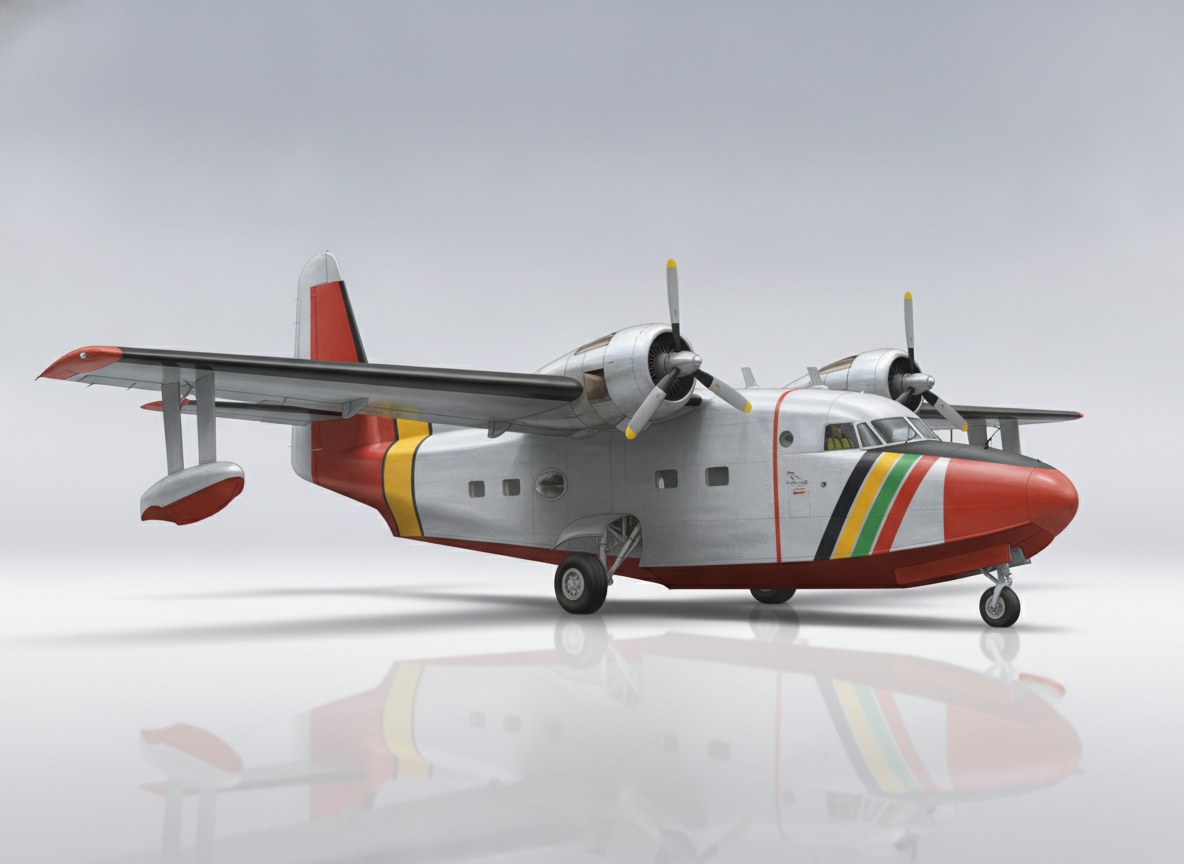
Service Dominance
The Albatross established itself as the premier amphibious rescue aircraft of its generation, with over 900 successful aircrew recoveries during the Korean War alone. United States Air Force SA-16A variants proved their worth in missions ranging from downed pilot extraction to ice flow surveillance, while Coast Guard UF-2G models became synonymous with maritime rescue operations until their retirement in March 1988. The aircraft's versatility extended beyond rescue work, serving roles in VIP transport, cargo hauling, and anti-submarine warfare across more than 20 nations.
Military Operations
During the Korean conflict from 1950 to 1953, USAF SA-16 and SA-16A models demonstrated exceptional capability in hostile environments, conducting water landings under enemy fire to retrieve downed airmen. The type continued this mission profile throughout the Vietnam War, operating from both water and prepared airstrips until helicopters eventually assumed primary rescue duties. Naval variants included the UF-1 for the U.S. Navy and specialized UF-2 long-wing models for the Japanese Maritime Self-Defense Force, delivered between February and May 1961.
The Manufacturer
Grumman Aircraft Engineering Corporation, founded in 1929, drew upon decades of amphibious aircraft expertise when developing the Albatross. The company had previously created successful water-capable designs including the Goose and Mallard, establishing a reputation for rugged marine aircraft construction. During World War II, Grumman's fighter aircraft like the F4F Wildcat and F6F Hellcat proved the company's engineering capabilities, experience that directly influenced the Albatross's robust design philosophy. Following Grumman's 1994 merger with Northrop to form Northrop Grumman Corporation, the amphibious aircraft legacy continued under the new corporate structure.
Manufacturing Excellence
Production commenced in August 1949 at Grumman's Bethpage, New York facility, with an innovative approach that saw Chrysler Corporation manufacturing hulls for the first 227 airframes through serial G364. This partnership allowed Grumman to focus on final assembly and systems integration while leveraging Chrysler's manufacturing capacity. Of the 466 total aircraft produced, 443 emerged as factory-delivered short-wing variants, while 21 received the improved long-wing configuration directly from the production line.
Engine and Technical Innovation
Twin Wright R-1820-76B nine-cylinder radial engines provided 1,425 horsepower each, delivering the thrust necessary for short-field takeoffs from both land and water surfaces. These proven powerplants, with over 75,000 examples built across all variants, had demonstrated reliability in World War II aircraft including the Douglas SBD Dauntless. The supercharged engines enabled operations at altitudes up to 23,800 feet while maintaining the low-speed handling characteristics essential for water operations.
Performance Characteristics
Pilots praised the Albatross for its stability during water landings and takeoffs, a critical factor in rough sea conditions during rescue missions. The aircraft achieved a maximum speed of 230 miles per hour while cruising efficiently over its 1,650-mile range, allowing extended patrol missions far from base. The high-wing configuration provided excellent stability and visibility, essential characteristics for search operations and precision water approaches.
Production Evolution
Significant improvements arrived with long-wing variants beginning in 1957, when 242 existing short-wing aircraft underwent conversion to the extended wingspan configuration. These modifications included 89 USAF SA-16B conversions starting in January 1957, followed by 79 Coast Guard UF-2G conversions beginning in April 1957. International operators received purpose-built long-wing aircraft, including 10 CSR-110 variants for the Royal Canadian Air Force delivered between September 1960 and March 1961.
Legacy and Preservation
By the 1980s, over 20 Albatross aircraft remained in service with foreign operators, though exact current airworthy numbers are limited. Notable preserved examples include SA-16B serial number 51-7254 at the Travis Air Force Base Aviation Museum in Fairfield, California, acquired in June 1989. The type's influence extended to experimental programs, including the Conroy Turbo Albatross prototype that first flew on February 25, 1970, featuring Rolls-Royce Dart turboprop engines, though no additional examples were produced.