
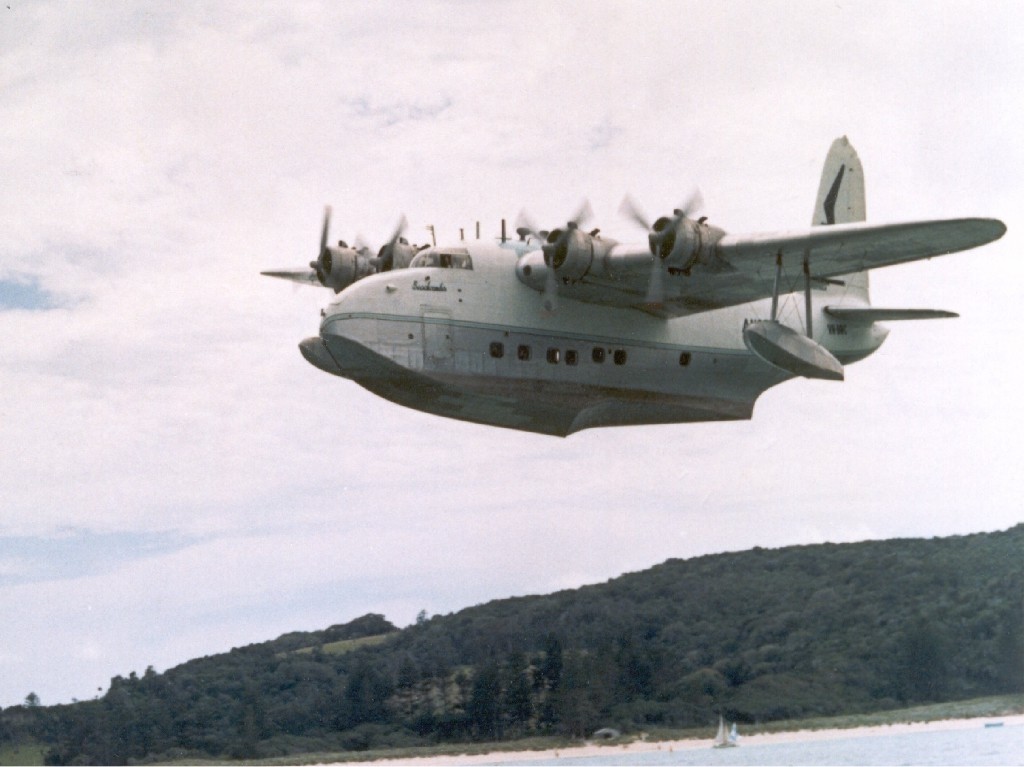
Service History
The Sandringham entered commercial service with Tasman Empire Airlines (TEAL) in September 1946, operating four aircraft leased from the British Ministry of Supply. These flying boats replaced TEAL's two S.30 Flying Boats on the demanding Tasman route, flying from Waitemata Harbour in Auckland to Rose Bay in Sydney. The airline rapidly expanded operations from 9 scheduled services per fortnight in August to daily services except Sunday by September's end, demonstrating the immediate demand for reliable trans-Tasman passenger service.
BOAC had previously operated 24 Sunderland Mk.III transport variants during World War II, which were refurbished to airline standards and designated the 'Hythe' class before some received Sandringham conversions. This military heritage provided the foundation for civilian operations, though the transition proved more challenging than anticipated.
Operational Challenges
The Sandringham's commercial service revealed significant limitations that foreshadowed the end of the flying boat era. The unpressurized aircraft could not exceed 10,000 feet altitude, forcing crews to fly through rather than above the notorious weather systems that plagued the Tasman Sea crossing. Engine overheating problems compounded operational difficulties, creating reliability issues that threatened passenger safety.
On December 3, 1947, aircraft ZK-AME experienced catastrophic engine failure, descending to within 100 feet of the sea surface before crew members arrested the descent by jettisoning freight, mail, and passenger luggage. This near-disaster prompted a commission of inquiry that discovered irregularities in the Certificate of Airworthiness, including missing performance data that the manufacturer had failed to provide.
TEAL grounded all four Sandringhams on February 23, 1948, while engineers resolved mechanical problems and regulatory authorities addressed certification issues. Modifications to engine cowling and baffles solved some overheating problems, allowing operations to resume on June 17, 1948, though the aircraft's fundamental limitations remained.
The Manufacturer
Short Brothers, founded in 1908, established itself as Britain's premier flying boat manufacturer during the interwar period. The company operated from facilities in Rochester and Belfast, where Sunderland-to-Sandringham conversions occurred before aircraft flew to their operational destinations. Short Brothers had designed the original Sunderland in response to Air Ministry specification R.2/33 in the early 1930s, creating a robust military platform that proved adaptable to civilian use.
The company's expertise in marine aircraft design stemmed from successful designs including the S.23 Empire flying boats, which pioneered long-distance passenger service across the British Empire. Short Brothers continues operating today as part of Bombardier Aerospace, though the original company underwent significant transformation through decades of mergers and acquisitions that ended its independence.
Engine and Technical Details
Most Sandringhams utilized four Pratt & Whitney R-1830 Twin Wasp engines, 14-cylinder radial air-cooled powerplants producing 1,200 horsepower each. Only the first conversion, designated Mk.I, retained Bristol Pegasus XXIII engines from its Sunderland configuration. The Twin Wasp installation provided superior performance and reliability, with engines already proven on RAF Consolidated Catalinas and Douglas Dakotas, simplifying maintenance logistics.
The Twin Wasp engines offered a critical safety advantage over Pegasus-powered aircraft: a Sandringham could maintain flight even with two engines failed on the same wing, while Pegasus variants would steadily lose altitude in similar circumstances. This capability proved essential for overwater operations where emergency landing options remained limited.
Sandringham conversions featured streamlined nose and tail structures replacing military fairings, improved windscreen design, and a mooring compartment similar to the earlier S.23 Empire boats. The luxurious interior accommodated passengers across two decks, with dedicated spaces for dining and socializing that reflected the era's emphasis on comfort during long-distance travel.
Production and Legacy
Short Brothers never manufactured new Sandringhams, instead converting 29 existing Sunderland airframes at their Belfast facility. The first conversion, completed in November 1945 from former BOAC transport G-AGKX (ex-military ML788), established the template for subsequent modifications. This conversion approach reflected postwar economic constraints and abundant surplus military aircraft availability.
The Sandringham's brief commercial career ended when more advanced Short Solent IV flying boats entered TEAL service in November 1949. The last scheduled Sandringham service occurred on December 19, 1949, flown by ZK-AME—ironically the same aircraft that had nearly crashed two years earlier. This final flight symbolized the end of an era, as land-based airliners increasingly dominated long-distance routes previously served by flying boats.
The Sandringham's legacy lies in demonstrating both the potential and limitations of converting military aircraft for civilian service. While the conversions provided immediate postwar passenger capacity, their operational challenges highlighted the need for purpose-designed commercial aircraft that could operate reliably above weather systems and provide the safety margins passengers expected.