
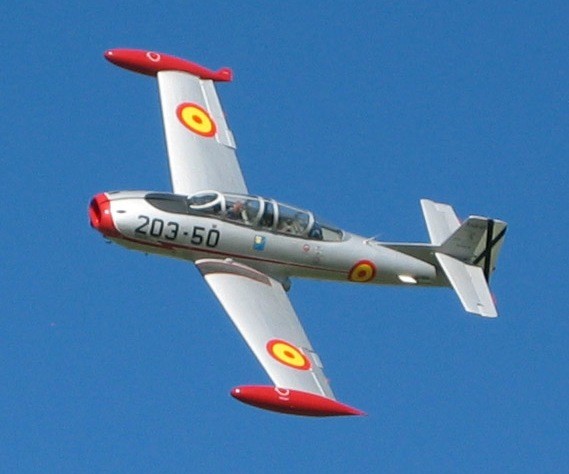
Design and Development
The HA-200 Saeta emerged from Spain's determination to develop indigenous jet aircraft capability in the 1950s. Willy Messerschmitt, the legendary German designer who relocated to Spain in 1951, led the design team that included Spanish engineers Juan de la Cruz Martín-Albo and Rafael Rubio Elola. Working at Hispano Aviación's facilities in Tablada, the team incorporated lessons learned from their earlier HA-100 piston-powered trainer project into this revolutionary jet design.
Major Fernando de Juan Valiente piloted the prototype's maiden flight on August 12, 1955, launching Spain into the jet age. The aircraft's development represented more than technological achievement—it symbolized Spain's post-Civil War industrial recovery and growing aviation expertise.
Production and Variants
Production commenced systematically with a pre-production series of ten aircraft ordered in 1957. The Spanish Air Force demonstrated confidence in the design by ordering thirty HA-200A basic trainers in 1959, followed by fifty-five improved HA-200D variants in 1963. The final major order came in 1970 with twenty-five single-seat HA-220E ground attack variants, bringing total Spanish production to 120 aircraft.
Egypt became the Saeta's only export customer, initially receiving ten HA-200B aircraft before establishing licensed production. The Egyptian facility manufactured ninety additional examples under the designation Helwan Al-Kahira, demonstrating the design's international appeal and technical transferability.
Specialized variants expanded the aircraft's mission profile. The HA-200E Super Saeta featured upgraded Turbomeca Marboré IV engines and modernized avionics. Several HA-220E aircraft were later converted to AR.10C photo-reconnaissance variants, showcasing the design's adaptability to diverse operational requirements.
The Manufacturer
Hispano Aviación inherited a complex legacy when it emerged from the former Hispano-Suiza group following the Spanish Civil War. Under Nationalist government control, the company initially focused on licensed production, manufacturing Spanish variants of the Messerschmitt Bf 109G designated HA-1109. This experience with German aircraft technology proved invaluable when Messerschmitt himself joined the company.
The company's Tablada facility became Spain's center for advanced aircraft development during the 1950s and 1960s. However, Hispano Aviación eventually ceased independent operations, being absorbed into larger Spanish aviation enterprises as the industry consolidated.
Technical Excellence
The Saeta's twin Turbomeca Marboré II F3 turbojets, produced under French license in Spain, provided reliable power with excellent fuel efficiency for training operations. Each engine delivered 1,057 pounds of thrust, propelling the 7,937-pound aircraft to a maximum speed of 429 mph and a service ceiling of 42,651 feet.
Measuring 29 feet 5 inches in length with a 34-foot 2-inch wingspan, the aircraft offered excellent handling characteristics for pilot training. Its rate of climb of 3,345 feet per minute and range of 932 miles provided adequate performance for both basic jet familiarization and advanced tactical training missions.
Combat Service
The HA-200 proved its combat worthiness during the Western Sahara Wars of the 1970s, where Spanish Air Force pilots employed the aircraft against Polisario Front forces. These operations represented the type's only confirmed combat missions, as Egyptian examples appear to have served exclusively in training roles.
Spanish Air Force service began in late 1962 and continued through the early 1980s. The aircraft successfully bridged Spain's transition from piston-powered trainers to modern jet instruction, preparing pilots for advanced fighters and attack aircraft. Ground attack variants demonstrated the design's versatility, carrying limited ordnance loads for close air support missions.
Legacy and Preservation
Several Saetas survive in museum collections worldwide, testament to their historical significance. The Flugmuseum Messerschmitt in Manching, Germany displays HA-200D serial 20/73, manufactured in 1966 and operated by the Spanish Air Force until 1981. The Messerschmitt Stiftung acquired and restored this example in 1995.
American museums also preserve the type. The Planes of Fame Air Museum displays HA-200A N212AM, manufactured in 1965, while March Field Air Museum recently acquired HA-200A N390WW, formerly assigned to the Spanish Air Force's 203 Squadron. This aircraft, imported to the United States in the 1980s, is currently undergoing restoration to original Spanish Air Force livery.
The HA-200 Saeta stands as a remarkable achievement in aviation history—Spain's first indigenous jet aircraft that successfully served in multiple roles across two decades. Under Messerschmitt's guidance, Spanish engineers created an aircraft that not only met their nation's training requirements but also demonstrated Spain's capability to compete in the international aviation market.