
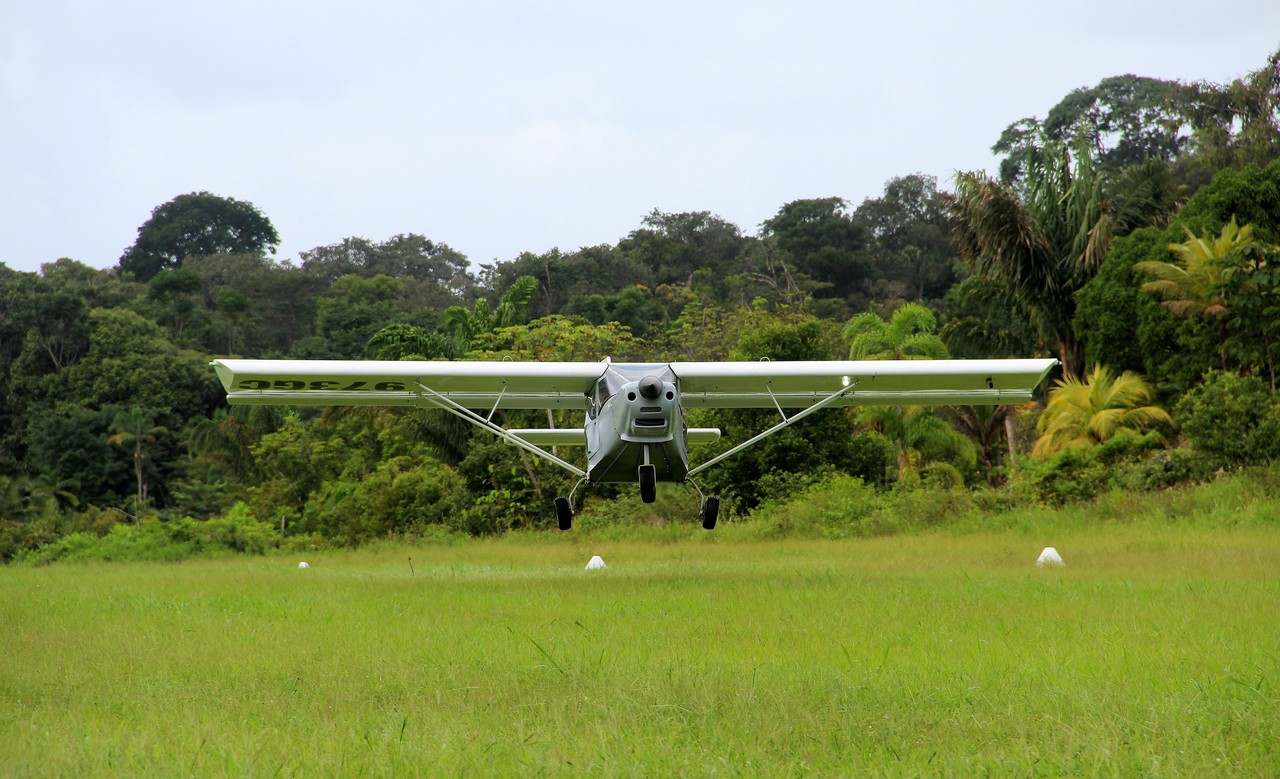
Design Innovation
Bill Sadler, an MIT-educated engineer with over 25 years of aircraft design experience, created the Vampire to address the ultralight community's need for a high-performance aircraft that could be easily transported. The pod-and-boom configuration featured an all-aluminum airframe construction that was ahead of its time, with foldable wings enabling owners to trailer the aircraft to flying sites. The original design specifications called for an empty weight of just 247 pounds while maintaining structural integrity under extreme aerobatic loads of positive and negative 6Gs.
Production History
Sadler Aircraft began production in the mid-1980s in the United States, completing approximately 28 aircraft before an industry downturn forced cessation of civilian operations. Production rights subsequently transferred to Australia, where Skywise Ultraflight Pty Ltd manufactured around 30 examples at Bankstown, New South Wales, during the late 1980s. After a production hiatus, manufacturing resumed in 2005 at Albion Park, with at least two aircraft completed before operations moved to Narellan in 2015. Wedgetail Aircraft acquired the rights in late 2016, establishing production at Camden and completing at least one additional aircraft that was displayed at the Oshkosh fly-in at Narromine in 2016.
Variants and Evolution
The Vampire series evolved through multiple iterations to meet changing regulations and market demands. The initial SV-1 variant utilized a 22-kilowatt KFM 107 Maxi two-cylinder two-stroke engine, while the SV-2 featured the more powerful 31-kilowatt Rotax 447UL-2V fan-cooled powerplant. Later Light Sport Aircraft versions incorporated the four-stroke Rotax 912 engine producing 100 horsepower, driving a three-blade Ivoprop propeller and achieving maximum speeds of 222 kilometers per hour.
Military Applications
Bill Sadler leveraged the Vampire's design for military applications, most notably the Piranha variant developed in 1997 for Turkish Aerospace Industries. This 1,450-pound air-to-ground attack fighter featured an enclosed Kevlar cockpit with bullet-resistant protection, wing-root machine gun installations, and underwing hardpoints for ordnance. Powered by a modified 450-horsepower Chevrolet V8 aluminum-block engine, the Piranha achieved vertical climb rates exceeding 4,000 feet per minute. A UAV variant designated GA-5 Warfang or UAV-18-50 underwent prototype testing, with one country conducting military evaluations, though no production contracts materialized.
Technical Performance
The Vampire's performance characteristics varied significantly across variants. Light Sport Aircraft versions equipped with the Rotax 912S engine achieved cruise speeds of 100 knots with maximum speeds reaching 120 knots, while maintaining climb rates of 1,000 feet per minute. The aircraft featured tricycle landing gear with trailing-link suspension and a steerable nose wheel, providing stable ground handling characteristics. The folding wing mechanism allowed the 30-foot wingspan to be reduced for road transport, a critical feature for ultralight operators with limited hangar access.
Legacy and Current Status
With at least 55 examples completed across all manufacturers, the Vampire series represents a significant achievement in ultralight aviation design. The type's 1982 EAA Grand Champion Award recognized its innovative approach to combining performance with practicality. Bill Sadler's subsequent involvement with General Atomics' Predator drone program in the late 1980s and early 1990s demonstrated how ultralight innovations could influence military unmanned aircraft development. Several examples remain airworthy today, including experimental and LSA category aircraft, though exact numbers of flying aircraft are not documented. The design's influence on foldable-wing ultralights and its bridge between sport and tactical aviation applications secured its place in aviation history as a pioneering concept that pushed the boundaries of lightweight aircraft performance.