
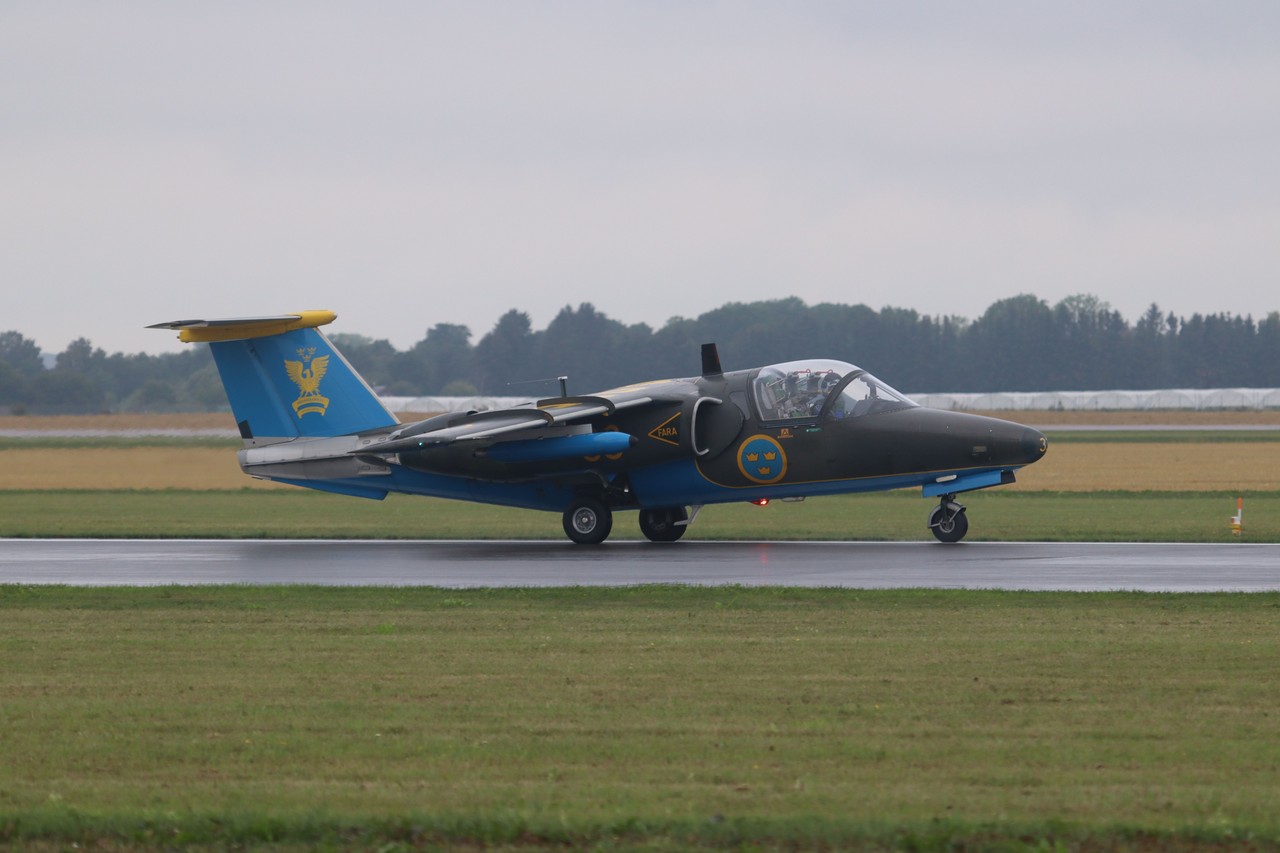
Development and Design
The Saab 105 emerged from an ambitious private venture launched by Svenska Aeroplan AB in 1959, targeting both military training and civilian business aviation markets. Chief designer Björn Leijonhufvud led the engineering team in creating a remarkably versatile aircraft intended to replace aging de Havilland Vampires in Swedish Air Force service while offering potential as a four-to-five seat business jet.
The design incorporated several innovative features for its era, including a shoulder-mounted wing with anhedral angle, distinctive T-tail configuration, and compact twin-jet layout. The side-by-side seating arrangement departed from conventional tandem trainer configurations, enhancing communication between instructor and student while maintaining excellent visibility for both occupants.
Test pilot Karl-Erik Fernberg lifted the first prototype into the air on June 29, 1963, marking the beginning of a development program that would span nearly two years before the second prototype followed on June 17, 1964. Early flight testing revealed generally favorable handling characteristics, though one prototype was lost in 1966 during spin trials, with the pilot successfully ejecting to safety.
Military Service and Variants
The Swedish Air Force became the primary operator, receiving 150 aircraft designated Sk 60 in various configurations between 1966 and 1969. The first delivery reached F 5 Ljungbyhed in April 1966, with student training operations commencing on July 17, 1968. Swedish variants included the Sk 60A four-seat trainer and liaison aircraft, the Sk 60B twin-seat attack version, and the Sk 60C reconnaissance variant equipped with nose-mounted cameras.
Austria emerged as the sole export customer, acquiring 40 aircraft designated 105OE beginning in July 1970. These aircraft replaced the Austrian Air Force's aging Saab 29 Tunnans and Vampires, serving in training, air defense, and specialized atmospheric sampling roles using pods designed to detect radioactivity and environmental pollutants. The Austrian variants featured reinforced wings and General Electric J85-17B engines producing 1,638 pounds of thrust each, compared to the Swedish-licensed RM9 engines used in domestic variants.
Powerplant Evolution
The Saab 105's engine history reflects the challenges of small-nation aircraft development. Initial prototypes utilized French Turboméca Aubisque turbojets producing 1,642 pounds of thrust each. Sweden licensed this engine for domestic production as the RM9, though early reliability issues required modifications that were not fully resolved until 1968.
While adequate for training missions, the original powerplants proved somewhat underpowered for heavy combat loads. The Austrian export model addressed this limitation by adopting proven General Electric J85-17B engines, the same powerplant that equipped the successful Northrop T-38 Talon trainer.
Recognizing the need for improved performance and reduced operating costs, Sweden launched an ambitious upgrade program in the 1990s. Between 1993 and 1998, approximately 115 aircraft received new Williams FJ44-2A turbofan engines, creating the Sk 60W variant. The first upgraded aircraft flew in August 1995, demonstrating significant improvements in thrust, fuel efficiency, and noise reduction.
The Manufacturer's Legacy
Svenska Aeroplan AB, founded in 1937, had established itself as a capable military aircraft manufacturer through designs like the Saab 21 fighter and J 29 Tunnan. The company expanded into automobile manufacturing in 1947, operating both divisions until divesting the car business in 1990. Following various ownership changes, including partial acquisition by BAE Systems in 1998, the aviation division emerged as the independent Saab AB, which continues operations today as a major defense and aerospace contractor.
Operational Performance
Pilots generally praised the Saab 105's handling characteristics, particularly its suitability for aerobatic training and its forgiving flight envelope. The aircraft demonstrated a maximum speed of 970 kilometers per hour and impressive range of 2,300 kilometers, with a service ceiling exceeding 13,700 meters. The side-by-side seating arrangement proved popular with instructors, facilitating better communication and supervision compared to tandem configurations.
End of an Era
Production concluded in 1969 after just 192 aircraft, limiting the type's global impact despite its technical merits. The Swedish Air Force operated their Sk 60 fleet for an impressive 57 years, with retirement occurring around 2020-2025. Austria retired its 105OE fleet in December 2020, marking the end of regular military operations for the type.
Today, few if any examples remain airworthy, though several are preserved in museums including the Flygvapnet Museum in Linköping, Sweden. The second Swedish prototype, retired in 1992, represents this unique chapter in Scandinavian aviation history. While never achieving the commercial success Saab envisioned, the 105 demonstrated the feasibility of multi-role jet aircraft and influenced subsequent trainer designs worldwide.