
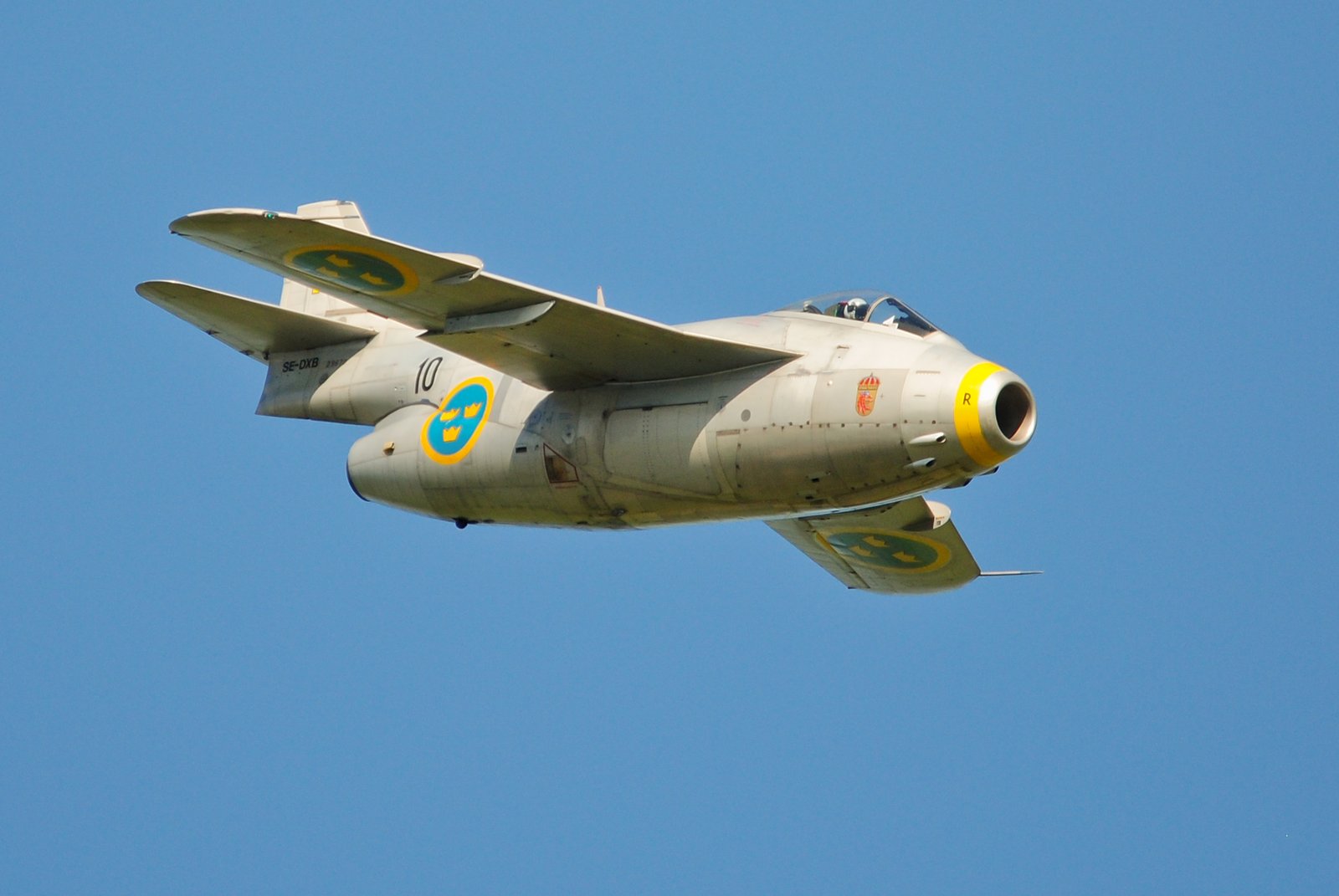
Dominating Swedish Skies
The SAAB 29 represented a quantum leap for Swedish aviation, replacing propeller-driven fighters with a thoroughly modern jet interceptor that could match contemporary Western designs. Between 1950 and 1965, the Tunnan formed the backbone of Swedish air defense, with its distinctive barrel-shaped fuselage earning the affectionate nickname "Flygande Tunnan" (Flying Barrel) from pilots and ground crews.
Combat Variants and Operational History
The Swedish Air Force operated eight distinct variants, each tailored for specific missions. The initial J 29A fighter delivered 224 aircraft beginning in 1951, followed by the versatile J/A 29B that first flew on March 11, 1953. This fighter-attacker variant featured 50% increased fuel capacity and wing hardpoints capable of carrying bombs, 80mm to 150mm rockets, anti-ship weapons, and even drop tanks that could serve as improvised napalm bombs.
The reconnaissance S 29C variant, with 76 aircraft built between 1954 and 1956, achieved international recognition when two aircraft set a speed record of 900.6 km/h over a 1,000-kilometer closed-circuit course in 1955. The final J 29F variant, with 308 aircraft produced, incorporated both afterburning engines and improved wing design featuring sawtooth leading edges and wing fences for enhanced high-speed handling.
SAAB's Engineering Achievement
Svenska Aeroplan Aktiebolaget, founded in 1937, designed the Tunnan as their first purpose-built jet fighter, moving beyond their earlier experience with licensed production and propeller aircraft. The engineering team faced the challenge of creating a high-performance interceptor adapted to Sweden's harsh operating conditions and neutral defense requirements.
The design incorporated several innovative features, including power-boosted ailerons and leading-edge slats on the outer wings to reduce landing speeds. Despite its rotund appearance, the aircraft proved remarkably agile, with pilots praising its maneuverability and robust construction suitable for operations from dispersed airfields.
Powerplant and Performance
The De Havilland Ghost 50 turbojet, designated RM2B in Swedish service, provided the Tunnan's impressive performance. Early variants used the Ghost 45 producing 4,400 pounds of thrust, while later models featured Swedish-developed afterburners that increased thrust by 25%. This powerplant enabled the J 29F to reach maximum speeds of 1,075 km/h (668 mph) in full afterburner and achieve service ceilings of 45,000 feet.
Fuel capacity varied significantly across variants, with the J 29B increasing internal fuel from 1,430 to 2,100 liters compared to the original design. External fuel tanks weighing up to 600 kg each could extend operational range to 1,500 kilometers, essential for Sweden's vast territorial defense requirements.
Armament and Combat Capability
All Tunnan variants carried four 20mm Hispano m/47 cannons mounted under the nose, each with 180 rounds of ammunition. Attack variants could deploy up to 24 Bofors 75mm unguided rockets against large bomber formations, or single 127mm Mk.26 target rockets for precision strikes. The A-29F fighter-attacker could carry two 551-pound bombs or 24 Bofors attack rockets on underwing pylons.
Later variants received capability for two Sidewinder air-to-air missiles, keeping the aging design relevant against evolving aerial threats through the early 1960s.
Production Legacy and Museum Preservation
The 661 aircraft produced between 1950 and 1956 represented not only SAAB's largest single production run but also Sweden's transition to jet-age air power independence. The continuous evolution from J 29A through J 29F demonstrated rapid technological advancement, with each variant incorporating lessons learned from operational experience and emerging threats.
The Tunnan's compact dimensions—790-meter takeoff distance and 650-meter landing roll—proved ideal for Sweden's road-base dispersal strategy, allowing operations from highway strips during periods of tension. This operational flexibility, combined with the aircraft's rugged construction and ease of maintenance, established design principles that would influence subsequent SAAB fighters through the present day.
While the Tunnan never saw combat, its 15-year service life provided Swedish pilots with their first experience in high-speed jet operations, establishing training protocols and operational procedures that supported Sweden's continued military aviation independence throughout the Cold War period.