
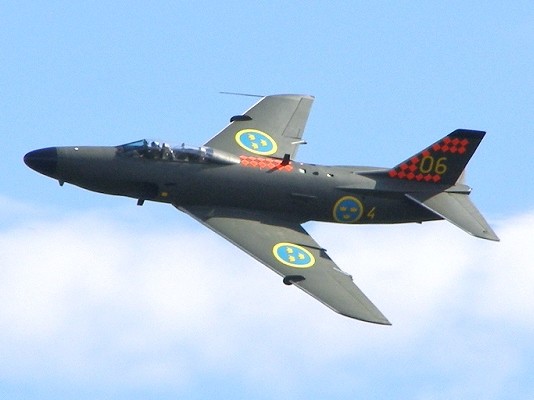
Service History
The Lansen entered Swedish Air Force service in 1955 and equipped 12 to 13 squadrons throughout its operational career, which lasted until 1997 with most aircraft retired by 1978. The type dominated Swedish tactical aviation during the height of the Cold War, serving exclusively with the Flygvapnet in three distinct variants that covered the full spectrum of combat roles. Unlike many contemporary jets that saw combat service, the Lansen's entire career was spent in peaceful training exercises and air defense patrols over neutral Sweden.
Operational Variants
The A32A attack variant formed the backbone of production, with 284 to 287 aircraft delivered between November 1955 and 1958. Armed with four 20mm cannons plus rockets and bombs, these aircraft replaced aging World War II-era SAAB B 18 bombers and A 21R attackers in the ground-attack role. The J32B all-weather fighter followed with 118 units, featuring upgraded 30mm nose cannons, four AIM-9 Sidewinder missiles, and advanced radar systems for interceptor duties. The reconnaissance S32C variant rounded out the family with 44 aircraft equipped for photo-reconnaissance missions.
The Manufacturer
Svenska Aeroplan AB originated in 1937 as a subsidiary of Svenska Tändsticks AB, the Swedish Match Company, beginning aircraft production in 1939 with the SAAB 17 dive bomber. Despite Sweden's neutrality during World War II, SAAB expanded rapidly and pioneered advanced aircraft designs throughout the Cold War era. The company merged with truck manufacturer Scania-Vabis in 1968 to form Saab-Scania AB, with the aeronautics division becoming independent Saab AB in 1995. Today, Saab AB continues as a major defense and aerospace contractor, building on the technological foundation established by projects like the Lansen.
Design Innovation
Project 1150, as the Lansen was initially designated, began in December 1948 under project manager Arthur Bråsjö's leadership. The design team employed mathematical coordinate-based engineering methods that represented early computer-aided design techniques. Chief test pilot Bengt Orlow flew the first prototype on November 3, 1952, and achieved the historic milestone of Sweden's first supersonic flight on October 25, 1953, when the aircraft exceeded Mach 1 in a shallow dive.
The Lansen incorporated several advanced features including swept-back low wings optimized for transonic flight and tandem two-seat configuration from the outset, despite single-seat prototypes. The A32A variant featured one of the first production radar systems using French CSF equipment, while the J32B received significantly more advanced radar for all-weather interception missions.
Engine and Performance
Powering the Lansen was the Volvo RM5A2 in A32A and J32B variants, or the RM6A in the S32C reconnaissance model. These engines were license-built Rolls-Royce Avon turbojets modified with Swedish-developed afterburners. The reliable axial-flow design provided 22.3 to 73.5 kilonewtons of thrust with afterburner engaged, enabling the aircraft to reach maximum speeds of 1,123 kilometers per hour and achieve supersonic performance in diving flight.
The J32B variant earned the nickname "Lansen-Sport" due to its extended afterburner system that provided superior performance compared to earlier models. This powerplant enabled the aircraft to reach operational ceilings above 15,000 meters with a maximum range approaching 2,000 kilometers on internal fuel.
Production Legacy
SAAB manufactured between 450 and 455 Lansen aircraft at its Linköping facility from 1955 to 1960, making it a relatively limited production run compared to contemporary American or Soviet designs. However, the aircraft's significance extends far beyond production numbers, as it established Sweden's capability to design and manufacture advanced supersonic combat aircraft independently during the Cold War.
The Lansen bridged the technological gap between propeller-driven World War II aircraft and the supersonic jets that followed, directly influencing SAAB's later successes with the J 35 Draken and JA 37 Viggen. This technological progression demonstrated how a neutral nation could maintain advanced defense capabilities through indigenous aircraft development.
Museum Preservation
As of 2012, only three Lansen aircraft remained in airworthy condition for experimental and test purposes, though none are believed to be actively flying today. Museum preservation efforts have saved several examples for future generations, including A32A serial number 32284 (registered as N4767R) displayed at the Estrella Warbirds Museum in California following complete restoration. This aircraft represents one of the few Lansen examples preserved outside Sweden, highlighting the international interest in this pioneering supersonic design that helped establish SAAB's reputation for innovative military aviation technology.