
Service History
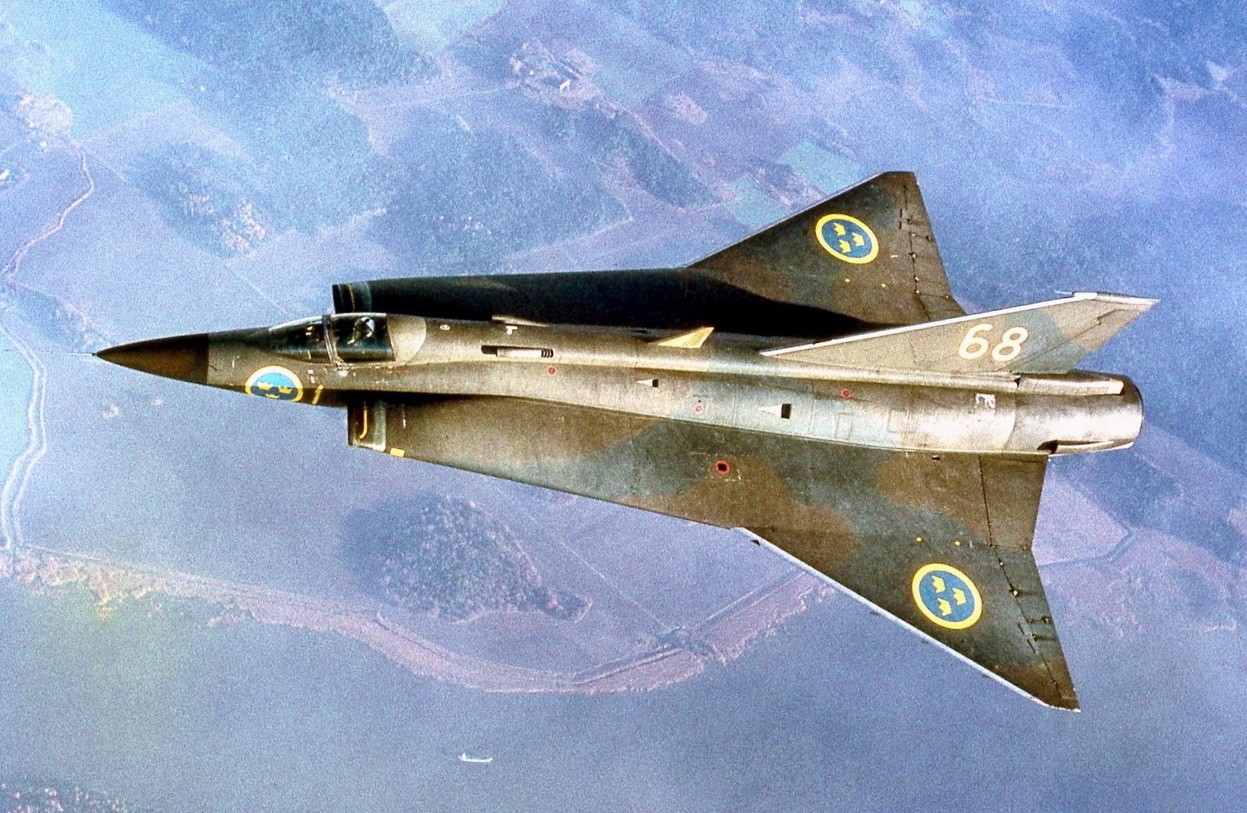
The Draken entered frontline service with the Swedish Air Force on March 6, 1960, where it served as the backbone of Sweden's air defenses for nearly four decades. More than 500 Draken aircraft of various versions protected Swedish airspace between 1960 and 1998, when the type was officially retired from Swedish service. Beyond Sweden, the aircraft proved its international appeal through exports to five nations: Austria operated Drakens until 2005, Denmark received 51 aircraft primarily for attack and surveillance roles, Finland built 12 under license, while Switzerland and Venezuela also operated the type.
Design Innovation and Development
Erik Bratt led the revolutionary design effort that froze the aircraft's configuration in March 1953, following successful testing of the smaller Saab 210 prototype that validated the double-delta wing concept. Chief test pilot Bengt Olow took the first Draken airborne on October 25, 1955, launching what Bratt later described as results that "exceeded expectations." The Swedish Air Force's procurement authority initially hesitated about the unconventional tailless layout, but the design's exceptional aerodynamic properties ultimately vindicated the bold engineering approach.
The aircraft's distinctive double-delta wing configuration represented a significant departure from conventional fighter designs of the era. This innovative layout provided the Draken with exceptional supersonic performance while maintaining good low-speed handling characteristics, crucial for operations from Sweden's dispersed airfields during wartime scenarios.
Production Variants and Capabilities
Saab manufactured 651 Drakens between 1955 and 1974, with production spanning multiple variants optimized for different missions. The initial J 35A fighter variant saw 90 aircraft built, followed by 73 improved J 35B models. The J 35D introduced enhanced radar systems across 120 airframes, while the final J 35F and J 35J variants incorporated the most advanced systems. Specialized versions included 25 SK 35C two-seat trainers delivered between 1962 and 1963, plus 59-60 S 35E surveillance aircraft and RF-35 reconnaissance variants.
Despite not being designed as a dogfighter, the Draken demonstrated impressive quick-turn capability and proved highly effective in air-to-air combat scenarios. The aircraft's versatility extended beyond pure fighter duties to encompass attack, surveillance, and training missions across multiple air forces.
Powerplant and Performance
The Draken's performance stemmed from Swedish-license produced Rolls-Royce Avon engines, designated RM6B and RM6C in Swedish service. Early J 35A variants utilized the RM6B (Avon Mark 48A) with EBK 65 afterburner, generating 10,600 pounds of dry thrust and 15,000 pounds with afterburning. Later variants employed the more powerful RM6C (Avon 300), enabling the final J 35J to achieve Mach 2 performance, while earlier versions reached Mach 1.7 to 1.8 in level flight.
The aircraft carried 590 gallons of internal fuel within its thick inner wing sections, providing substantial range for interception missions. Maximum loaded weight reached 10,500 kilograms on the J 35J variant, demonstrating the structural robustness required for high-performance military operations.
The Manufacturer's Legacy
Svenska Aeroplan Aktiebolaget developed the Draken as part of their comprehensive Cold War fighter program, following earlier successes with the J 29 Tunnan and J 32 Lansen. The company continues operations today as Saab AB, maintaining its position as a leading Swedish defense and aerospace manufacturer. The Draken's development showcased Saab's engineering capabilities and established the company's reputation for innovative military aircraft design.
Continuing Legacy
Today, only two Drakens remain airworthy: J 35J 35556 SE-DXR and SK 35C 35810 SE-DXP, both operated by the Swedish Air Force Historic Flight. Six former Danish aircraft continue flying with the National Test Pilot School in Mojave, California, where they provide advanced jet training for test pilots. Museum examples preserve the type's legacy worldwide, including an RF-35 reconnaissance variant at the Estrella Warbird Museum in Paso Robles, California.
The Draken's 50-year service milestone, celebrated in 2005, underscored the fundamental soundness of its original design. As one of the first truly supersonic fighters developed outside the superpowers, the aircraft proved that innovative engineering could overcome resource limitations, leaving an enduring mark on aviation history through its distinctive silhouette and technological achievements.