
Service History
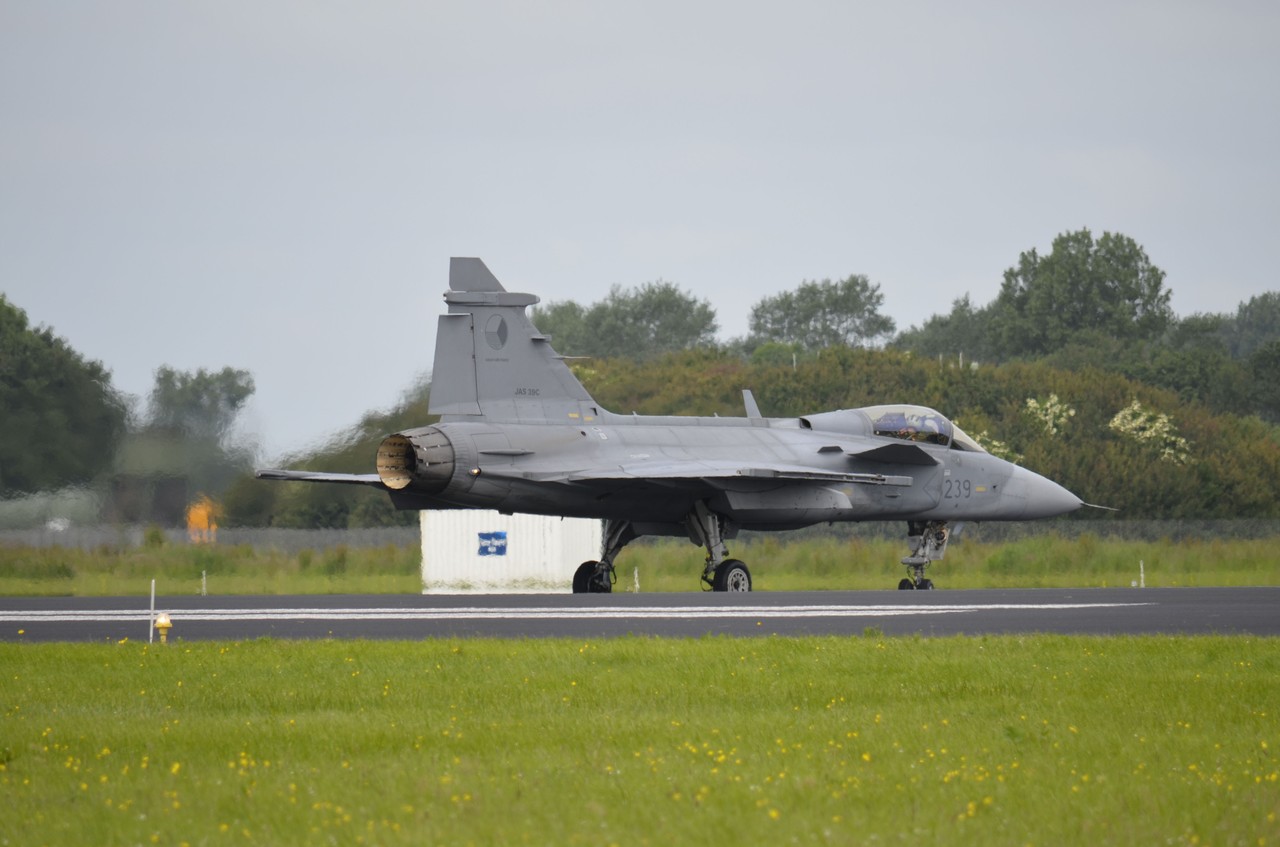
The Gripen achieved initial operational capability with the Swedish Air Force in 1995, with the first operational squadron established on November 1, 1997. By 2012, more than 240 Gripens were flying with multiple air forces worldwide. The aircraft has found success in international markets, serving with Brazil (as the F-39), Czech Republic, Hungary, South Africa, Thailand, and the United Kingdom for training purposes. Slovakia and Bulgaria have also committed to operating the type. Despite its combat capabilities, the Gripen has served primarily in peacetime roles, conducting air defense missions, training exercises, and international cooperation flights rather than wartime combat operations.
Development and Early Flight Testing
SAAB's engineering team began funded definition work for the Gripen in June 1980, following Sweden's requirement for a lightweight multirole fighter designated JAS (Jakt, Attack, Spaning - fighter, attack, reconnaissance). The Swedish government approved the program on May 6, 1982, ordering 30 aircraft plus five prototypes. The first prototype, designated 39-1, rolled out on April 26, 1987, and made its maiden flight on December 9, 1988, from Linköping with test pilot Stig Holmström at the controls during a flight lasting approximately 50 minutes.
Early flight testing proved challenging, with the first prototype suffering a gear-up landing in 1989 and the second prototype (39-2) crashing in May 1990. A more serious incident occurred on August 8, 1993, when production aircraft 39102 crashed near Stockholm during a demonstration flight. Pilot Lars Rådström ejected safely, and subsequent investigation revealed flight control software issues that were resolved by December 1994.
The Manufacturer
SAAB AB, originally founded as Svenska Aeroplan AB in 1937, developed the Gripen as part of Sweden's long tradition of indigenous fighter aircraft design. The company had previously produced successful military aircraft including the SAAB 21, SAAB 35 Draken, and SAAB 37 Viggen, with 329 Viggens built between 1970 and 1990. During Gripen development, SAAB faced political debates about Sweden's military aviation future but persevered with the program. The company briefly merged with British Aerospace in 1998 to form BAE Systems for export marketing, but SAAB AB was re-established as an independent Swedish aerospace and defense company in 2001 and continues operations today.
Engine and Technical Innovation
The Gripen's powerplant is the Volvo RM12, a Swedish-manufactured derivative of the General Electric F404 afterburning turbofan. Volvo Aero (now GKN Aerospace Sweden) conducted first test runs of the RM12 in January 1985, with the engine successfully tested in a SAAB Viggen testbed in February 1987. The RM12 produces approximately 54 kilonewtons of dry thrust and 80 kilonewtons with afterburner, enabling the Gripen's impressive high angle-of-attack performance tested to at least 28 degrees.
The aircraft incorporated several advanced design features including digital fly-by-wire flight controls with relaxed static stability, a canard-delta wing configuration optimized for supermaneuverability, and supercruise capability. These innovations represented a significant advancement over the previous generation Viggen and positioned the Gripen as a competitive fourth-generation fighter aircraft.
Production History
Gripen production proceeded in distinct batches, with the first production aircraft (39101) flying on September 10, 1992. The Swedish Air Force received its first operational Gripen (39102) on June 8, 1993. Batch 1 comprised 30 JAS 39A single-seat aircraft delivered between 1993 and 1996, with the final aircraft (39129) delivered on December 13, 1996. Batch 2 included 110 aircraft approved in June 1992 and continued into the early 2000s, with the final 19 aircraft built to interim JAS 39C standards.
Batch 3, ordered in December 1996, consisted of 64 aircraft including 50 JAS 39C single-seat and 14 JAS 39D two-seat variants delivered between 2003 and 2007. The improved C/D variants featured enhanced avionics and air-to-air refueling capability, with the first JAS 39C (39208) flying on August 14, 2002. Production continues today, with SAAB inaugurating a final assembly line in Brazil on May 9, 2023, for Brazilian F-39 Gripen E aircraft.
Variants and Performance
The Gripen family includes several variants optimized for different roles. The JAS 39A single-seat fighter totaled 102 aircraft, while 14 JAS 39B two-seat trainers were produced for pilot conversion training. The enhanced JAS 39C and JAS 39D variants incorporated improved avionics systems and aerial refueling capability. The latest Gripen E variant, first flown on May 27, 2008, represents a new generation with enhanced sensors and capabilities.
Performance specifications include a maximum speed exceeding Mach 2 at altitude (approximately 2,250 kilometers per hour), with low-level speeds of 700 miles per hour. Combat range extends to 800 nautical miles with external fuel tanks, while service ceiling reaches 52,500 feet. The aircraft carries a 27-millimeter Mauser BK-27 cannon and can accommodate various air-to-air missiles including AIM-9 Sidewinder and Meteor beyond-visual-range missiles on multiple hardpoints.
Legacy and Current Operations
With total production exceeding 247 units as of 2023, the Gripen has established itself as a successful export fighter aircraft, particularly notable for a nation of Sweden's size. The aircraft symbolizes Sweden's commitment to defense independence and technological capability in the post-Cold War era. Its emphasis on survivability, versatility, and cost-effectiveness has made it attractive to smaller air forces seeking advanced multirole capability without the expense of larger twin-engine fighters. Production continues with ongoing deliveries to international customers, ensuring the Gripen's operational relevance well into the 21st century.