
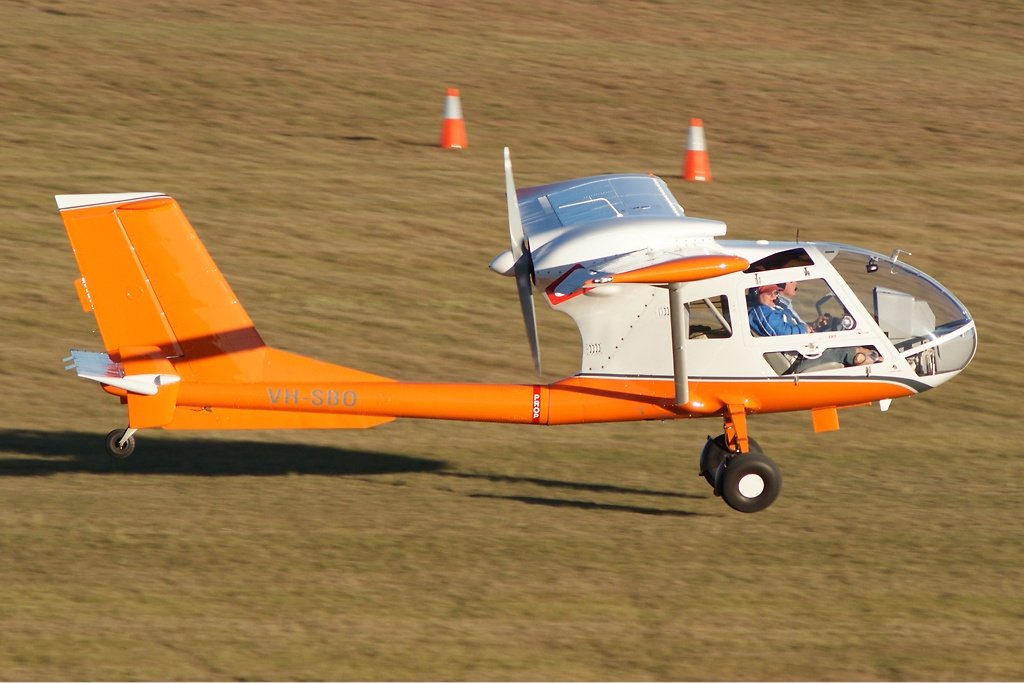
Development and Design
The SB-7 Seeker originated from the design work of C.W. Whitney and D. Adams at Seabird Aviation Australia, initially conceived as the SB-5 Sentinel before evolving into the production Seeker. The prototype VH-SBI, construction number 89001, completed its maiden flight on October 1, 1989, at Hervey Bay Airport, powered by a Lycoming O-235 engine during a 36-minute test flight. The third prototype, VH-SBU, followed in 1990, establishing the aircraft's design credentials for FAR Part 23 certification.
Engineers designed the Seeker specifically for observation roles that traditionally required expensive helicopter operations, including pipeline inspection, coastal surveillance, environmental monitoring, and aerial photography. The aircraft features exceptional visibility for its occupants, stable handling characteristics at low speeds, and docile stall behavior that enhances safety during extended surveillance missions.
The Manufacturer's Evolution
Seabird Aviation Australia Pty Ltd began as Seabird Ultralight Aircraft in 1983, initially producing lightweight recreational aircraft like the SB-1 Rouseabout and SB-1 Bushranger. The company transformed itself in 1986, adopting its new name and shifting focus toward certified aircraft production. Operating from facilities at Hervey Bay Airport in Pialba, Queensland, Seabird successfully transitioned from the ultralight market to manufacturing certified aircraft for commercial and military customers.
The company's global expansion began in 2004 when Seabird Aviation Jordan established production at KADDB facilities to serve northern hemisphere markets. Design authority initially remained in Australia but later transferred to Jordan for development work and supplemental type certifications. In early 2014, Seabird Aviation Australia was acquired by US-based Seeker Aviation, a division of CSI Aviation in Albuquerque, New Mexico, led by retired Marine Colonel Allen E. Weh.
Military Service and Operations
The Iraqi Air Force became the Seeker's most notable military operator when it received aircraft YI-001 and YI-002 on July 29, 2004. These Australian-built aircraft arrived via USAF C-130H transport to Basrah on August 18, 2004, with Iraqi pilot training commencing on August 7, 2004. The aircraft served primarily for pipeline and power-line inspection and protection missions during Iraq's reconstruction period.
The Royal Jordanian Air Force operates Seekers alongside other military services including Tanzania's air force for observation duties. In September 2004, South Africa's Paramount Group ordered five SB7L-360 aircraft with options for ten additional units, becoming the exclusive distributor for African and Asian markets. The US government negotiated the transfer of 25 surveillance-configured Seekers to Yemen in 2014 alongside Air Tractor AT-802s for counter-terrorism operations.
Engine Variants and Performance
Seeker aircraft employ various Lycoming powerplants depending on the specific variant. The initial SB-7L-235 prototype used a Lycoming O-235 engine, while production SB-7L-360 aircraft feature the Lycoming O-360 producing 168 horsepower, de-rated to 125 kilowatts for operational reliability. Later SB-7L-360A-2 variants received the more powerful Lycoming IO-390 engine generating 210 horsepower, enabling higher gross weights and increased surveillance equipment payloads.
The aircraft's fuel system accommodates 115 liters (25 Imperial gallons) as standard configuration, with an optional extended-range system holding 192 liters (42 Imperial gallons). Performance improvements include an 18 km/h (10 mph) cruise speed increase when equipped with the optional Hoffman three-blade controllable propeller system.
Notable Achievements
Australian aviatrix Gaby Kennard demonstrated the Seeker's capabilities in 1993 when she flew aircraft VH-OPT, construction number 92-005, on a circumnavigation of Australia covering 13,000 kilometers in 96 hours. This achievement highlighted the aircraft's reliability and endurance for extended missions.
Production and Legacy
Global production expanded significantly beyond the original Australian facility. Seabird Aviation America began manufacturing in Albuquerque, New Mexico, in 2007, followed by Erickson's Portland, Oregon facility in 2016. Erickson, known for its Sikorsky S-64 Aircrane helicopter conversions, continues Seeker production under the Seeker Aircraft designation.
At least 14 documented aircraft were produced through construction number 070014, including various prototypes and early production examples. Aircraft remain operational with military and civilian operators across Australia, the United States, Middle East, and Africa. The Seeker represents a successful transition from Australia's ultralight aircraft industry to certified surveillance aircraft production, establishing a niche market for cost-effective observation platforms worldwide.