
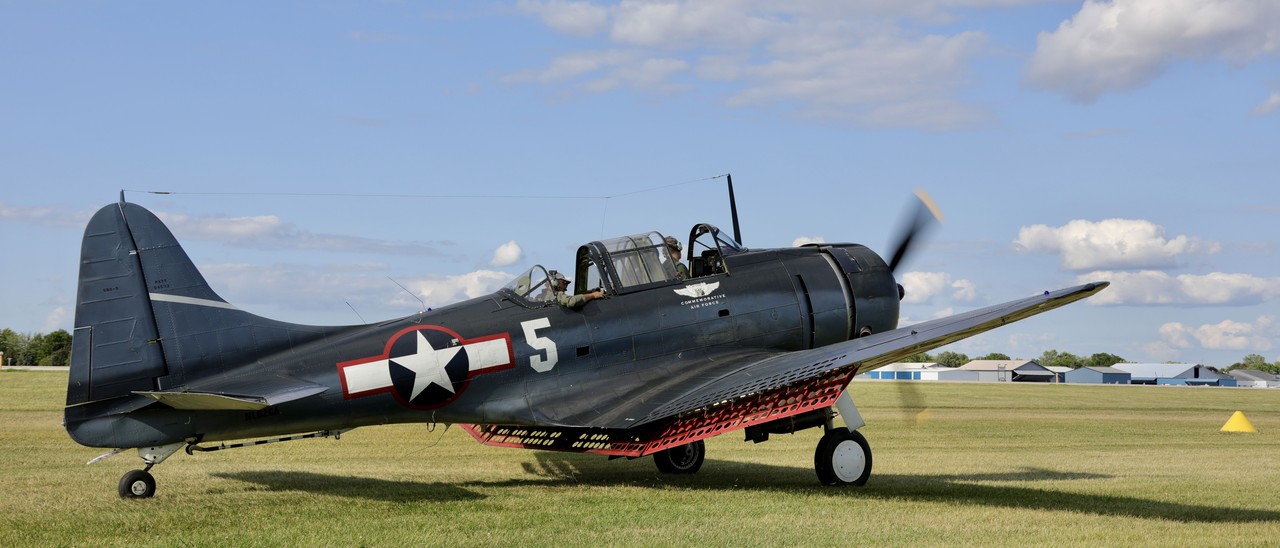
Combat Dominance in the Pacific
The SBD Dauntless proved its worth from the first day of American involvement in World War II through the conflict's end, becoming one of the few U.S. naval aircraft to serve continuously throughout the Pacific campaign. Despite earning the nickname "Slow But Deadly" due to its modest speed compared to contemporary fighters, the Dauntless sank more than 300,000 tons of Japanese shipping, including 18 warships ranging from submarines to battleships—more enemy tonnage than any other Allied aircraft in the Pacific theater.
The aircraft's finest hour came during the Battle of Midway on June 4-7, 1942, when SBD squadrons from USS Enterprise, Yorktown, and Hornet delivered the crushing blows that sank four Japanese aircraft carriers: Akagi, Kaga, Soryu, and Hiryu. Lieutenant Richard H. Best of Squadron VS-6, flying from Enterprise, personally delivered the fatal bomb that sank the flagship Akagi, later receiving the Navy Cross for his actions.
Design Evolution and Innovation
The Dauntless emerged from the design leadership of Ed Heinemann, who joined Douglas Aircraft Company in 1938 when Douglas acquired Northrop's El Segundo factory. Heinemann evolved the design from Northrop's earlier BT-1 dive bomber, creating the XBT-2 prototype that became the XSBD-1. The Navy placed its first production order for 144 aircraft in April 1939, comprising 57 SBD-1s and 87 SBD-2s.
The aircraft's most distinctive feature was its Swiss-designed perforated dive brakes—large flaps that deployed to stabilize the aircraft during steep 70-80 degree bombing dives. This innovation allowed pilots to maintain control while diving at near-vertical angles, delivering bombs with unprecedented accuracy for naval aviation. Beginning with the SBD-3 variant, the aircraft incorporated self-sealing fuel tanks and increased armament, making it the first truly combat-ready version.
Production and Variants
Douglas Aircraft Company produced 5,936 Dauntless aircraft between 1940 and 1944, with manufacturing occurring primarily at plants in El Segundo, California, and Tulsa, Oklahoma. The most numerous variant was the SBD-5, with 2,965 built, many at the Tulsa facility. The final SBD-6 rolled off the assembly line on July 21, 1944, marking the end of production as faster aircraft like the Curtiss SB2C Helldiver entered service.
The progression of variants reflected continuous improvement: the SBD-1 served as the initial Marine Corps version with 57 built, while the SBD-3 became the backbone of early Pacific operations with 584 aircraft featuring enhanced fuel capacity and four machine guns. The SBD-4 introduced a 24-volt electrical system in 780 airframes, and the final SBD-6 variant incorporated the most powerful engine with 1,350 horsepower.
The Manufacturing Legacy
Douglas Aircraft Company, founded by Donald Wills Douglas Sr. in 1921, established itself as a premier manufacturer of both commercial and military aircraft. The company pioneered successful airliners like the DC-3 while simultaneously developing military types including the Dauntless. After merging with McDonnell Aircraft in 1967 to form McDonnell Douglas, the company was eventually absorbed by Boeing in 1997, where the Douglas legacy continues today.
Powerplant and Performance
The Dauntless was powered throughout its production run by variants of the reliable Wright R-1820 Cyclone nine-cylinder radial engine, manufactured by Wright Aeronautical (later Curtiss-Wright). Early SBD-1 and SBD-2 models used the R-1820-32 producing 1,000 horsepower, while the SBD-3, SBD-4, and SBD-5 employed the R-1820-60 generating 1,200 horsepower. The final SBD-6 received the most powerful R-1820-66 rated at 1,350 horsepower.
With its two-man crew consisting of a pilot and radioman/gunner, the SBD-5 achieved a maximum speed of 255 mph and could reach altitudes up to 25,530 feet. The aircraft's range of approximately 1,100 miles made it suitable for long-range Pacific operations. Forward armament consisted of two .50-caliber machine guns, while the rear gunner operated two .30-caliber weapons for defense.
Operational Statistics
By April 1944, SBD Dauntless aircraft had accumulated 1,189,473 operational flight hours, representing 25 percent of all U.S. Navy carrier aviation hours during that period. The aircraft served with Navy carrier-based VS (scouting) and VB (bombing) squadrons, Marine Corps VMSB (Marine Scout Bombing) units, and limited numbers with the U.S. Army Air Forces as the A-24 series. International operators included the Royal Navy, Royal New Zealand Air Force No. 25 Squadron, and the Free French forces.
Museum Preservation
Today, surviving Dauntless aircraft are preserved in prominent museums as testaments to their historical significance. The Smithsonian National Air and Space Museum displays SBD-6 BuNo 54605, the sixth production aircraft of that variant, which was accepted on March 30, 1944, and served as a trainer at Naval Air Station Patuxent River. The National WWII Museum in New Orleans houses SBD-3 BuNo 06508, a Guadalcanal veteran recovered from Lake Michigan in 1990, while the National Museum of the Marine Corps preserves another SBD-3 representing the type's service with Marine aviation units.