
Service History
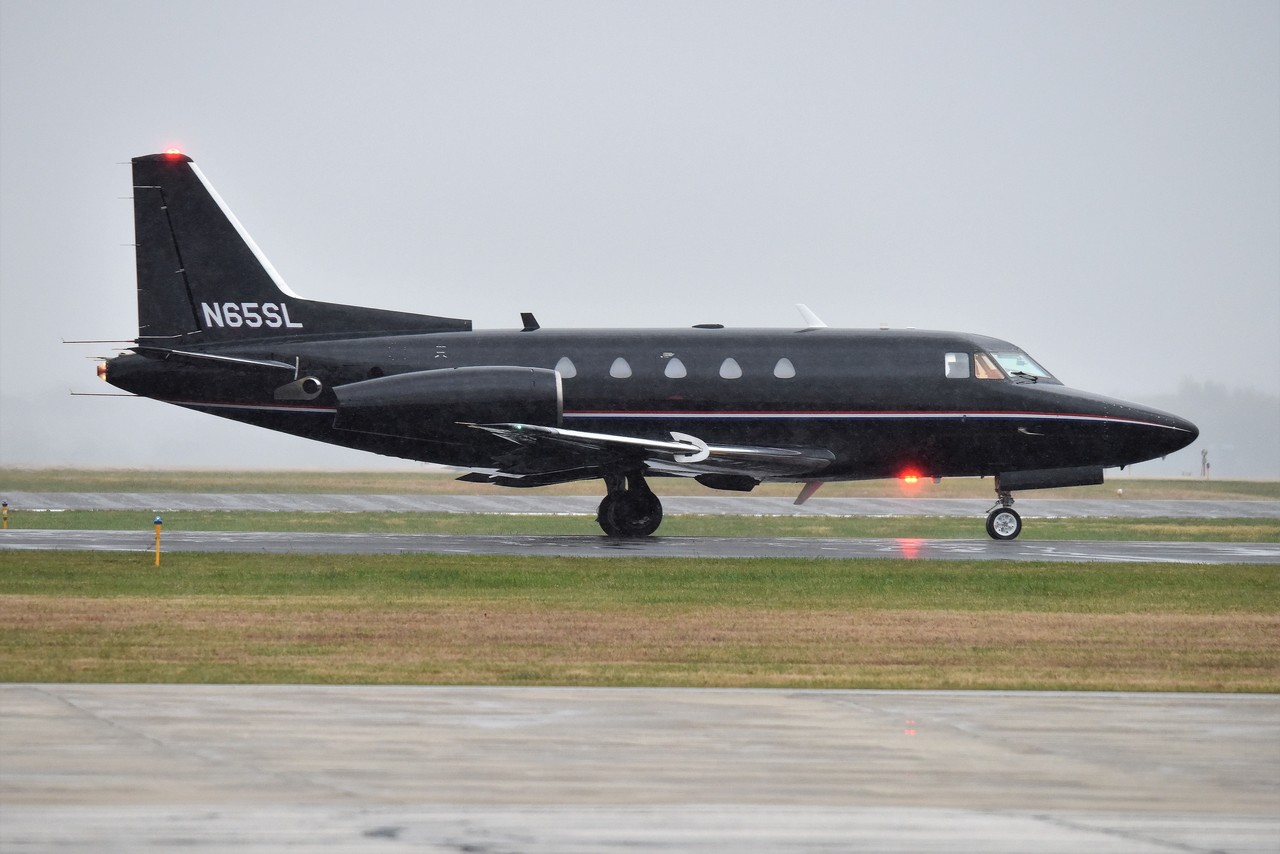
The Sabreliner established itself as a dominant force in the emerging business jet market of the 1960s, with 426 civilian aircraft delivered alongside 211 military variants. Corporate operators like Monsanto embraced the type early, with Monsanto operating what became the oldest continuous company jet division using a Series 40. The aircraft's spacious cabin and transcontinental range made it ideal for executive transport, offering accommodations that ranged from the prototype's four-passenger club seating arrangement to the production Series 40's capacity for eleven passengers.
Military Service
Designated T-39 Sabreliner in military service, the aircraft served the United States Air Force, Navy, and Marine Corps primarily as a trainer and utility transport. The USAF placed its initial production order in October 1958 for T-39A-1-NA aircraft with serial numbers 59-2868 through 59-2871. Approximately 200 T-39s were built for military use, providing pilot training and personnel transport capabilities rather than combat missions.
The type's military service was marked by one tragic incident during the Cold War. On January 28, 1964, a USAF T-39 was shot down by a Soviet MiG-19 over East Germany after straying from West German airspace during a training flight, killing all three crew members aboard. Many retired military T-39s later entered civilian service after receiving FAA certification.
The Manufacturer
North American Aviation, the Sabreliner's creator, operated as an independent company from 1929 until 1967, establishing itself as one of America's premier aircraft manufacturers. The company produced legendary designs including the P-51 Mustang fighter, F-86 Sabre jet, and B-25 Mitchell bomber. In 1967, North American merged with Rockwell Standard to form Rockwell International, which continued Sabreliner production until 1982.
Following the end of production, Rockwell sold the Sabreliner division to private equity firm Wolsey & Company in 1982, creating the Sabreliner Corporation. This entity evolved into Sabreliner Services, which continues operating today as a support organization for Sabreliner operators worldwide.
Engine and Technical Evolution
The Sabreliner's powerplant evolved significantly throughout its production run, reflecting advances in jet engine technology. The prototype NA-246 utilized two General Electric YJ85 turbojets for its maiden flight at Palmdale, California. Early production variants, including the Series 40, Series 60, and Series 75, along with military T-39A aircraft, were powered by Pratt & Whitney JT12A-6A and JT12A-8 turbojets.
Later variants incorporated more efficient turbofan engines, with the Series 75A and 80 receiving General Electric CF700 turbofans. The final production Series 65, of which 76 units were built, featured Garrett AiResearch TFE731-3R-1D turbofans paired with the revolutionary Mark V supercritical wing designed by Raisbeck Engineering in 1976. This combination represented the first application of supercritical wing technology in United States service.
Design Innovation
The Sabreliner underwent continuous refinement throughout its production life. The Series 60 featured a fuselage stretched by 3 feet 2 inches compared to the original Series 40, while the Series 70 and 75 variants incorporated taller cabin configurations for improved passenger comfort. Only nine of the taller-cabin Series 75 aircraft were manufactured.
The prototype received its airworthiness certificate on April 25, 1958, with civilian type certification following in April 1963 for the Series 40 and in 1967 for the stretched Series 60.
Production and Legacy
Manufacturing spanned 23 years, with notable production milestones including 65 Series 40 aircraft and 76 Series 65 units representing the final production variant delivered in 1982. The first production Sabreliner 40, bearing serial number 282-001 and registration N116SC, was acquired by Sabreliner Corporation in 1996 from a Mexican operator and designated "Sabre One" for corporate use.
By 2007, the majority of the 800-plus Sabreliners remained in active service, demonstrating the type's durability with only 56 aircraft lost to accidents by that date. The aircraft's low accident rate and continued operational viability decades after production ended testify to its sound engineering and construction quality.
Today, Sabreliner Services continues supporting operators from its St. Louis-Lambert base, ensuring parts availability and maintenance expertise for the remaining fleet. The Sabreliner's legacy as North American Aviation's successful entry into business aviation represents a significant chapter in the evolution of corporate air transport.