
Service History
The Sabre 80 carved out a significant niche in corporate aviation during its production run, with 72 aircraft delivered between 1974 and 1981. As part of the broader Sabreliner family that totaled over 800 aircraft, the Sabre 80 represented the evolution from earlier turbojet-powered variants to more efficient turbofan technology. Major corporations embraced the type, with Monsanto operating one of America's oldest continuous corporate jet divisions using Sabreliner aircraft. The aircraft's combination of speed, range, and operating economics made it particularly attractive to business operators seeking a twin-engine alternative to larger corporate jets.
The Manufacturer
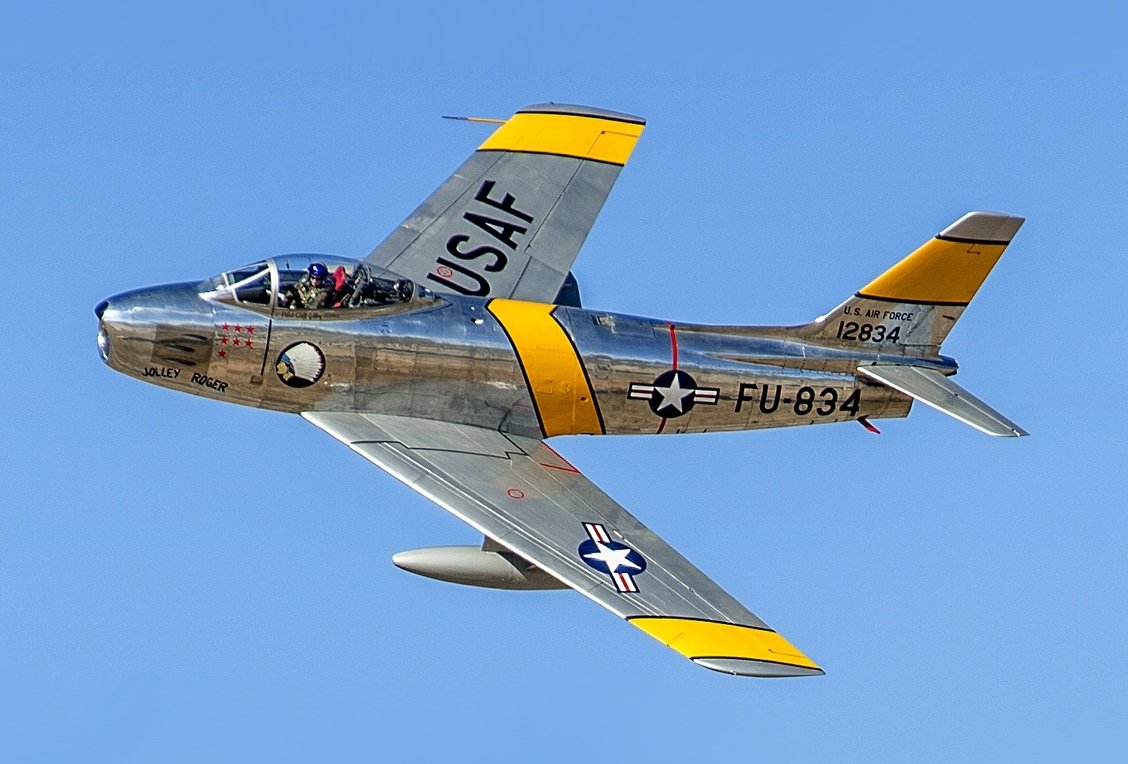
Rockwell International emerged in 1973 from the merger of North American Aviation and Rockwell Standard, inheriting the Sabreliner design that North American had developed throughout the 1950s. The original civilian prototype, designated NA-265, had conducted its maiden flight on September 16, 1958, powered by two General Electric YJ85 turbojet engines. The aircraft earned its name from its visual similarity to North American's F-86 Sabre fighter, particularly in the wing and tail configuration. Following years of corporate consolidation in the aerospace industry, Rockwell sold its Sabreliner division to private equity firm Wolsey & Co. in 1982, which formed Sabreliner Corporation to continue supporting operators. This entity eventually became Sabreliner Services, maintaining the legacy of the aircraft family.
Engine & Technical Innovation
The Sabre 80's defining characteristic was its powerplant: two General Electric CF700-2D-2 turbofan engines, each producing 4,500 pounds of thrust with a 5,000-hour overhaul interval. This represented a quantum leap over the Pratt & Whitney JT12A turbojet engines that powered earlier Sabreliner variants, delivering improved fuel efficiency, reduced noise levels, and lower emissions. The CF700 turbofan configuration made the Sabre 80 significantly more appealing to corporate operators concerned with operating costs and airport noise restrictions.
A revolutionary development occurred in 1976 when Rockwell contracted Raisbeck Engineering of Seattle to redesign the Sabreliner's wing with a supercritical configuration. The Raisbeck Mark V wing became the first supercritical wing design to enter service in the United States, offering improved high-speed performance and fuel efficiency. Existing Sabre 80 aircraft were retrofitted with this advanced wing as the Series 80A variant, demonstrating Rockwell's commitment to keeping the design competitive.
Performance & Pilot Experience
With a maximum gross weight of 23,000 pounds and an empty weight of 13,200 pounds, the Sabre 80 could carry a maximum payload of 1,720 pounds while maintaining its impressive range capabilities. The aircraft's 1,101-gallon fuel capacity provided extended range for transcontinental flights, making it suitable for coast-to-coast corporate missions without fuel stops. Pilots appreciated the aircraft's handling characteristics, which combined the responsiveness of its fighter heritage with the stability required for business operations.
The Sabre 80's cabin could accommodate up to 10 passengers in a comfortable corporate configuration, with standard amenities including air conditioning, improved braking systems, and enhanced interior appointments compared to earlier Sabreliner variants. The aircraft's cruise performance and high-altitude capability made it competitive with other business jets of its era while offering the operational flexibility of twin-engine configuration.
Military Heritage
While the Sabre 80 itself was exclusively a civilian variant, the Sabreliner family included approximately 200 military T-39 aircraft used for training and utility missions by the U.S. Air Force. The military connection became tragically notable during the Cold War when a USAF T-39 on a training flight from West Germany strayed into East German airspace on January 28, 1964, and was shot down by a Soviet MiG-19 fighter, killing all three crew members. This incident highlighted the strategic tensions of the era and the risks faced by military aviators during routine training operations.
Production Legacy
Production of the Sabre 80 concluded in 1981 as part of the broader end of Sabreliner manufacturing in 1982. The final variant, the Series 65 introduced in 1979, incorporated the supercritical wing design and Garrett turbofan engines, with 76 aircraft built before production ceased. By May 2007, 56 Sabreliners across all variants had been lost in accidents, though many Sabre 80 aircraft remain in active service within the private aviation market.
The Sabre 80's legacy lies in its role as a bridge between the early turbojet-powered business jets and the modern turbofan-equipped corporate aircraft that dominate today's market. Its introduction of advanced aerodynamic features like the supercritical wing to civilian aviation helped establish technological foundations that continue to influence business jet design. The aircraft represents an important chapter in the evolution of corporate aviation, demonstrating how military-derived designs could be successfully adapted for civilian use while incorporating cutting-edge propulsion and aerodynamic technologies.