
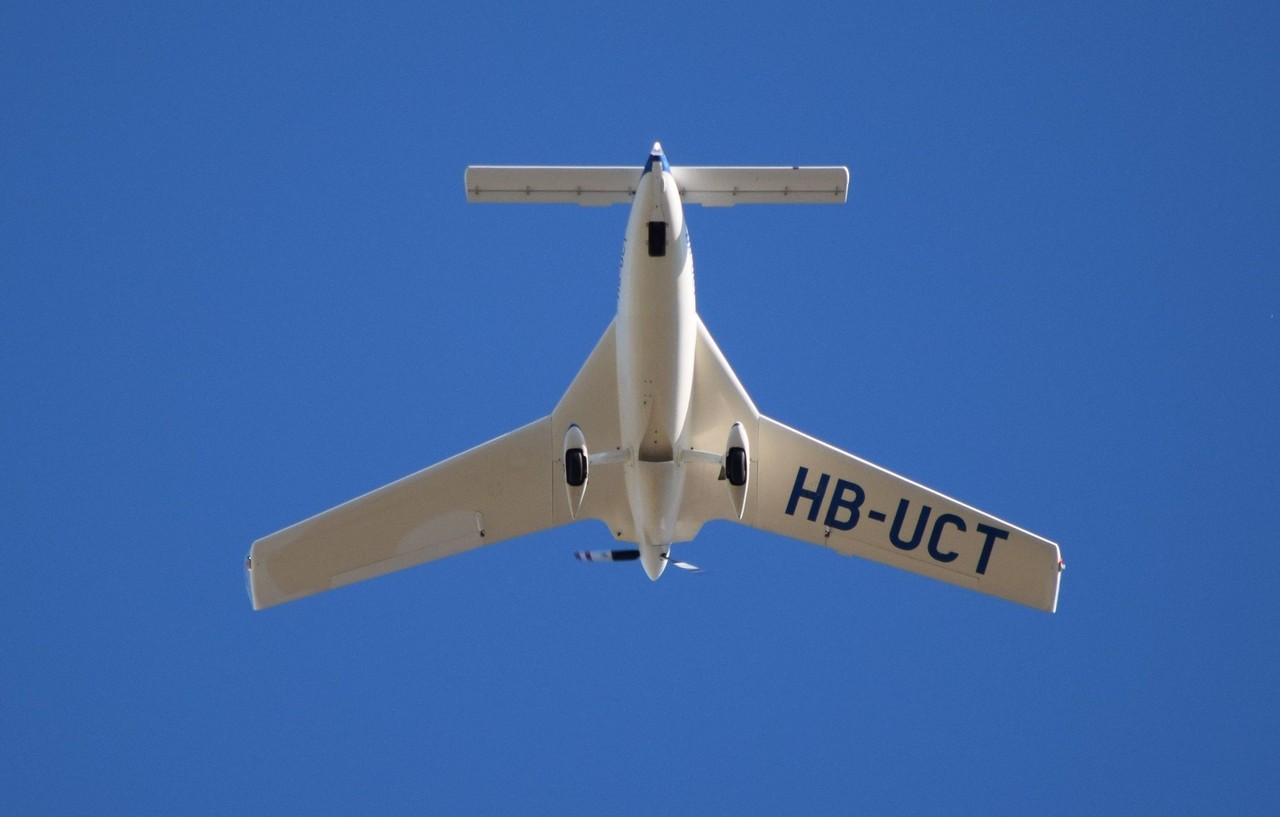
Design Innovation and Development
The Speed Canard emerged from the creative partnership of designers Peter Krauss and Jörg Elzenbeck, who drew inspiration from Burt Rutan's VariEze while creating an entirely original design without Rutan's input. Their revolutionary approach positioned the main wing mid-fuselage with a forward canard surface, departing dramatically from conventional aircraft layouts of the era.
The designers incorporated several ingenious features that set their aircraft apart. They adapted the tandem cockpit and canopy design from the Grob Twin Astir sailplane, creating an efficient two-seat configuration. Most notably, they developed an innovative twin rudder system mounted on the wingtip fins that could operate independently. When both rudders deflected outward simultaneously, they canceled each other's yaw effects while functioning as highly effective airbrakes—a breakthrough in aerodynamic control systems.
Manufacturing and Certification Milestone
Gyroflug-FFT MbH achieved what many considered impossible when German authorities certified the Speed Canard in 1983. No composite canard aircraft had ever received certification from any aviation authority worldwide, making this approval a watershed moment for unconventional aircraft design. The certification process validated the structural integrity and flight characteristics of composite construction in a canard configuration.
Production began during the 1980s at the company's Menges facility, strategically located along the River Danube. Manufacturing continued through the 1990s, with the company completing 62 aircraft by 1995. Each Speed Canard represented sophisticated composite construction techniques that were cutting-edge for general aviation aircraft of that period.
Technical Specifications and Performance
The SC-01 B-160 variant featured a single Lycoming O-320-D1A air-cooled flat-four piston engine producing 120 kilowatts (160 horsepower). A three-bladed MT-Propeller MTV-6-C/LD efficiently converted this power into thrust. The powerplant configuration provided sufficient performance for the aircraft's intended role as a high-performance sports plane.
With an empty weight of 440 kilograms and maximum takeoff weight of 715 kilograms, the Speed Canard offered impressive performance parameters. It achieved a maximum speed of 295 kilometers per hour at sea level and cruised at 275 kilometers per hour at 3,050 meters altitude. The aircraft demonstrated a service ceiling of 5,640 meters and climbing capability of 6.6 meters per second. Its 160-liter fuel capacity provided a range of 1,650 kilometers, making it suitable for cross-country flights.
Operational History and Military Applications
In late 1988, Gyroflug formed a significant partnership with Litton Industries, adapting the Speed Canard for specialized military surveillance missions. Litton selected the aircraft as the platform for their Advanced Tactical Surveillance System, recognizing the canard's stable flight characteristics and composite construction as ideal for carrying sensitive electronic equipment.
This military application demonstrated the Speed Canard's versatility beyond its original sports aviation role. The partnership with Litton Industries, a major defense contractor, validated the aircraft's professional capabilities and opened new market opportunities for Gyroflug.
Expansion Attempts and Market Challenges
In 1987, Gyroflug announced development of a four-seat variant designated the E 401, attempting to expand their market reach beyond the two-seat sports aircraft segment. However, the company abandoned this ambitious project shortly after the announcement, likely due to technical challenges or market conditions that made the larger variant economically unfeasible.
The abandonment of the four-seat project reflected the difficulties facing small aircraft manufacturers in developing multiple variants simultaneously. Limited resources and the specialized nature of canard aircraft likely contributed to focusing efforts on the proven two-seat configuration.
Safety Record and Continued Operations
The Aviation Safety Network documents multiple accidents involving Speed Canards between 1984 and 2024, including several fatal incidents. Notable crashes occurred in locations ranging from Texas to Australia to South Africa, indicating the aircraft's global distribution. The June 10, 1990 crash of a Litton-operated aircraft near Mineral Wells, Texas, resulted in one fatality during the military surveillance program.
Despite these incidents, Speed Canards continue operating worldwide. As recently as January 2024, aircraft registration HB-UCT was involved in a minor incident, confirming that examples remain active in various countries. The longevity of these composite aircraft demonstrates the durability of their construction and the dedication of their owners.
Legacy and Impact
The Gyroflug SC-01 Speed Canard's certification breakthrough opened pathways for subsequent composite canard designs worldwide. By proving that unconventional configurations could meet stringent airworthiness standards, Krauss and Elzenbeck's creation influenced aviation authorities' approaches to certifying innovative aircraft designs. Though production numbers remained modest at 62 units, the Speed Canard's historical significance far exceeds its manufacturing footprint.