
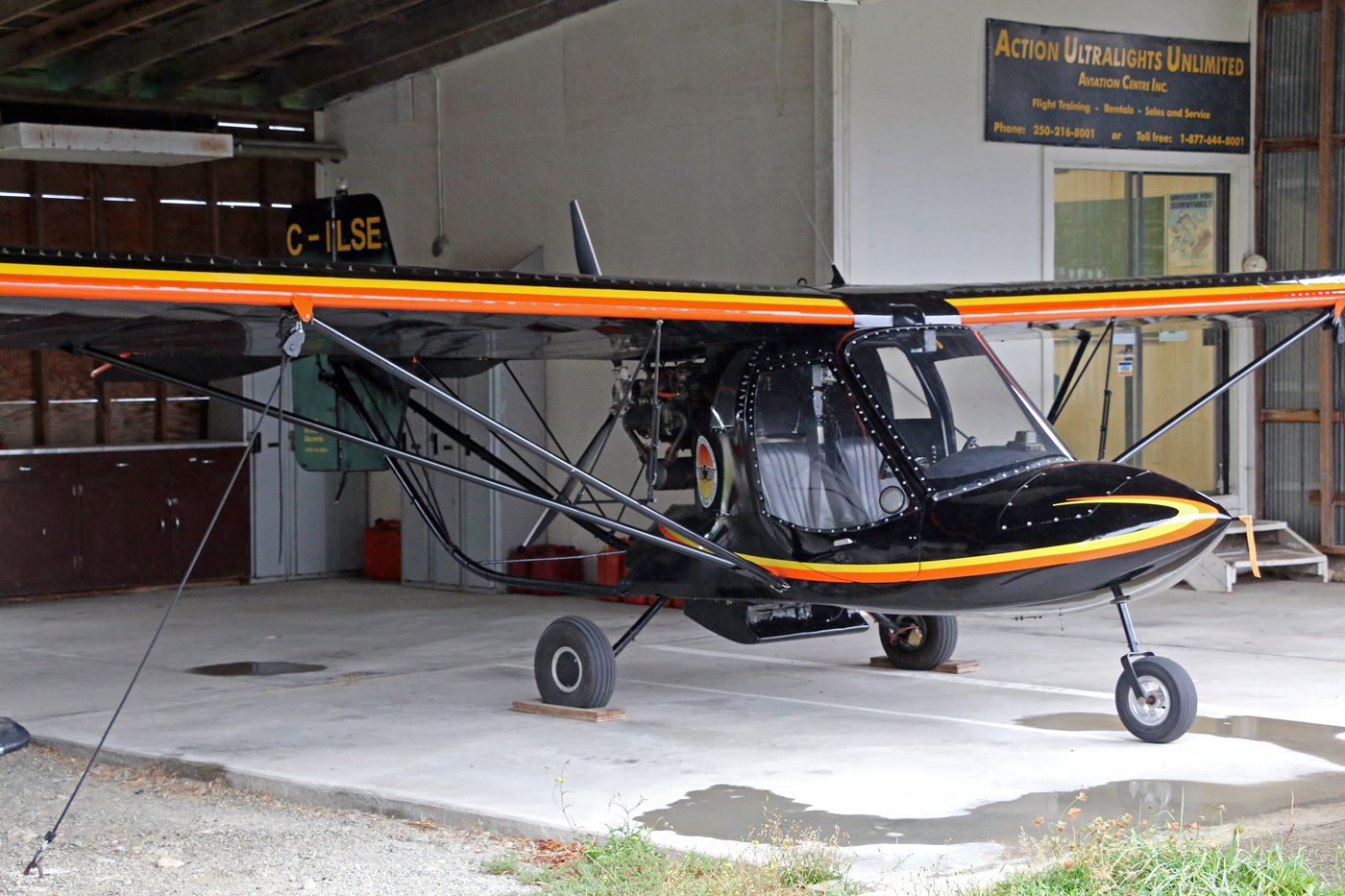
Design Innovation and Market Position
Chuck Hamilton's design for the Scepter emerged during the golden age of ultralight kit aircraft, when amateur builders sought alternatives to traditional tractor-configuration designs. The aircraft's most distinctive feature was its four-tube tail structure, specifically engineered to provide adequate propeller clearance for the pusher engine arrangement. Unlike most ultralight aircraft that employed stick controls, Hamilton incorporated control yokes—a feature more commonly found in certified aircraft—giving pilots a more conventional flying experience.
The Scepter's adaptability set it apart in the ultralight market. Beyond its standard tricycle gear configuration, the aircraft could be fitted with floats or skis for seasonal operations. Optional equipment included electrically-operated flaperons, trim systems, wheel pants for improved aerodynamics, and even a ballistic parachute system for emergency situations.
Manufacturing History
Production began in 1991 under Innovation Engineering of Davenport, Iowa, before transitioning to SlipStream International in Wautoma, Wisconsin. The company specialized in strut-braced, high-wing pusher designs using aluminum tubing construction with riveted stainless steel gussets and fabric covering. This construction method balanced structural integrity with the weight constraints critical to ultralight aircraft performance.
Despite its innovative features, the Scepter found limited market acceptance. By 2004, when production officially ended, exactly 20 aircraft had been completed—a modest figure compared to SlipStream's more successful Genesis model, which achieved over 200 completions by 2011. The low production numbers reflected the specialized nature of single-seat ultralights and the challenges facing small kit manufacturers in the increasingly competitive homebuilt market.
Powerplant Options
The standard powerplant was the 40-horsepower Rotax 447, a twin-cylinder, two-stroke engine that became synonymous with ultralight aviation during the 1980s and 1990s. For builders seeking additional performance, the aircraft could accommodate the 50-horsepower Rotax 503 or the 45-horsepower Zanzottera MZ 201 from Italy. All engines were mounted in pusher configuration, contributing to the aircraft's distinctive appearance and providing the pilot with an unobstructed forward view.
The Rotax engines, manufactured in Austria, earned reputation for reliability in amateur-built aircraft applications. Their lightweight design and air-cooling made them ideal for ultralight use, though their two-stroke operation required more frequent maintenance than four-stroke alternatives.
Performance Characteristics
With its 40-horsepower Rotax 447, the Scepter achieved a cruise speed of 66 mph and a stall speed of 43 mph, providing a comfortable speed range for ultralight operations. The aircraft's never-exceed speed of 120 mph gave pilots adequate margin for varying flight conditions. Range was limited to 135 miles with its 10-gallon fuel capacity, typical for aircraft in this category.
The Scepter's climb performance of 750 to 1,000 feet per minute was respectable for a single-seat ultralight, while its service ceiling of 6,000 feet met the operational limits imposed on ultralight aircraft. The glide ratio of 8:1 provided reasonable unpowered performance, and the wing loading of 7.3 pounds per square foot contributed to stable flight characteristics.
Legacy and Current Status
While SlipStream International continued producing other models through at least 2015, the Scepter represented a specialized niche that never achieved commercial success. The aircraft's limited production run of 20 examples makes surviving airframes relatively rare among ultralight enthusiasts.
The Scepter's inclusion in the ICAO aircraft type designator system (SCEP) and FAA databases reflects its recognition as a legitimate aircraft type, despite its limited numbers. Some examples remain airworthy as experimental amateur-built aircraft, though exact current numbers are unknown.
The aircraft appeared in various ultralight demonstrations and promotional videos, including YouTube presentations that showcased its flying characteristics to potential builders. These recordings now serve as historical documentation of the aircraft's performance and the enthusiasm of the 1990s ultralight community.
Design Philosophy Impact
The Scepter's emphasis on conventional controls and refined construction techniques represented an evolution in ultralight design philosophy. While earlier ultralights often prioritized simplicity and minimum cost, aircraft like the Scepter incorporated features that enhanced pilot comfort and safety, even at the expense of complexity and weight.
This approach influenced later ultralight and light sport aircraft designs, which increasingly adopted conventional control systems and structural techniques borrowed from certified aviation. The Scepter's pusher configuration also contributed to the broader acceptance of this arrangement in recreational aviation, demonstrating its viability for amateur builders.