
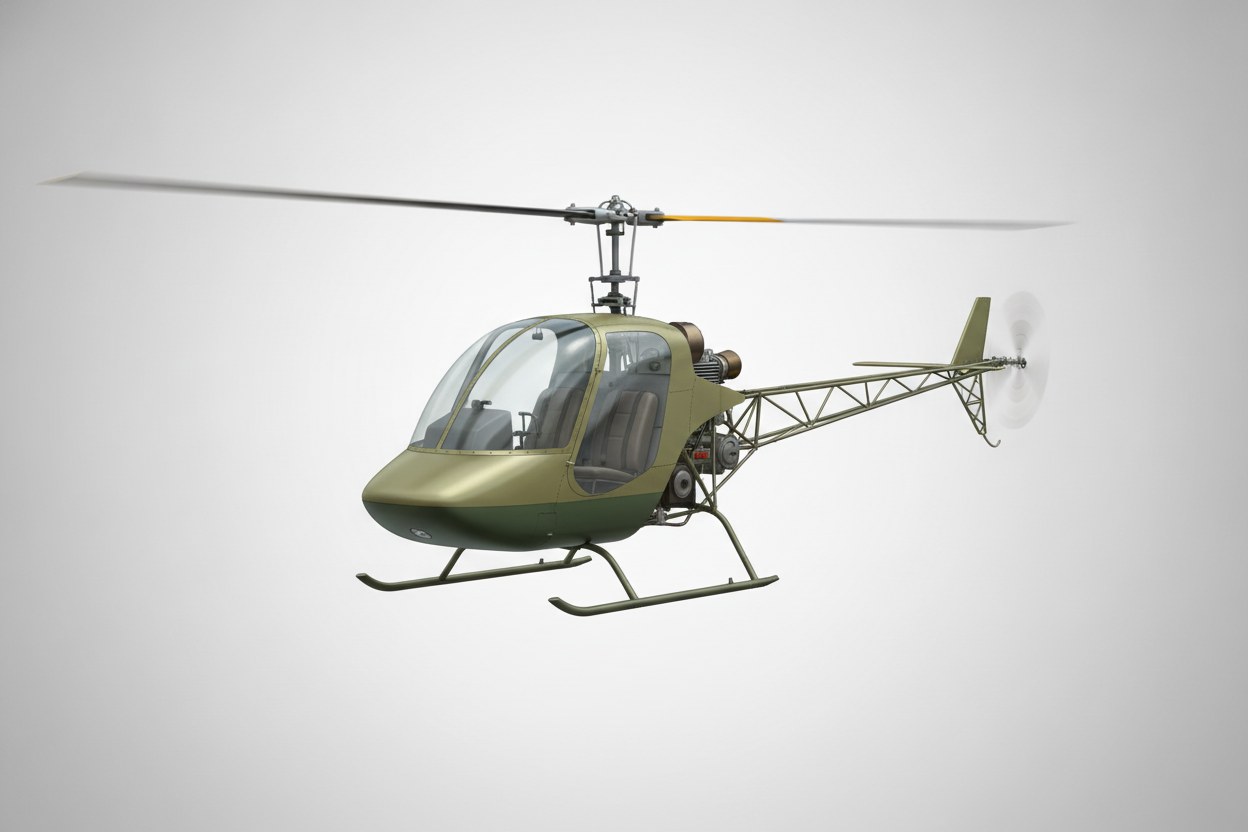
Design Origins and Development
The Scorpion originated from the innovative mind of B.J. Schramm, who established Schramm Aircraft Company in the early 1960s with the ambitious goal of creating an "ultimate transportation and recreational vehicle for the homebuilder." His 1961 Javelin prototype, an open-cockpit single-seat design, evolved into the refined Scorpion by 1966. RotorWay Aircraft Inc. took over production and marketing of Schramm's design, launching kit production in 1967.
Production Evolution
The Scorpion family underwent continuous refinement throughout its production life. The original single-seat Scorpion gave way to the popular two-seat Scorpion Too in 1971, marketed as the Scorpion II. RotorWay introduced the Scorpion 133 variant in 1974, coinciding with their development of the in-house RW133 engine. The final iteration, the Scorpion 145, appeared briefly in 1984 before the entire Scorpion line was discontinued that same year.
Production records indicate hundreds of kits were manufactured, with registration databases showing examples ranging from serial number 2721 to BA-1412, spanning production through 1983. The affordable pricing strategy proved successful, with complete kits including engines selling for approximately $7,000 in the early 1970s.
The Manufacturer's Journey
RotorWay Aircraft Inc., later operating as RotorWay International, established itself as a pioneer in the homebuilt helicopter market from its Tempe, Arizona facility. Unlike traditional aircraft manufacturers focused on certified aircraft, RotorWay carved out a unique niche providing complete helicopter kits to amateur builders. The company's philosophy centered on making helicopter ownership accessible to recreational pilots who previously could not afford factory-built rotorcraft.
The company operated independently for over five decades before transferring its assets to Rotor X in 2021, ending the original RotorWay era. During its operational lifetime, RotorWay built a reputation for innovation and customer support in the experimental aircraft community.
Engine Development and Technical Innovation
Early Scorpion variants utilized two-stroke marine engines, including Evinrude powerplants producing 125 horsepower. However, RotorWay recognized the limitations of adapting marine engines for aircraft use and invested in developing their own powerplant. The breakthrough came in 1974 with the introduction of the RW133, a four-cylinder horizontally opposed liquid-cooled engine producing 133 horsepower at 3,500 rpm.
The RW133, displacing 133 cubic inches and weighing 170 pounds, represented a significant advancement in homebuilt helicopter powerplants. This reliable four-cycle engine enabled the Scorpion to achieve a maximum gross weight of 1,125 pounds while maintaining reasonable performance characteristics. RotorWay later developed the RW145 variant, though this engine saw limited production before the Scorpion line ended.
Performance and Flying Characteristics
The two-seat Scorpion Too delivered respectable performance for its class, with a cruise speed of 75 mph and maximum range of 125 miles. The aircraft demonstrated a healthy climb rate of 1,000 feet per minute at sea level, making it suitable for recreational flying in varied terrain. With an empty weight of 750 pounds and useful load of 435 pounds, the Scorpion could accommodate two average-sized occupants with minimal baggage.
The semi-rigid two-blade main rotor system, covering 452 square feet of disc area, provided stable flight characteristics appreciated by amateur-built helicopter pilots. In 1977, RotorWay increased blade length from 24 feet to 25 feet, enhancing the aircraft's power efficiency and overall performance.
Build Experience and Kit Assembly
RotorWay designed the Scorpion kits for amateur builders, with assembly times averaging approximately 2,000 hours for the Scorpion Too variant. The company provided comprehensive documentation and support, recognizing that most builders had limited aircraft construction experience. This approach contributed significantly to the type's success in the homebuilt market.
Legacy and Preservation
Today, dozens of Scorpion variants remain active on civil aircraft registers worldwide. Notable examples include N4209D, a 1980 Scorpion 133, and G-BODK, a Scorpion 133 registered in the United Kingdom. The Smithsonian Institution's National Air and Space Museum in Washington, D.C., preserves a RotorWay Scorpion Too (catalog number NASM A19860266000), recognizing the type's significance in democratizing helicopter aviation.
The Scorpion's influence extended far beyond its production numbers. By proving that safe, affordable helicopter kits were viable, RotorWay opened the door for subsequent homebuilt rotorcraft designs and established the foundation for the modern experimental helicopter movement. The success of the Scorpion line directly enabled RotorWay's later development of the Exec series, which continued the company's mission through 2021.