
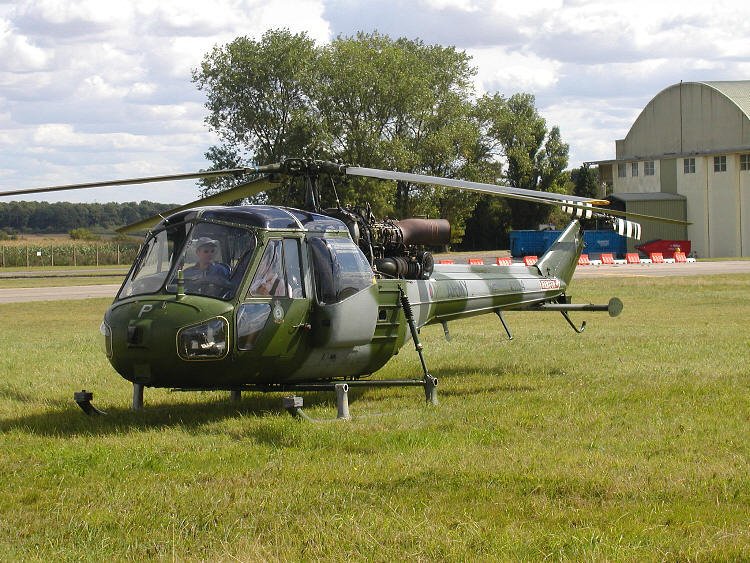
Development and Origins
The Scout emerged from Westland's acquisition of Saunders-Roe and their promising P.531 project, itself an evolution of the earlier Skeeter helicopter. Originally designated the Sprite, the aircraft underwent extensive development to meet Ministry of Defence requirements for a general-purpose military helicopter. The first prototype flew in July 1958, followed by the crucial P.531-2 pre-production variant on August 9, 1959, equipped with the Bristol Siddeley Nimbus engine that would define the aircraft's performance characteristics.
Engineering teams conducted rigorous testing from the Canadian wilderness to Nairobi's heat, certifying the airframe for operations in temperatures ranging from -26°C to ISA+30°C. Particular attention focused on developing an undercarriage system resistant to dangerous ground resonance effects. The first production Scout AH.1 took flight on August 4, 1960, with powered flight controls following in March 1961.
Engine Challenges and Solutions
The Scout's Rolls-Royce Nimbus turboshaft engine, rated at 1,050 shaft horsepower but torque-limited to 685 shp, initially plagued the program with catastrophic reliability problems. Early operational aircraft achieved merely four to six flying hours between engine failures, with crews allegedly competing for prizes when reaching 25 hours of engine life. These failures destroyed at least 11 military and civilian aircraft, forcing extensive redesign efforts.
By 1964, concentrated engineering work and operational experience dramatically improved engine reliability to two or three changes per 1,000 flying hours. This transformation proved crucial for the Scout's eventual success, though the early reputation for mechanical problems delayed full operational introduction until 1963.
Military Service Record
The Army Air Corps received its first operational Scouts in early 1963, with an initial order of 66 aircraft placed just one month after the prototype's maiden flight. Engine delays forced the interim adoption of French Alouette II helicopters until Scout deliveries commenced. Once operational, the type rapidly proved its versatility across multiple conflict zones.
Scouts flew combat missions during the Indonesia-Malaysia confrontation in Borneo, supported British forces during the Aden Emergency, and operated in Oman's harsh desert conditions during the Jebel Akhdar War. The aircraft served throughout the Rhodesian conflict and maintained a significant presence in Northern Ireland during the Troubles. Naval operations included service with 3 CBAS from 1971 through 1982, when the squadron was renumbered as 847 Naval Air Squadron before transitioning to the Westland Lynx.
One tragic incident occurred on September 3, 1967, when Scout XT641 was destroyed in Aden after National Liberation Front forces captured and executed the pilot and his Foreign Office passenger, then burned the aircraft in a wadi bed during a flight from Ataq to Mayfa'ah.
Production and Manufacturing
Westland manufactured approximately 150 Scouts between 1960 and 1968, primarily at the former Fairey Aviation Division factory in Hayes, with additional production at the company's Yeovil, Somerset facility. The aircraft featured a conventional single-rotor configuration with NACA 0012 airfoil sections and accommodated a pilot plus three passengers in standard configuration.
With an empty weight of 3,232 pounds and maximum takeoff weight of 5,300 pounds, the Scout offered substantial payload capacity for its size class. Operational roles encompassed anti-tank warfare, casualty evacuation, liaison transport, battlefield observation, and search-and-rescue missions, making it a true multi-role platform.
Legacy and Preservation
The Scout's service life extended well beyond its production years, with Territorial Army 666 Squadron operating the type through the late 1980s. The aircraft's robust design and operational flexibility established it as the standard tactical helicopter for British forces following its 1963 introduction, offering dramatically improved reliability and payload capacity compared to its Skeeter predecessor.
Notable civilian operators included King Hussein of Jordan, who maintained a personal Scout for royal transport duties. Today, at least one Scout remains operational with the Historic Army Aircraft Flight, with aircraft XT626/G-CIBW continuing to fly after construction in 1966. This preserved example serves as a testament to the design's enduring engineering quality and historical significance in British military aviation.
The Scout's successful development also paved the way for its naval variant, the Westland Wasp, demonstrating the versatility of the basic P.531 design concept across multiple service branches and operational environments.