
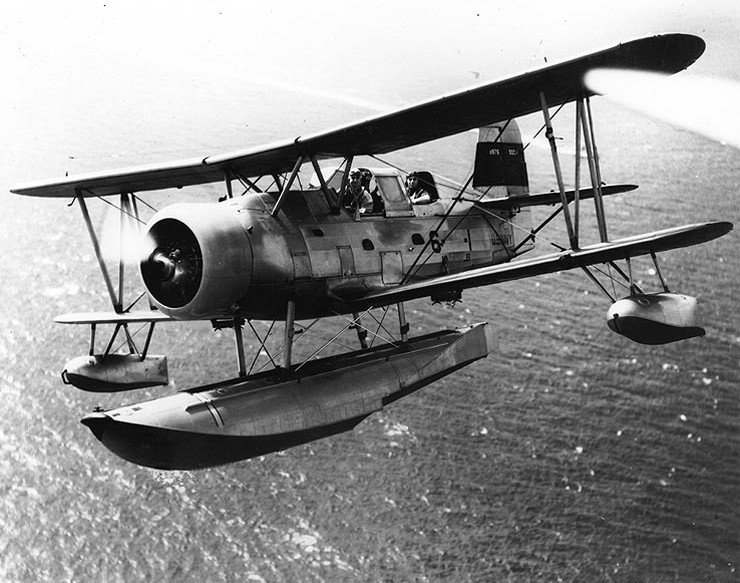
Designed by Alexander Solla for the Curtiss-Wright Corporation, the SOC Seagull was developed to combine scout and observation roles into a single aircraft platform. The prototype first flew in March 1934, and the aircraft officially entered service in 1935. To facilitate stowage aboard battleships and cruisers, the SOC featured a distinctive folding-wing design. These aircraft were typically launched via catapult and recovered through sea landings.
Production of the SOC began in 1935 and continued through 1938. While source records vary slightly, Curtiss produced between 258 and 261 aircraft (covering models SOC-1 through SOC-4). Additionally, the Naval Aircraft Factory (NAF) in Philadelphia, Pennsylvania, manufactured 64 SON-1 aircraft starting in 1940, which were based on the SOC-3 design. Depending on the Curtiss production total used, the overall number of aircraft built ranges from 322 to 325.
Technically, the SOC was powered by a Pratt & Whitney R-1340 radial piston engine producing 550 horsepower. This powerplant enabled a maximum speed of 165 mph and a cruise speed of 116 knots (133 mph). The aircraft had a stall speed of 48.6 knots and a range of 675 miles (or 587 nautical miles at 5,000 feet). For offensive or utility roles, the aircraft could carry a bomb load of either two 100 lb bombs or two 250 lb bombs.
In military service, the SOC was operated by the United States Navy, the United States Marine Corps, and the United States Coast Guard, the latter of which experimented with three SOC-4 aircraft. The SOC is distinguished as the only U.S. Navy biplane to engage in aerial combat during World War II. A notable encounter occurred during the attack on Pearl Harbor, where SOC floatplanes from the USS Northampton fought and shot down a Japanese A6M Zero. Furthermore, starting in late 1941, SOC-3A variants equipped with arresting hooks and wheels served on escort carriers.
Despite being largely displaced by the Vought OS2U Kingfisher, the SOC returned to front-line service in late 1943 after the intended replacement, the Curtiss SO3C Seamew, failed to perform adequately. The Seagull continued to serve across the Mediterranean, Atlantic, and Pacific theaters until the final aircraft was retired in September 1947.