
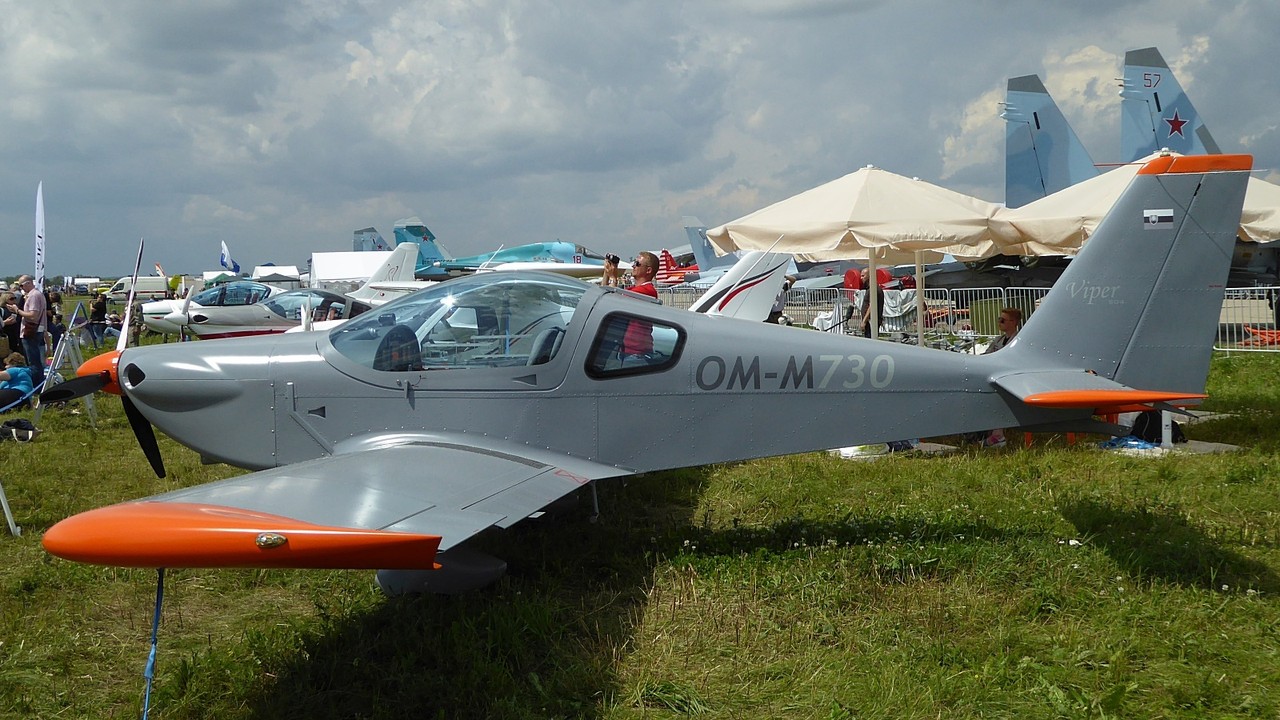
Development and Design Philosophy
Design work on the Viper commenced in 2004 under Tomark's vision to continue "the famous tradition and legendary era of Czechoslovak aircraft production." The company, originally established in 1995 as a mechanical engineering firm serving automotive and aviation industries, created its specialized TomarkAero division to focus exclusively on all-metal two-seater sports aircraft manufacturing.
The aircraft's development targeted specific operational requirements: touring capability, flight training suitability, and glider towing capacity. Initially aimed at French flying clubs, the design philosophy emphasized modern construction techniques combined with proven reliability. The engineering team achieved first flight on November 1, 2006, leading to market introduction in 2008.
Construction and Technical Innovation
The SD4 represents a sophisticated blend of traditional aluminum construction with selective composite integration. The airframe utilizes all-metal construction with aluminum skinning produced through CNC machining, ensuring precision and repeatability in manufacturing. Composite materials enhance performance in specific applications: wing tips, fuselage upper decking, engine cowling, and wheel fairings benefit from composite construction's weight savings and aerodynamic properties.
The wing design features constant chord construction built around one main spar and one auxiliary spar, with curved, slightly upswept tips that improve both aesthetics and aerodynamic efficiency. This configuration provides predictable handling characteristics essential for training applications while maintaining performance suitable for touring missions.
Powerplant and Performance
Rotax 912 engines power all SD4 variants, offering operators two displacement options. The standard configuration employs the 60 kW (81 horsepower) Rotax 912UL, while customers requiring additional performance can specify the 75 kW (100 horsepower) Rotax 912ULS. Both engines feature the Rotax signature combination of liquid-cooled cylinder heads and air-cooled cylinders, equipped with reduction gearing and dual carburetors.
This powerplant selection delivers cruise speeds of 200 kilometers per hour (108 knots) with stall speeds as low as 65 kilometers per hour with flaps deployed. The aircraft achieves climb rates between 5 and 6 meters per second, reaching service ceilings of 5,000 meters. With fuel capacity ranging from 70 to 100 liters, the SD4 provides operational ranges between 750 and 1,100 kilometers depending on configuration and flight conditions.
Production and Market Expansion
Production commenced in 2008 at Tomark's Prešov, Slovakia facility, with 26 aircraft completed by November 2010. Market success prompted expansion into the United States following Light Sport Aircraft certification in October 2010, when manufacturing began at Winnsboro, Texas, specifically serving North American customers.
International market penetration continued with aircraft deliveries to Australia and New Zealand. The first New Zealand registration occurred on January 31, 2013, when ZK-EAW (serial number 035) was registered to Wilson Aviation Ltd of Hamilton. By mid-2010, European operations included two aircraft registered in France and ten in Slovakia, demonstrating growing acceptance in the aircraft's target markets.
Regulatory Achievement
The SD4 achieved significant certification milestones that validated its design and opened international markets. EASA type certification was awarded in March 2016 as the SD4 RTC (Restricted Type Certificate), following mandatory SPIN tests completed in November 2015 for CS-LSA category compliance. United States acceptance as a Light Sport Aircraft provided access to the substantial American recreational aviation market.
These certifications confirmed the aircraft's compliance with modern safety standards while maintaining the operational flexibility that defines the light sport aircraft category. The regulatory approval process validated design decisions made during the aircraft's development phase and provided operational parameters for commercial service.
Operational Versatility
The SD4's mission flexibility stems from its fundamental design parameters and performance characteristics. Training operations benefit from predictable handling characteristics, side-by-side seating that facilitates instruction, and docile stall behavior. Touring applications leverage the aircraft's 750-kilometer minimum range, comfortable cabin accommodations, and cruise performance suitable for cross-country flight.
Glider towing capability expands operational utility, providing soaring clubs with a modern alternative to aging tow aircraft. The combination of adequate power, appropriate speed range, and robust construction addresses the specific demands of glider launching operations while maintaining efficiency for other mission profiles.
Current Status and Legacy
Continuous production since 2008 demonstrates market acceptance and operational success. Active aircraft registrations in multiple countries, including a United States registration certificate issued October 30, 2025, with expiration October 31, 2032, confirm ongoing operational service. The aircraft represents successful revival of Central European aviation manufacturing tradition adapted to contemporary light sport aircraft market demands.