
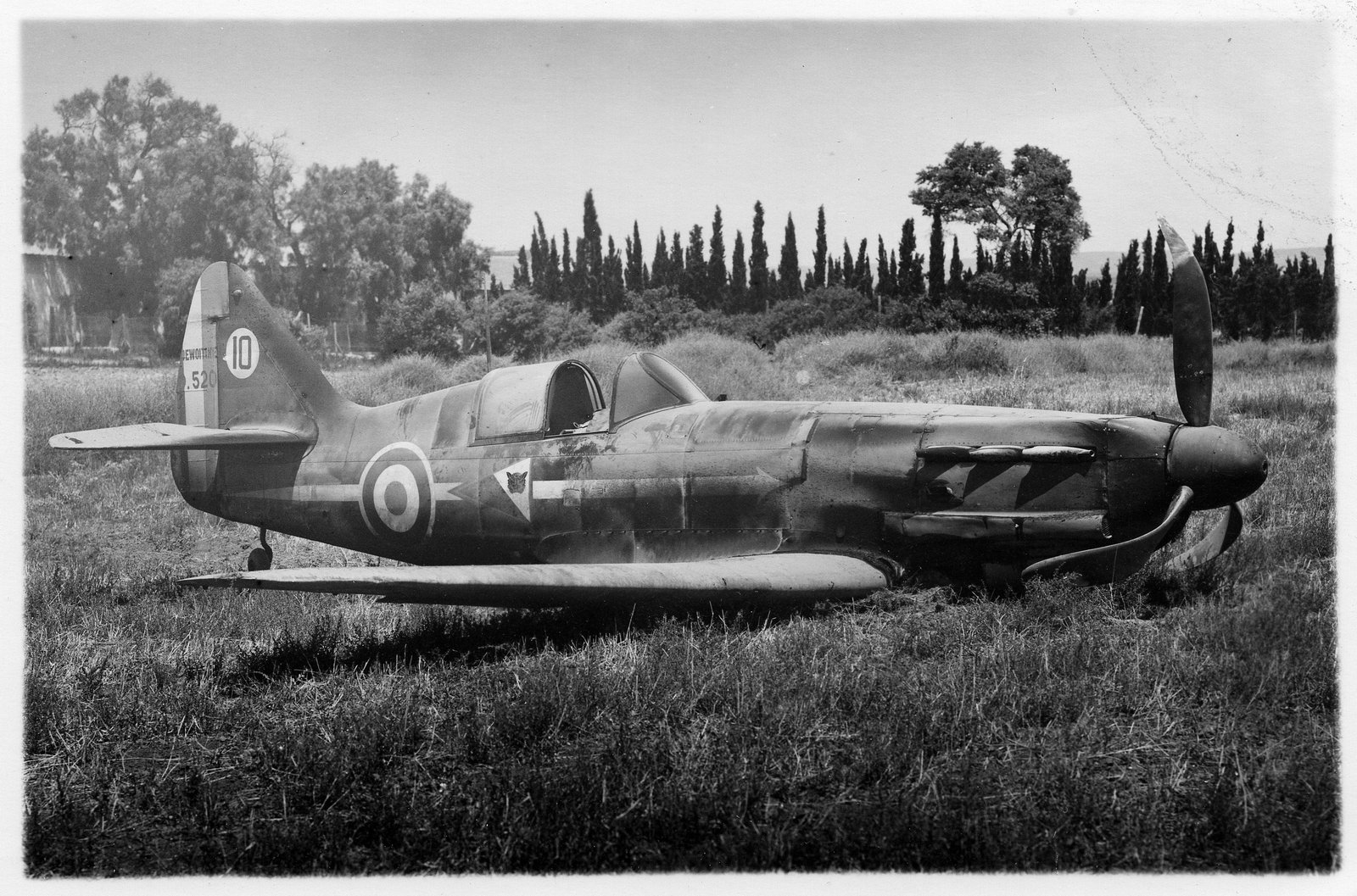
Designed by Émile Dewoitine and his team at Société Nationale de Constructions Aéronautiques du Midi (SNCAM), the D.520 was a modern, single-seat fighter characterized by its all-metal, low-wing monoplane layout, retractable landing gear, and enclosed cockpit. The prototype first flew on October 2, 1938. Production began in 1939, with aircraft entering squadron service in early 1940. Total production figures vary by source; while some estimates suggest approximately 900 aircraft were built between 1939 and 1942, more detailed records indicate 769 airframes were produced, with 437 completed before the June 1940 armistice and 332 built under Vichy and German control through 1944.
Technically, the D.520 was powered by a liquid-cooled Hispano-Suiza 12Y V-12 piston engine, specifically the 12Y-45 or 12Y-49 models, producing between 935 and 950 hp. Its armament was formidable for the era, featuring a 20 mm Hispano-Suiza HS.404 cannon firing through the propeller hub and four 7.5 mm MAC 1934 machine guns in the wings. The aircraft achieved a top speed of approximately 332 mph (534 km/h) and had a service ceiling of about 36,000 feet. With a rate of climb of 14.3 m/s and a ferry range of 1,200 km, it was regarded as roughly competitive with the Messerschmitt Bf 109E and the Hawker Hurricane.
During the Battle of France, the D.520 saw its first combat on May 13, 1940, when Groupe de Chasse I/3 engaged Luftwaffe forces. On that day, Sous-Lieutenant Pomier-Layrargues scored the type's first victory by downing a Heinkel He 111. Throughout the campaign, D.520 units claimed between 114 and 147 confirmed victories. The most successful pilot of the type was Pierre Le Gloan, who achieved 16 of his 18 total victories while flying the D.520. Beyond the initial campaign, the aircraft served with the Vichy French Air Force, the Free French Air Forces, and later with Axis powers. The Luftwaffe utilized captured aircraft as advanced trainers, while the Regia Aeronautica (Italy) operated approximately 60 units and the Royal Bulgarian Air Force operated about 100. It also saw service with the Romanian Air Force and was deployed during the Syria-Lebanon campaign of 1941 and Operation Torch in 1942.