
Wartime Legacy
The original S.E.5a earned its reputation as one of the finest fighters of World War I, with 5,265 aircraft produced between 1916 and 1918. Twenty-one Royal Flying Corps and Royal Air Force squadrons operated the type across multiple theaters including France, Egypt, Palestine, and Mesopotamia. The aircraft proved instrumental in training novice pilots, as its inherently stable design allowed less experienced aviators to compete effectively against seasoned German pilots flying the formidable Fokker D.VII.
Legendary aces including Albert Ball, who scored 17 of his 44 victories in the type, Billy Bishop, Mick Mannock, and James McCudden all achieved fame flying the S.E.5a. No. 56 Squadron became the first operational unit in March 1917, deploying to France the following month. Major C.E.M. Pickthorn MC of No. 84 Squadron exemplified the aircraft's capabilities when he destroyed a Fokker D.VII near Chimay, Belgium, on November 10, 1918, just one day before the Armistice.
Design and Development
Henry Folland served as chief designer, working alongside John Kenworthy at the Royal Aircraft Factory in Farnborough. Their objective was creating a stable, easy-to-fly fighter that could rival the Sopwith Camel's maneuverability while providing superior speed and handling characteristics for inexperienced pilots. The design incorporated several innovations including an exceptionally strong airframe capable of high-speed dives, squared-off wings for improved low-speed lateral control, and dihedral wing configuration for enhanced stability.
Early development faced significant challenges when two prototypes crashed, including one that killed test pilot Major Frank Goodden on January 28, 1917. Engineers quickly identified and resolved wing structural weaknesses before production commenced. The initial S.E.5 variant used the troublesome 150-horsepower geared Hispano-Suiza 8A engine, but the definitive S.E.5a employed the more reliable 200-horsepower Hispano-Suiza 8B or the high-compression Wolseley Viper engine.
Manufacturing and Production
Six British companies manufactured the original aircraft: Royal Aircraft Factory produced 200 units, Vickers built 2,164, Austin Motors contributed 1,650, Air Navigation and Engineering Company added 560, Martinsyde manufactured 258, and Wolseley Motors produced 431. Curtiss in the United States built one example before the Armistice cancelled a planned order for 1,000 aircraft equipped with Wright-Martin engines.
Modern replica construction began in earnest during 1965 when Miles Aircraft built two examples for film work, later transferred to the Irish register. Bobby Strahlmann, Tom Davis, and Gil Bodine collaborated on a notable project starting in 1971, producing three airworthy replicas plus one static display model. One of their aircraft, delivered in 1988 and registered N910AV, now resides at the Museum of Flight in Seattle, Washington.
Contemporary Replica Building
The Vintage Aviator Ltd of New Zealand has emerged as the most ambitious modern replica program, constructing four SE5a-1 reproductions using authentic Hispano-Suiza engines and archived original drawings. Doug Elliott and Irland Brown created a full-scale replica now displayed at the Western NC Air Museum. These modern builders work without centralized production, instead relying on original Royal Aircraft Factory plans and drawings.
Authentic construction methods and materials characterize serious replica projects. Builders employ fabric-covered wooden construction techniques identical to World War I practices, though modern materials and safety equipment provide enhanced reliability. Original Hispano-Suiza engines remain highly sought after, with some replica builders acquiring authentic powerplants from aircraft graveyards and private collections.
Performance and Specifications
The S.E.5a demonstrated impressive performance figures for its era, achieving a maximum speed of 138 miles per hour at altitude with a service ceiling of 17,000 feet. Rate of climb approached 1,000 feet per minute, while operational range extended approximately 300 miles. Standard armament consisted of one synchronized .303-caliber Vickers machine gun mounted in the fuselage, with some aircraft carrying additional weapons and light bombs for ground attack missions.
Surviving Legacy
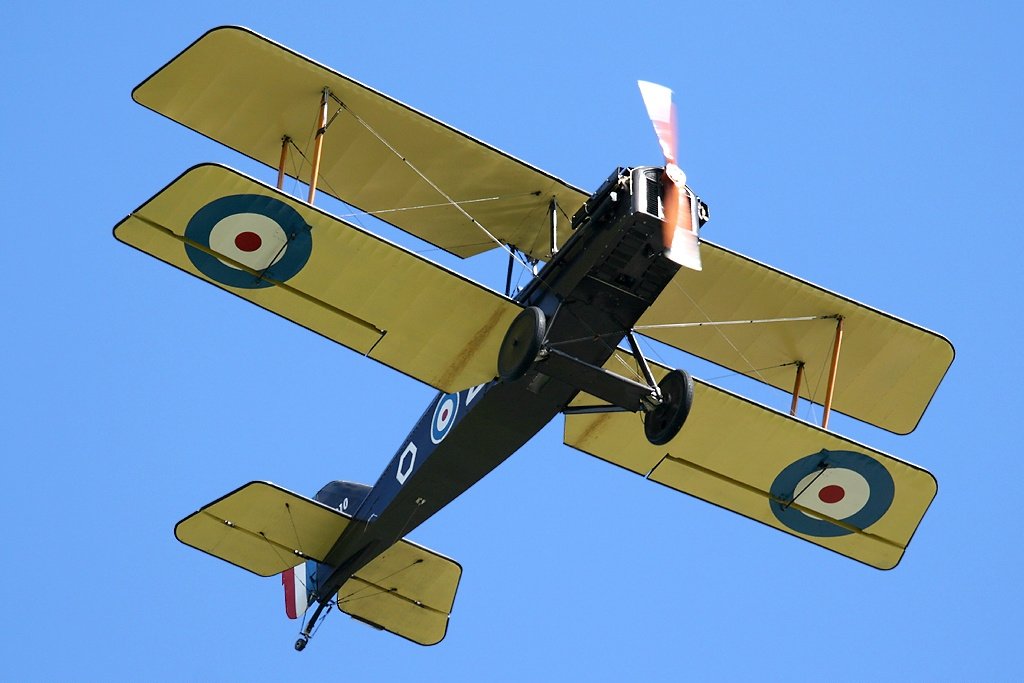
Approximately 10 to 15 airworthy replicas operate worldwide today, preserving the flight characteristics and appearance of this historic fighter. The Shuttleworth Collection in the United Kingdom maintains a particularly significant example, a Wolseley-built S.E.5a from No. 84 Squadron that underwent restorations in 1959, 1975, and 2007. Old Rhinebeck Aerodrome in New York operates a flying replica for public demonstrations, while various private owners continue the tradition of keeping these magnificent machines airworthy.
These modern reproductions serve as living monuments to the original aircraft's contribution to Allied victory in World War I, allowing new generations to witness the grace and power that made the S.E.5a one of history's most celebrated fighters.