
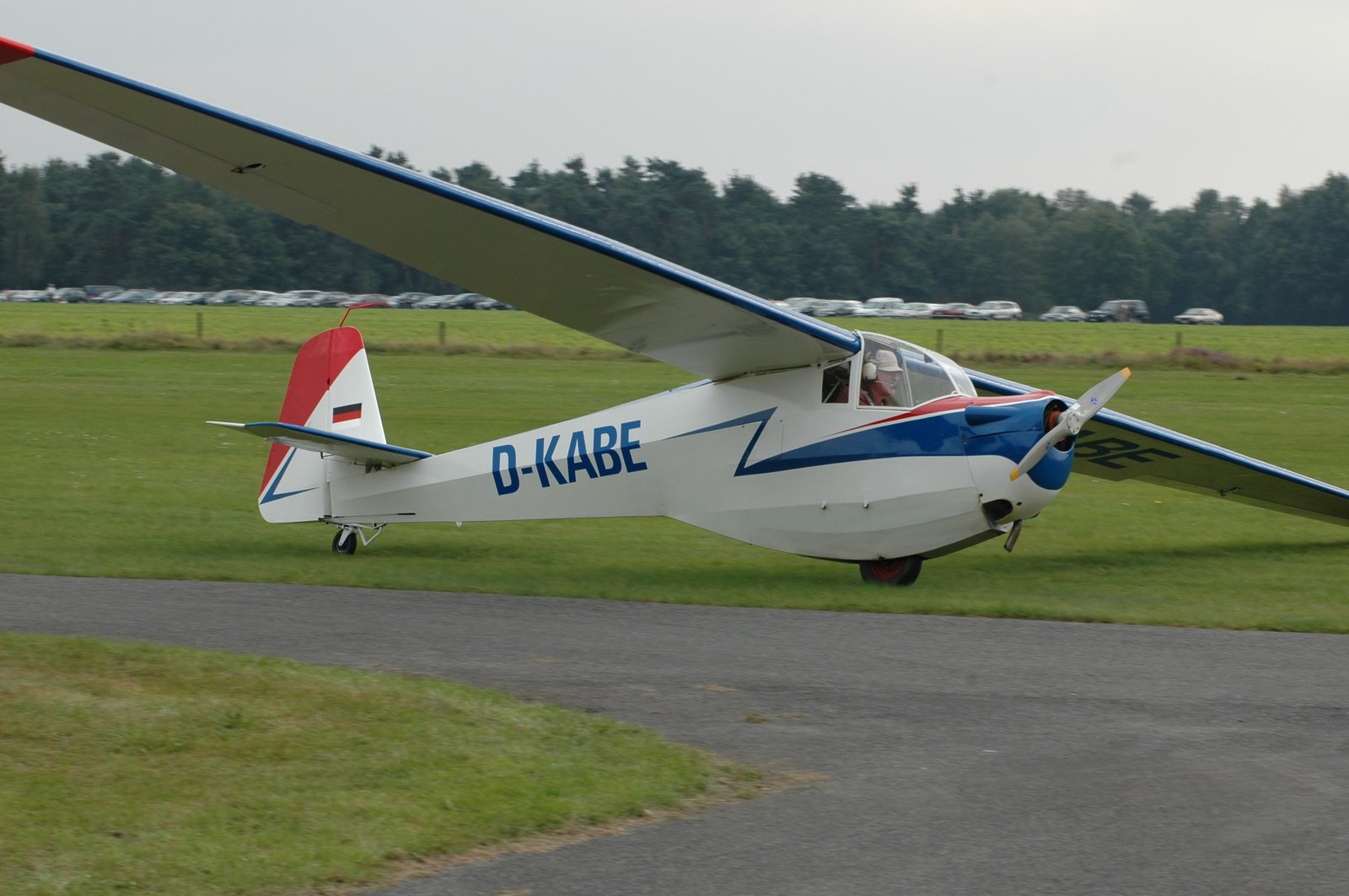
Development and Design Innovation
The SF-24 Motorspatz emerged from the innovative mind of Egon Scheibe in 1957 as a revolutionary approach to sailplane operation. Rather than requiring expensive ground equipment or tow aircraft for launch, Scheibe envisioned a glider that could take off under its own power, climb to soaring altitude, then shut down the engine to achieve the performance of a pure sailplane. His solution was elegantly simple: mount a lightweight Hirth engine in the nose of his proven L-Spatz-55 and L-Spatz-III single-seat glider designs.
The prototype took to the air in 1960, validating Scheibe's concept of the self-launching sailplane. Though Soaring Magazine would later describe it in 1983 as "one of the more primitive of the breed of self-launching sailplanes," this assessment reflected the aircraft's pioneering status rather than any fundamental flaw in design. The Motorspatz was breaking new ground in a category that barely existed.
Technical Configuration
The SF-24's design philosophy prioritized soaring performance while accepting the weight penalty of an onboard powerplant. The aircraft featured a welded steel tube fuselage married to wooden wing and tail surfaces, all covered in doped aircraft fabric. The 46-foot wingspan incorporated an efficient Mu 14% airfoil section, providing excellent lift-to-drag characteristics essential for sustained soaring flight.
Powering the Motorspatz was the Hirth F10A, a compact two-stroke engine that delivered 24 horsepower at 4,800 rpm and could produce 26 horsepower at 5,000 rpm for takeoff. Weighing just 56 pounds, this air-cooled, inverted inline engine represented an ideal powerplant for the self-launching concept. The engine's lightweight construction was crucial, as every pound saved translated directly to improved soaring performance.
The aircraft's configuration included a monowheel main landing gear with a small tailwheel, typical of glider designs. Spoilers provided precise glidepath control during approach and landing. At a gross weight of 761 pounds, the Motorspatz achieved a wing loading of just 5.98 pounds per square foot, enabling its impressive sink rate of 200 feet per minute at 50 mph.
Scheibe Flugzeugbau Legacy
Egon Scheibe's company, Scheibe Flugzeugbau, represented one of West Germany's specialized aircraft manufacturers focused on glider and light aircraft development. Founded in the post-war aviation renaissance, the company concentrated on innovative designs that pushed the boundaries of unpowered flight. The Motorspatz project demonstrated Scheibe's willingness to explore new concepts in an era when most manufacturers adhered to conventional approaches.
The company's expertise in glider construction proved invaluable when adapting proven airframes for powered flight. By leveraging existing designs like the L-Spatz series, Scheibe could focus engineering resources on integrating the powerplant rather than developing an entirely new aircraft from scratch.
Production and Variants
From 1961 to 1965, Scheibe produced exactly 50 Motorspatz aircraft across three variants. The original SF-24 established the basic configuration, followed by the SF-24A and SF-24B improved versions. These later variants incorporated refinements based on operational experience, though specific details of the improvements remain limited in available records.
The aircraft never received type certification, which significantly limited its commercial potential. This regulatory status relegated the Motorspatz to experimental and club operations, preventing it from achieving broader market penetration despite its innovative capabilities.
Operational Service
The Motorspatz found its niche primarily in gliding clubs and training operations where its self-launching capability offered significant operational advantages. Traditional gliders required either ground-based winch launches or aerotows by powered aircraft, both expensive and logistically complex operations. The SF-24 could simply start its engine, taxi to the runway, and depart like any conventional aircraft.
Once airborne and established in lift, pilots could shut down the Hirth engine and achieve the soaring performance of a pure glider. This operational flexibility made the Motorspatz particularly attractive to clubs operating from airports without dedicated glider facilities or those seeking to reduce operational costs.
Engine Heritage
The Hirth F10A engine represented the expertise of a company with deep aviation roots dating to 1926. After World War II, the reformed Hirth company specialized in two-stroke aircraft engines from 1965 to 1974, when the firm entered voluntary liquidation. Hans Göbler subsequently acquired the assets, continuing production as Göbler-Hirthmotoren GmbH and preserving the technical legacy.
Current Status and Legacy
As of July 2011, two Motorspatz aircraft remained registered with the Federal Aviation Administration in the United States. One SF-24 carried Experimental-Exhibition category registration, while an SF-24B operated under Experimental-Research and Development status. At least one aircraft maintained currency with a certificate valid through May 2029, indicating continued airworthiness efforts by dedicated owners.
The SF-24 Motorspatz's true significance lies not in production numbers or commercial success, but in its pioneering role in self-launching sailplane development. The aircraft proved that combining powered takeoff capability with soaring performance was technically feasible, establishing principles that would influence motorglider design for decades to come. Modern self-launching sailplanes owe their conceptual foundation to innovative aircraft like the Motorspatz, which dared to challenge conventional wisdom about the boundaries between powered and unpowered flight.