
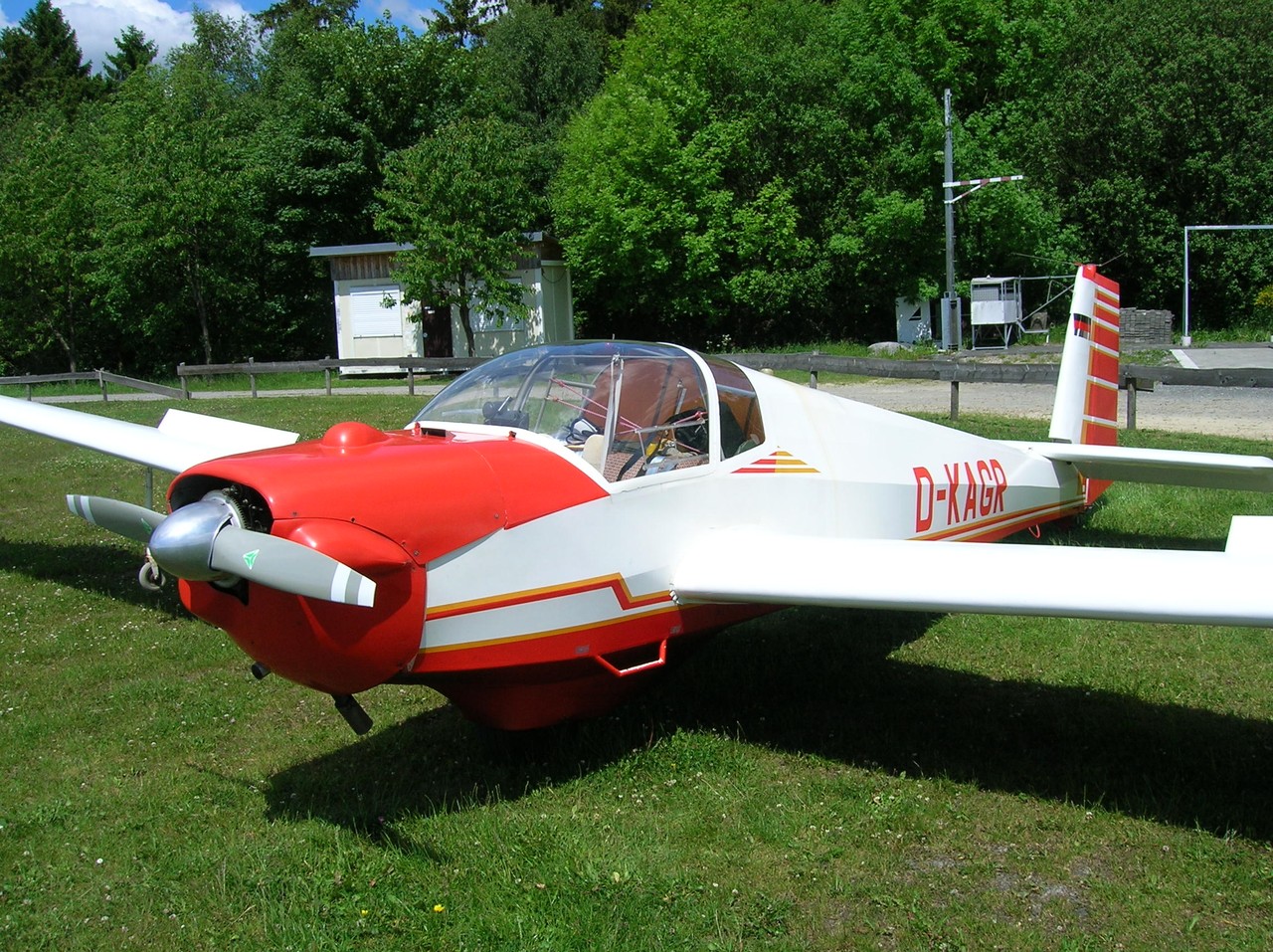
Revolutionary Design Achievement
The SF-25 Falke fundamentally transformed motorglider aviation by proving that lightweight aircraft engines could reliably power glider airframes for extended touring flights. Where previous motorgliders served primarily as training aids requiring frequent ground support, the Falke demonstrated true independence. By 1975, nearly 400 SF-25B variants alone had entered service across Europe, establishing the type as the dominant touring motorglider of its era.
Service Dominance
Twenty-five gliding schools throughout Germany adopted the Falke as their primary basic trainer, replacing traditional tow-launched gliders for initial instruction. The aircraft's ability to launch independently eliminated costly tow plane operations while providing students with realistic cross-country flying experience. Flying clubs across Europe embraced the type for touring operations, with pilots regularly completing 300-mile flights that would have been impossible in conventional gliders.
The Scheibe Legacy
Egon Scheibe founded Scheibe Flugzeugbau after World War II, initially focusing on his successful Bergfalke tandem glider design. The young German engineer recognized that reliable lightweight engines could transform gliding from a purely soaring sport into practical cross-country flying. His company operated continuously until 2006, when difficult market conditions and the founder's advancing age led to closure of the original firm. Scheibe Aircraft GmbH assumed operations in May 2006, continuing support for the worldwide Falke fleet.
International Production Success
Beyond German production, the Falke's success prompted international licensing agreements with four major manufacturers. Sportavia-Pützer built additional aircraft in Germany, while Slingsby produced the type as the T.61 in the United Kingdom. Loravia manufactured French variants, and Aeronautica Umbra assembled Italian examples. This multinational production approach distributed approximately 1,500 aircraft across Europe and beyond during the 43-year production run.
Engine Evolution
Early SF-25A variants employed the 40-horsepower Hirth F10A2a two-stroke engine, which pilots found somewhat unreliable for extended touring. The 1967 SF-25B introduced the revolutionary 45-horsepower Stark Stamo four-stroke engine, based on Volkswagen automotive components, vastly improving operational reliability. The SF-25C of 1971 featured the 65-horsepower Limbach 1700, providing enhanced performance and electric starting.
The most significant powerplant advancement came in 1989 when prototype D-KIAJ first flew with the 80-horsepower Rotax 912 engine. This Austrian-built, water-cooled flat-four became the most popular Falke powerplant, with many earlier aircraft retrofitted with Rotax engines. Current production aircraft utilize 80 to 115-horsepower Rotax variants, including the turbocharged 914F3.
Pilot Experience
Pilots praised the Falke's forgiving handling characteristics and genuine dual-purpose capability. Unlike pure gliders, the aircraft could maintain level flight at cruise power while retaining excellent soaring performance with the engine throttled back. The side-by-side seating arrangement facilitated instruction and made the aircraft popular for recreational touring. Wing-mounted support wheels on later variants enabled operations from unpaved airstrips common at gliding sites.
Technical Innovation
The SF-25B introduced the defining configuration change by relocating the wing from mid-fuselage to low-mounted position, improving ground handling and pilot visibility. Supporting wheels beneath each wing enabled independent ground operations without wingtip handlers. The 1987 Falke 2000 prototype D-KBUG tested tricycle landing gear, entering production in 1990 as an alternative to the traditional tailwheel configuration.
Performance Specifications
Typical SF-25C variants cruise at 95 knots with the engine operating, while achieving glide ratios exceeding 25:1 with power reduced. Service ceiling reaches 14,000 feet, with initial climb rates of 400 feet per minute. Range extends beyond 400 nautical miles with full fuel, enabling true cross-country touring capability previously impossible in glider aircraft.
Enduring Legacy
The SF-25 Falke established the practical touring motorglider category, inspiring numerous subsequent designs worldwide. Many original aircraft remain active today, particularly Rotax-powered variants and retrofitted examples. The type's success demonstrated that motorgliders could serve roles beyond training, opening markets for modern touring motorgliders that continue the Falke's legacy of combining soaring efficiency with powered aircraft utility.