
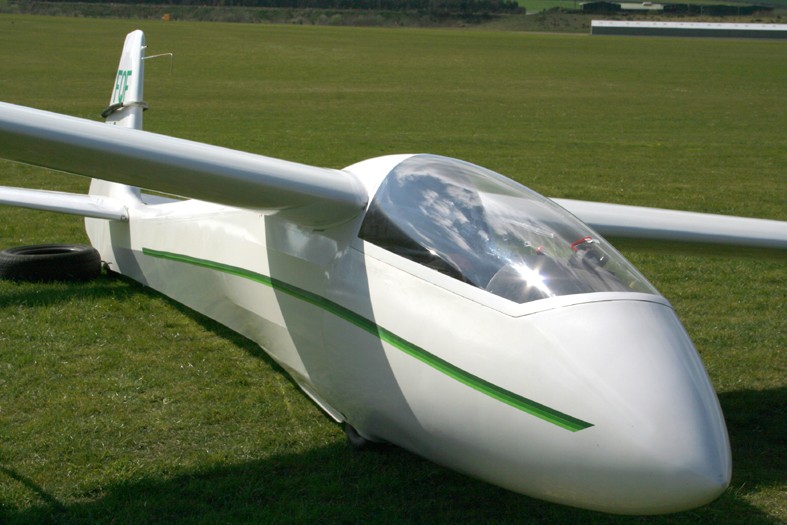
Development and Design Innovation
The SF-27 emerged from Scheibe Flugzeugbau's evolution of the successful Zugvogel series, which had begun with Rudolf Kaiser's original design in 1954. Egon Scheibe led the development of this advanced competition sailplane, incorporating cutting-edge materials and construction techniques for its era. The aircraft featured steel tube construction with a fiberglass nose, an innovation that provided both structural integrity and aerodynamic efficiency.
The SF-27M variant represented a significant leap forward in motor glider technology. Its retractable engine installation, mounted on a pylon behind the cockpit, could be deployed in approximately 30 minutes, transforming the pure glider into a self-launching aircraft. This capability eliminated the need for ground crews and tow aircraft, giving pilots unprecedented independence in cross-country soaring.
Technical Excellence
Scheibe engineers designed the SF-27 for FAI Open Class and Standard Class competition, incorporating several advanced features. The all-flying tail provided precise control authority, while Schempp-Hirth dive brakes offered reliable speed control during steep descents. The semi-reclining seating position reduced pilot fatigue during long competition flights.
The SF-27M's powerplant was the 19-kilowatt Hirth F-102 A2, a two-cylinder, two-stroke, air-cooled engine manufactured by Hirth Motoren KG. This reliable power source enabled measured service ceilings of 4,900 meters and cruising speeds of 145 kilometers per hour. When retracted, the engine installation had minimal impact on the aircraft's exceptional soaring performance, maintaining the impressive 34:1 glide ratio at 88 kilometers per hour.
The Manufacturer's Legacy
Scheibe Flugzeugbau operated from their facility in Dachau, Germany, during the post-World War II aviation renaissance. Egon Scheibe had been active in prewar sailplane development, working on projects like the Mu 13 series before continuing his innovative work in the postwar era. The company specialized in gliders and motor gliders, building upon their experience with earlier Zugvogel variants and the SF-26 model.
Production of the SF-27 series ran from 1964 through at least 1969, with construction numbers in the 63xx and 64xx series designated for the motor glider variants. The company's focus on advanced composite construction and innovative design solutions established them as leaders in European sailplane manufacturing during the 1960s.
International Operations
The SF-27 achieved worldwide distribution, with examples registered across multiple continents. German registrations included D-KOCI and D-KOSL, while international operators included N100LH in the United States, SE-TOH and SE-TGP in Sweden, and BGA 3934 in the United Kingdom. Australia became a significant market with multiple registrations: VH-ZOT (construction number 6321), VH-XOE (6312), VH-GYX (6322), and VH-ZAA (6326). New Zealand operators included ZK-GOT and ZK-GOU.
The aircraft's performance capabilities made it popular among serious competition pilots. Its 15-meter wingspan and 12.0 square meter wing area provided an aspect ratio of 8.7, optimized for thermal soaring and cross-country flights. The modest stalling speed of 55 kilometers per hour made it forgiving during low-speed maneuvering around thermals.
Operational Record and Safety
The Aviation Safety Network documented 23 accidents involving SF-27 aircraft between 1967 and 2006, with incidents occurring primarily in Germany and across Europe. The relatively low fatality rate, with only one recorded death in 1974, reflected the aircraft's inherently safe flight characteristics and the skill level of its typical operators.
Notable incidents included the accident involving BGA 3934 at Sutton Bank in the United Kingdom, though many aircraft continued flying well into the 2000s. VH-ZOT was photographed in Australia as late as 1999, demonstrating the type's longevity and continued airworthiness.
Legacy and Influence
The SF-27 series played a crucial role in advancing motor glider technology during the 1960s, bridging the gap between pure sailplanes and powered aircraft. Its success influenced subsequent motor glider designs and proved the viability of retractable engine installations for competition aircraft. The approximately 120 examples built established Scheibe as an innovative force in sailplane manufacturing.
While exact numbers of currently airworthy aircraft remain unknown, several examples are preserved in museums and private collections. The SF-27's contribution to aviation history lies not in production numbers, but in its pioneering role in self-launching sailplane technology that became standard in modern motor gliders.